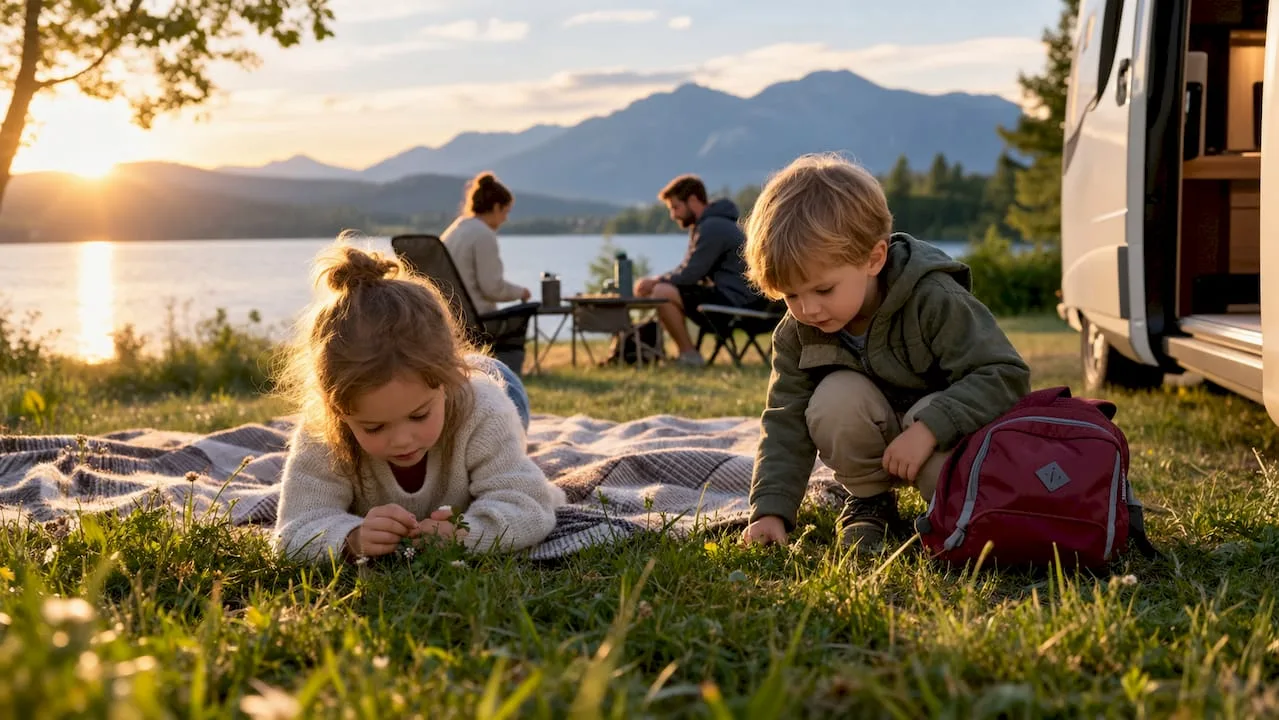
Yes, travelling with children by campervan is often one of the most practical options for families in Slovenia, provided you get three things right. Choose a campervan that suits your family in terms of size and sleeping arrangements, maintain your children’s daily routine while travelling, and keep driving distances shorter with regular breaks. When these three elements are in place, a campervan gives children more freedom while reducing stress for parents compared with a traditional holiday with suitcases. For local advice and campervan rental, you can contact
Campervan.
In brief:
- Families with young children should choose a campervan with enough space, including a fixed toilet and heating suitable for all seasons.
- When preparing for the trip, limit luggage to items you actually use every day and use organiser bags to make storage and access easier.
- When planning your driving schedule, include regular breaks to prevent boredom and restlessness, and choose driving times when the children are likely to sleep.
- When choosing destinations in Slovenia, shorter journeys, safe swimming areas and locations with playgrounds are ideal for relaxing and playing outdoors.
- Campsites offer greater convenience, access to sanitary facilities and often children’s playgrounds. Wild camping should only be considered where it is legally permitted, helping you avoid unnecessary fines.
Table of Contents
How to choose the right campervan for your family
The size of your campervan should match the number and age of your children, rather than the other way around. A family with two young children may need less space than a family with three teenagers, who may require separate sleeping areas and considerably more storage for their belongings. When choosing a campervan for longer trips through Slovenia or the Balkans, a fixed toilet can be particularly useful, as it eliminates the need to search for sanitary facilities in the middle of the night while carrying a small child.
Webasto-style heating is particularly valuable in spring and autumn, when nights can still be cold, while in summer you will appreciate good ventilation and shade. Also check how much practical storage space the vehicle has for nappies, toys and children’s equipment, as these items can quickly take up more space than expected.
When collecting the vehicle, it is worth checking a few things before setting off:
- how the heating and hot-water boiler work,
- how the chemical toilet works and where it can be emptied,
- the condition of the gas cylinder and how to replace it,
- what is included in the basic insurance and how to contact 24/7 roadside assistance.
Some campervan models are more compact and easier to drive in cities, while others provide more living space for longer stays. The right choice depends mainly on the children’s ages and the length of your trip.
What children’s equipment do you really need in a campervan?
It makes sense to limit children’s luggage to the things you actually use every day rather than trying to bring everything you have at home. A basic list for a safe and comfortable family campervan trip includes:
- An approved child car seat suitable for the child’s age and weight.
- A first-aid kit with age-appropriate medicine for fever and pain.
- A portable changing mat that can be used anywhere.
- A night light or projector to make falling asleep easier in a new environment.
- A small box with a limited selection of toys that you can rotate every other day.
Space inside a campervan is limited, so it is better to pack into smaller fabric bags organised by category and place them in drawers rather than using one large suitcase. This makes it easier for children to find their own toys without parents having to empty half of the vehicle.
Expert tip: Bring one observation game, such as “who can spot a red car first”, and one quiet activity such as stickers or drawing on a magnetic board. A combination of movement and quiet activities generally works better than relying on screens alone.
How to organise driving so children do not become restless
Long drives without breaks are one of the main causes of bad moods among children, rather than the journey itself. Family travel experts recommend preparing a selection of
activities and regular stops in advance, helping prevent boredom before it starts.
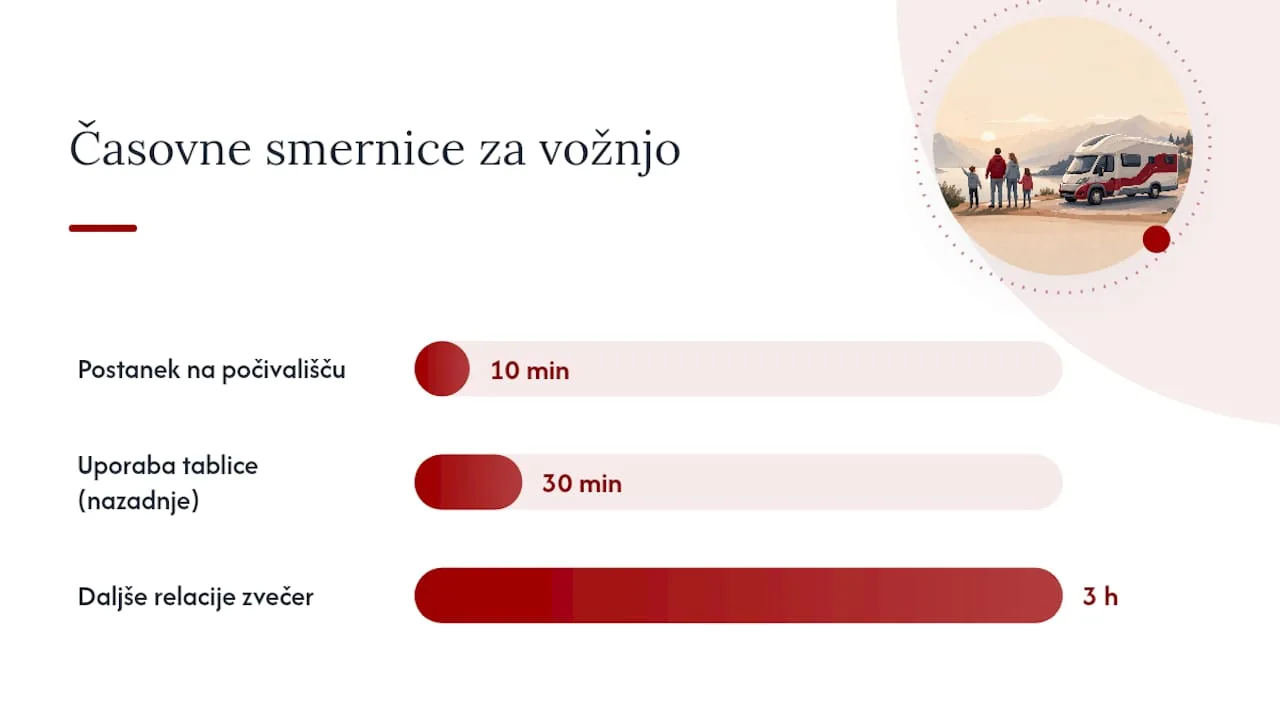
In practice, this means taking regular breaks, even if it is only for ten minutes at a rest area with a playground. Good activities for children during a campervan journey include:
- audio stories or children’s podcasts instead of constant screen time,
- observation games based on the surrounding landscape and adapted to the child’s age,
- limited tablet use, for example only during the final 30 minutes before reaching your destination.
Whenever possible, consider driving longer distances in the evening when the children are already asleep. Many families find that driving for three hours after dinner is much easier than driving for three hours in the middle of the afternoon, when children may be tired, hungry and irritable.
Which destinations and overnight stops in Slovenia are suitable for children?
When choosing a destination, the actual driving time is more important than the distance in kilometres. Children generally cope much better with a one-and-a-half-hour drive than a three-hour journey, so it makes sense to look for destinations close to Ljubljana or plan one stop along the way.
A good family-friendly destination should ideally offer:
- a relatively short drive from your starting point, ideally under two hours,
- a safe swimming area or shallow water for younger children,
- a children’s playground near the campsite or overnight parking area,
- walking trails without steep climbs.
Family-friendly accommodation options include campsites with swimming pools or river access, thermal spas with children’s pools, and farm stays where children can see and interact with animals. For specific route ideas, see our
campervan guide to Slovenia.
Instead of changing locations every day, consider staying in one place for three or four days. This gives children time to become familiar with their surroundings, which can mean less crying and more independent play, while parents spend less time packing up and moving the vehicle.
Campsites or wild camping: what is better for a family?
Wild camping is not permitted everywhere in Slovenia, so it is important to check local regulations before spending the night, as rules can vary between municipalities and protected natural areas. You can find more information about where
campervan overnight stays are legal in our dedicated guide covering specific examples by region.
For families with young children, a campsite is usually the more practical choice. Access to sanitary facilities, hot water and often a children’s playground can easily outweigh the slightly higher cost of an overnight stay.
Regardless of where you stay, the vehicle still needs regular servicing and supplies:
- Empty the chemical toilet every three to four days, depending on the size of the tank and your usage.
- Top up the fresh-water tank during longer stops rather than waiting until it is completely empty.
- Use an electrical hookup to charge the leisure battery whenever you stay at a campsite with electricity.
How to maintain your child’s routine while travelling
Children often sleep better while travelling when their familiar evening routine remains unchanged. Families travelling by campervan frequently report that
keeping the same order of dinner, washing and bedtime works just as well in the vehicle as it does at home.
For cooking in a campervan, simple meals that do not require lots of dishes work particularly well: stews, pasta with a single sauce or sandwiches for lunch. Food that spoils quickly should be placed in the refrigerator immediately after shopping rather than left out until the evening.
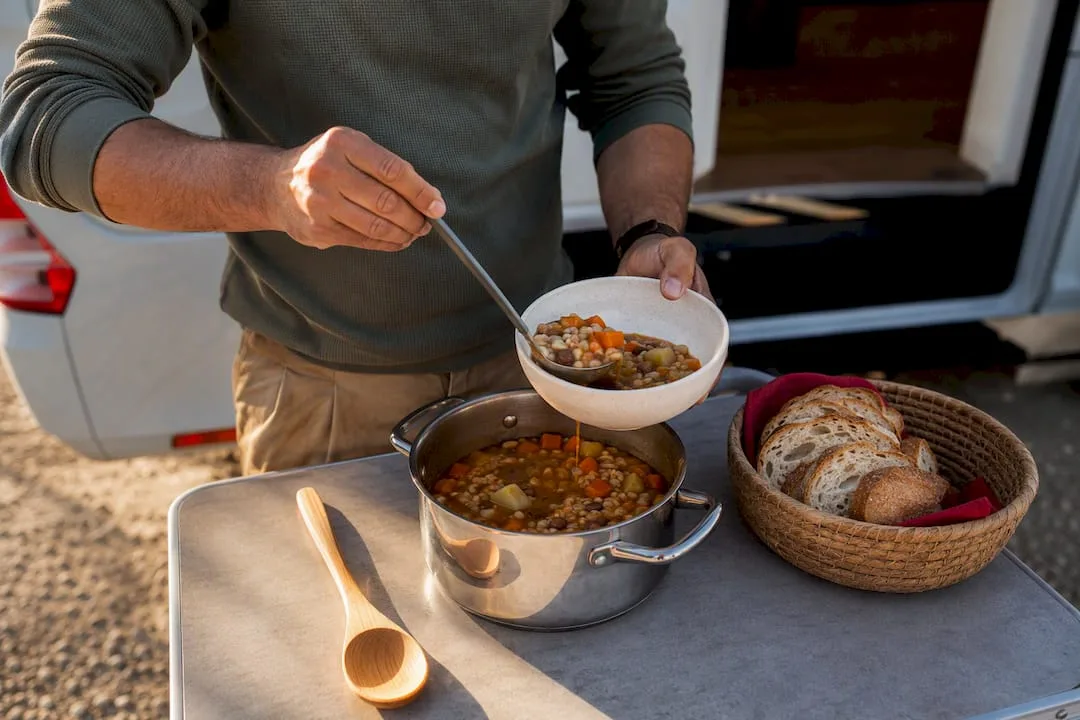
For babies, a thermos with warm water can be useful for preparing formula, and it is always worth carrying at least one spare meal in case of unexpected delays on the road.
Expert tip: Plan only one main activity per day and leave the rest of the schedule flexible. An overly busy itinerary is often a bigger source of frustration for young children than the driving itself.
How to ensure child safety and health on the road
A basic first-aid kit should include a thermometer, plasters, oral rehydration supplies and age-appropriate medicine for fever. Before a longer trip, it is also sensible to check the insurance and roadside assistance conditions provided by your campervan rental company.
For health-related travel information before your trip, check official sources such as
Gov.si and relevant travel-health resources that publish current advice for travellers.
A few simple preventive measures can reduce risks in the confined space of a campervan:
- secure drawers and cupboard doors while driving,
- never leave a child unattended near water or playground equipment,
- make sure all windows and roof vents are safely closed before going to sleep.
What Campervan.si recommends before your first night in a campervan
A proper pickup checklist can prevent many unpleasant surprises during your first night. Before leaving the rental office, check that the heating, toilet, gas system, water supply and leisure battery are working properly rather than discovering a problem after arriving at a campsite without electricity.
On the first evening, establish a basic layout inside the vehicle: where dirty shoes will go, where the children’s night-time equipment will be kept and where breakfast will be prepared in the morning. Repeat this routine every evening to make life in the campervan easier.
The most common mistakes made by first-time renters include:
- overpacking and taking up valuable space needed for children to move around,
- travelling without a backup plan for bad weather,
- forgetting to refill the fresh-water tank before heading to more remote campsites.
Our practical guide to
campervan camping equipment covers details that are often overlooked during vehicle pickup.
Why we recommend campervans for families
A campervan gives families more than transportation: it provides a home that moves at the child’s pace. This means less need to adapt to hotel and restaurant schedules, which can be one of the biggest sources of stress when travelling with young children. Travel sources highlight
freedom, closer contact with nature and less reliance on toys as some of the key advantages, and the experiences of families who have rented through Campervan.si support this in practice.
One common mistake parents make is trying to fit a campervan trip into their old holiday routine. It works the other way around: once parents adapt to the slower pace of campervan travel, the journey becomes much easier for everyone.
— Rok
How to start planning a family campervan trip
Some campervan rental providers in Ljubljana offer well-maintained vehicles, clear insurance conditions and support throughout the journey, including roadside assistance and advice on travelling through Slovenia and neighbouring regions.
For families planning their first campervan trip, a good starting point is to compare the available models and dates on the campervan rental page in Ljubljana. If you are considering travelling during the summer season, also take a look at our
summer campervan rental 2026 offer, where available models and prices are already published. Before confirming your booking, check our guide to planning a campervan road trip through Slovenia, which helps you create a realistic itinerary based on your children’s ages. Booking is simple: choose your campervan, dates and pickup in Ljubljana, and the Campervan.si team takes care of the rest.
Sources
For additional advice on travelling with children and family experiences with campervans, see Tourism Kranj,
Vzajemna and Lucina potepanja. For local guides to Slovenia, see Campervan.si guides covering
campervan camping equipment and
campervan overnight stays.
Recommended