Travelling with a dog in a campervan is safe and practical when your dog is properly secured during driving, all required veterinary documents are in order, and your stops are planned around your dog’s needs. Three things are essential: a proper dog seat belt or travel crate, a microchip and EU pet passport, and checking the requirements in advance if your journey takes you outside the EU. Without these precautions, travelling with a dog can quickly become stressful and risky. With them, a
campervan road trip with your dog is much easier than many people expect.
In brief:
- Dogs should be properly secured while travelling, either with a suitable dog seat belt or in a travel crate that is large enough and securely fastened.
- For travel within the EU, your dog needs a valid microchip, an EU pet passport and a valid rabies vaccination. When travelling outside the EU, a rabies antibody titration test may also be required.
- For both short and long trips, gradually getting your dog used to the campervan is recommended. Start with short drives and test trips to reduce stress and anxiety.
- When choosing a campervan, pay attention to the available interior space, ventilation and the possibility of securely positioning a travel crate or dog harness, especially if you are travelling with a large dog.
- Prepare essential dog travel equipment, including food, water, veterinary documents, a first-aid kit and tick and flea protection. The campervan should also have suitable attachment points for the crate and a comfortable sleeping area.
Table of Contents
Dog safety while driving: seat belts, travel crates and legal requirements
Your dog should never be allowed to move freely around the campervan while you are driving. This is not simply a recommendation but an important safety measure. In the event of sudden braking, an unsecured dog can become a projectile and seriously injure itself or passengers. There are two main options for safely transporting your dog.
- Dog seat belt or safety harness, attached to the vehicle’s seat belt or a suitable anchor point and generally suitable for small to medium-sized dogs.
- Securely fastened travel crate, placed on a solid, non-slip surface, preferably low in the vehicle and away from direct sunlight.
- A combination of both can be useful when travelling with several dogs or with a combination of dogs and children.
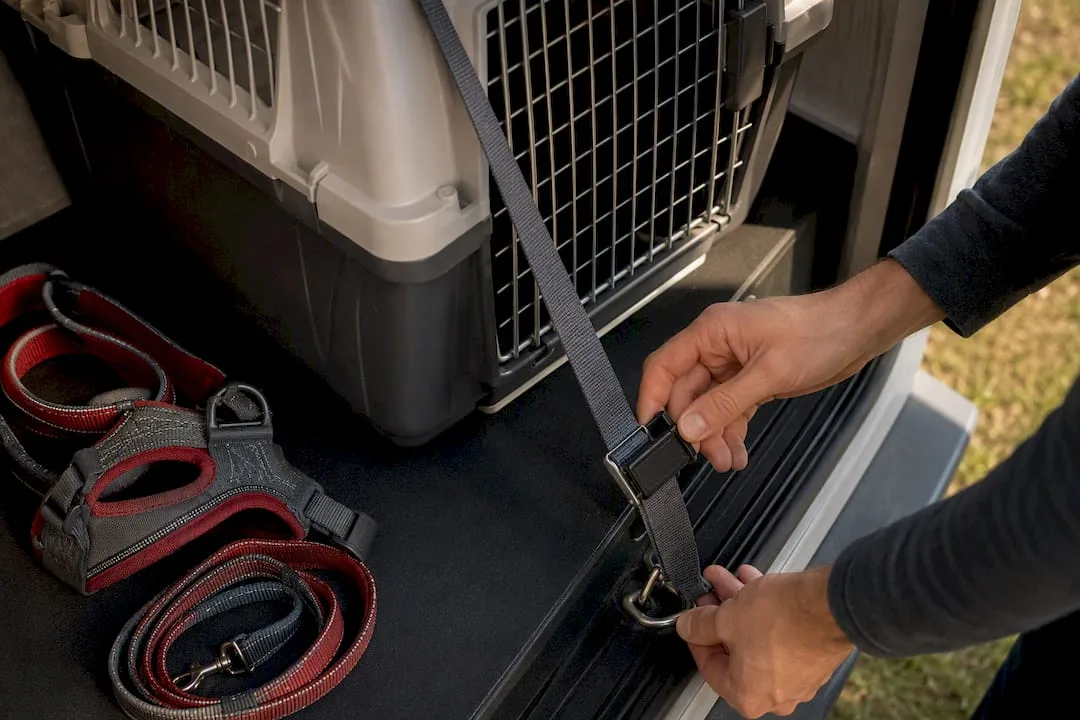
The travel crate should be large enough for your dog to turn around and lie down comfortably, but it should also be securely fastened so that it cannot move when the campervan takes a corner or brakes suddenly. For large dog breeds, a properly secured crate is often a better option than a harness because it can provide greater protection in the event of a sudden stop.
Expert tip: Secure the travel crate with a suitable strap or fastening system rather than relying on its own weight. Before setting off on a longer journey, take a short test drive and check whether the crate moves when you brake or turn.
An unsecured dog can also create a legal and safety issue. Apart from the possibility of a fine, a loose dog can distract the driver, jump between the seats or obstruct the driver’s view of the road.
What documents do you need to travel with a dog within and outside the EU?
Before setting off, make sure your dog has a valid microchip and an
EU pet passport with a valid rabies vaccination. These are essential requirements for travelling with a dog within the EU and may be checked at borders or when entering certain accommodation facilities.
Travelling to countries outside the EU can involve additional requirements. The Administration of the Republic of Slovenia for Food Safety, Veterinary Sector and Plant Protection (UVHVVR) recommends checking the entry and re-entry requirements well in advance, as some procedures can take several months.
- A rabies antibody titration test is mandatory for some destinations and must be completed in advance rather than immediately before departure.
- If the test is not completed within the required timeframe, your dog may be refused entry or subject to quarantine when returning to the EU.
- Required waiting periods can range from several weeks to three months, depending on the destination and vaccination status.
Requirements can change, so always check the latest information directly with the relevant official authorities, especially if your
campervan road trip takes you to the Balkans or other destinations outside the European Union. If you are planning such a trip, check the requirements at least two to three months before departure.
How to get your dog used to a campervan before a long trip
A dog seeing a campervan for the first time on the day of departure is likely to feel stressed and may even become physically unwell. Experts recommend
gradually introducing your dog to the campervan over several days or up to two weeks before a longer journey.
- Start by allowing your dog to spend some time inside the parked campervan without driving, so it can become familiar with the smells, sounds and available space.
- Next, take a short drive, perhaps ten minutes to a nearby park, and reward your dog with praise afterwards.
- Gradually increase the length of the journeys until your dog is comfortable and no longer shows signs of anxiety, excessive drooling or constant licking.
- Before the actual trip, take at least one test drive that is approximately as long as the first planned driving stage of your journey.
Signs of stress in dogs are usually quite easy to recognise once you know what to look for: excessive panting without heat, trembling, hiding or refusing food. Feed your dog at least two hours before driving rather than immediately before departure to reduce the risk of travel sickness.
One useful trick used by experienced campervan owners is
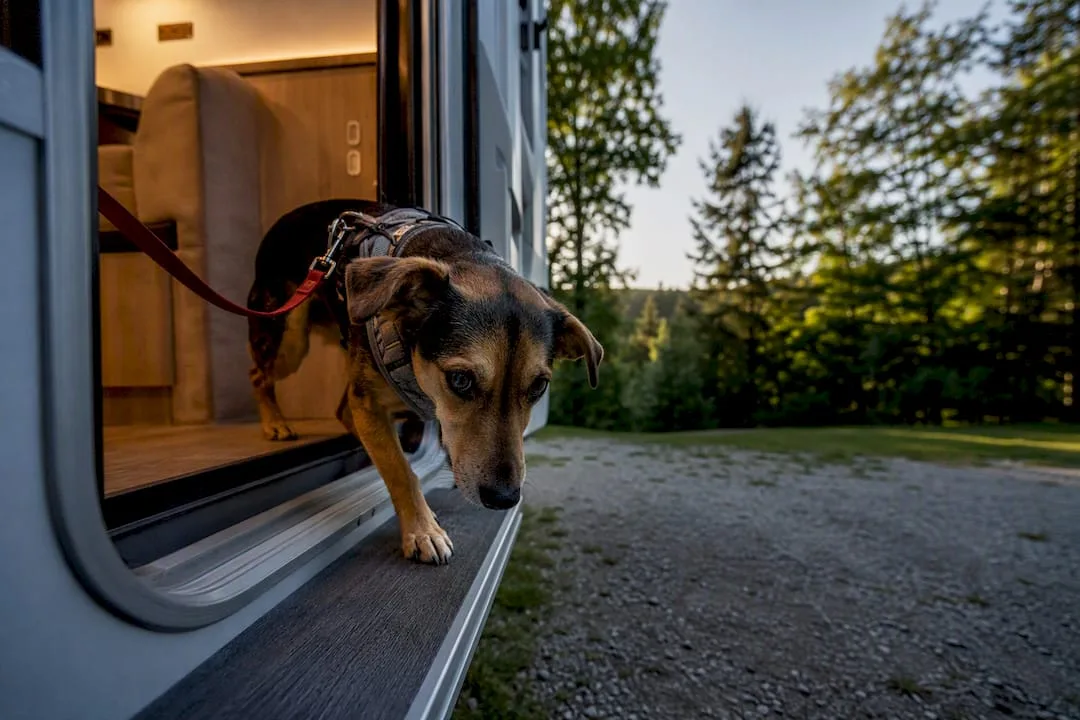
teaching your dog to enter and exit through the side door rather than the rear doors. This reduces the risk of your dog suddenly jumping out when you open the rear storage area.
What to pack: dog travel equipment for a campervan trip
A well-prepared dog travel bag can prevent many unpleasant situations on the road. It is useful to divide everything into two categories: essentials and comfort items.
Essential equipment includes enough food for the entire journey plus an emergency reserve, collapsible food and water bowls, veterinary documents stored in a waterproof folder, a basic dog first-aid kit including disinfectant, bandages and tick tweezers, and effective tick and flea protection. This is particularly important during summer campervan trips through Slovenia and the Balkans. An identification tag with your phone number is also a useful addition to your dog’s microchip, as anyone who finds your dog can immediately see how to contact you.
For additional comfort, bring a familiar blanket or bed carrying the scent of home, a few favourite toys, window shades and, if necessary, a cooling mat for hot summer days.
- Food and water for at least three extra days beyond the planned amount.
- A first-aid kit suitable for your dog’s size and individual needs.
- Tick and flea protection appropriate for the season and destination.
- A familiar blanket, toy or dog bed to provide a sense of security.
Expert tip: Keep your dog’s equipment inside a closed cupboard or under a seat rather than on an open shelf. During sudden braking, anything left unsecured can become a dangerous projectile.
How to choose a campervan that is suitable for travelling with a dog
Not every campervan is equally suitable for travelling with a dog. When choosing a vehicle, pay particular attention to the available interior space, as a travel crate should ideally be positioned on a solid floor rather than on a bed or seat that can move while driving.
- Check whether the seats have suitable attachment points for a dog safety harness or whether there is enough floor space for a travel crate.
- Good ventilation and air conditioning are essential, especially in summer, because the interior of a campervan can heat up quickly without adequate airflow.
- A low entrance or pull-out step can make it easier and safer for older or smaller dogs to get in and out of the campervan.
- For smaller dogs, a compact campervan may provide sufficient space, while for large breeds it is worth checking the interior dimensions before booking.
When renting a campervan, always ask about the rental provider’s pet policy, as conditions vary and some companies may charge an additional cleaning fee. It is also worth checking
the sleeping arrangements, as you may want to use part of the interior space for a travel crate rather than an additional bed.
Local tips for travelling with a dog in Slovenia
Slovenia has plenty of destinations where your dog can be part of the adventure rather than simply waiting inside the vehicle. The Logar Valley, Soča Valley and Kolpa River are popular with dog owners because they offer walking trails, access to water and plenty of shade during the summer.
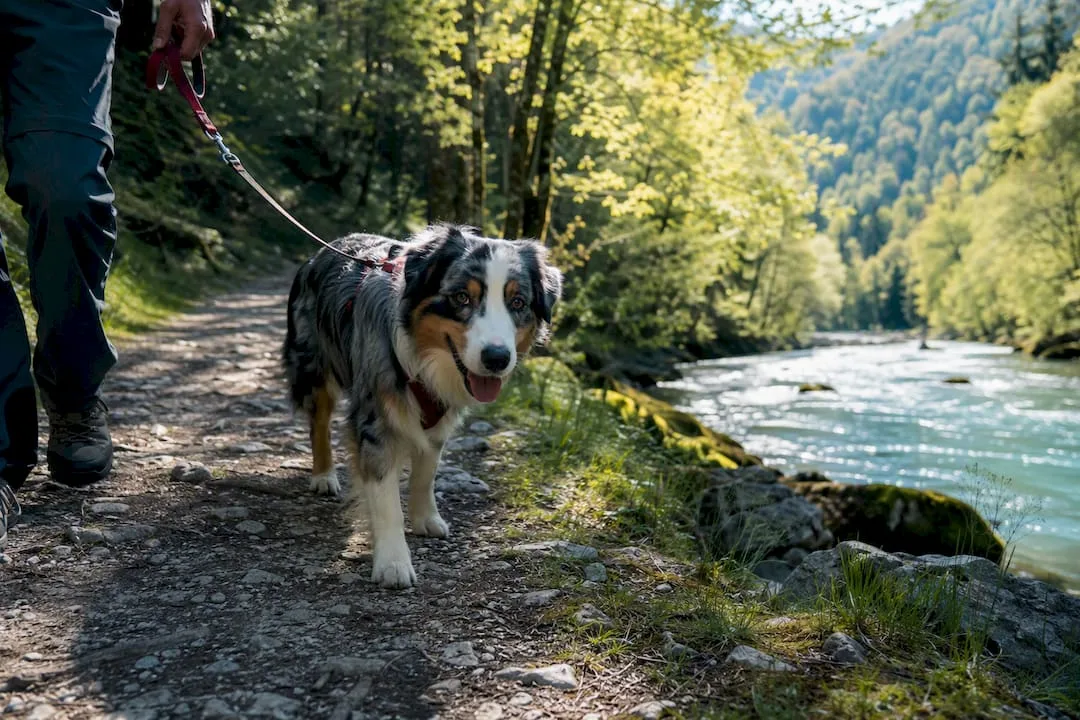
When
planning a campervan road trip through Slovenia, it makes sense to adapt your stops to your dog rather than the other way around. Some dogs need a break every hour, while others are comfortable travelling for two hours at a time. Before choosing an overnight stop, also check where
campervan overnight parking is actually legal, as wild camping with a dog can create additional risks, from ticks to unsuitable waste disposal.
What travelling with a dog is really like
On one of our trips towards the Kolpa River, we ended up stopping almost every hour, even though that was not part of the original plan. Our dog became restless earlier than we expected, so we adjusted the schedule and the trip became much more relaxed than our original itinerary. The most common mistake we see among dog owners is not a lack of equipment, but an overly ambitious schedule with no extra time for breaks.
The advice is simple: allow twice as much time as you think you will need and watch your dog rather than the clock. If you are considering which vehicle would be best for such a trip, take a look at our
campervan rental options.
— Rok
Campervan rental for travelling with a dog at Campervan.si
Campervan.si is a starting point for families and individuals who want to travel with their dog without having to guess which campervan will provide enough space and a comfortable environment for the journey. Our fleet includes the Mercedes V Marco Polo and Ford Transit Nugget Plus, both equipped with a kitchen, fixed toilet and sufficient interior space for safely positioning a travel crate.
Before booking, check our
campervan models and rental conditions, which also outline any additional requirements regarding travelling with pets. When you collect your campervan in Ljubljana, we can advise you on which model best suits the size and temperament of your dog and share practical tips for travelling through Slovenia, the Balkans or the Alps. You can arrange your booking through our main
campervan rental website, where you can also check available dates for the summer season.
Where to check official rules and practical advice
For accurate and up-to-date requirements regarding pet travel documents, vaccinations and procedures for returning to the EU, the GOV.SI information page on travelling with pets is the first official source worth checking. UVHVVR regularly updates the requirements for travelling to third countries, so check the latest information shortly before your trip rather than relying only on information collected months in advance.
For practical advice on driving, equipment and choosing campsites, the Avtokampi.si guide to travelling with a dog is also useful. It complements official information with practical experience from campervan travellers.
Sources
Recommended