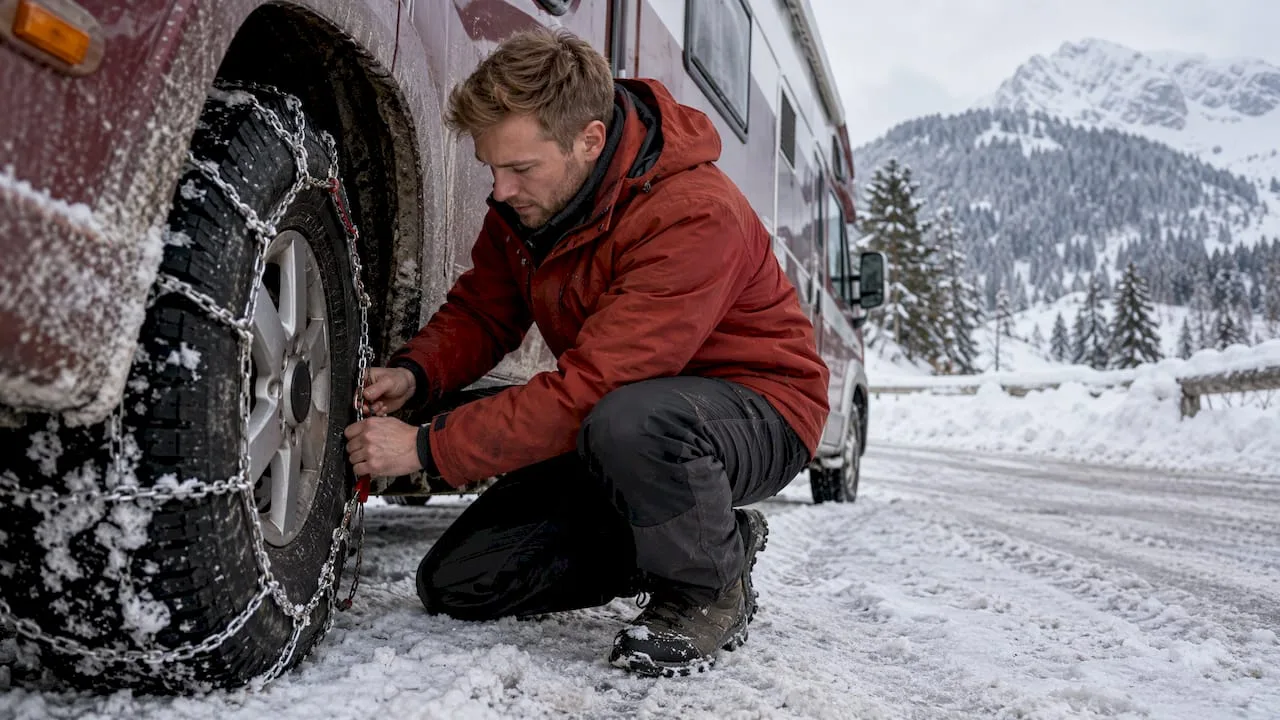
Choose the right snow chains for a campervan by winter tyre size, vehicle model and the space in the wheel arch, not by what is cheapest on the shelf. Fit them to the drive wheels, drive no faster than 50 km/h with them and take them off once the road is no longer covered in snow. In Slovenia, winter equipment is mandatory from 15 November to 15 March and whenever winter conditions occur, so chains in a campervan are not just an extra for mountain passes but part of a calm and safe winter trip. Below we have gathered everything you need: how to check compatibility, which chains suit taller and heavier vehicles, how to tension them and what the law requires.
Campervan
Set off on a winter trip in the right campervan
See our campervans for rent in Ljubljana and find the one that suits your winter travel plans.
Key takeaways
- In Slovenia, winter equipment is mandatory from 15 November to 15 March and in winter conditions; chains are mandatory where a road sign requires them.
- Choose chains by tyre size, vehicle make, model and year, and the space in the wheel arch; tyre size alone is not enough.
- Fit them to the drive wheels, re-tension them after a few metres of driving and do not drive faster than 50 km/h with them.
- Chains do not replace winter tyres, but they help you on packed snow, ice and steep hills.
- With a campervan, clear the roof too before driving: snow on the vehicle is punishable by a €200 fine.
Table of contents
When are snow chains mandatory in Slovenia
Slovenian rules are clear and apply to everyone who sets off in a campervan in winter, including visitors from abroad. According to the
Slovenian Traffic Safety Agency (AVP), winter equipment is mandatory from 15 November to 15 March, and also outside this period whenever there are winter conditions on the road. What exactly counts as winter equipment depends on the vehicle category.
| Vehicle category |
What counts as winter equipment |
| M1, N1 (cars and light vans, most compact campervans) |
winter tyres on all wheels, or summer tyres with suitable chains for the drive wheels |
| M2, M3, N2, N3 (heavier vehicles) |
winter tyres at least on the drive wheels, or summer tyres with suitable chains for the drive wheels, plus a shovel |
You will find the vehicle category in the registration document. For larger, heavier motorhomes it is worth checking before you leave, as the rules for them also require a shovel.
A few more important details:
- Tread depth. Under Article 46 of the Slovenian Rules on Vehicle Parts and Equipment, tyres that count as winter equipment must have at least 3 mm of depth in the main tread grooves.
- Road sign. On sections where chains are mandatory, this is shown by road sign 2307, often with an additional plate that also permits driving with winter tyres.
- Fines. AVP lists a €40 fine for inadequate winter equipment. If this causes you to obstruct or block other traffic, the fine rises to €500 and 5 penalty points.
So chains in a campervan are a good insurance policy even when you have winter tyres: on a snowy hill up to a ski resort or on a mountain pass, they are often the only way to continue safely without blocking the road for others.
Campervan
Come and choose a campervan for your winter trip
See our campervan rental options in Ljubljana and choose a vehicle for your plans to travel around Slovenia.
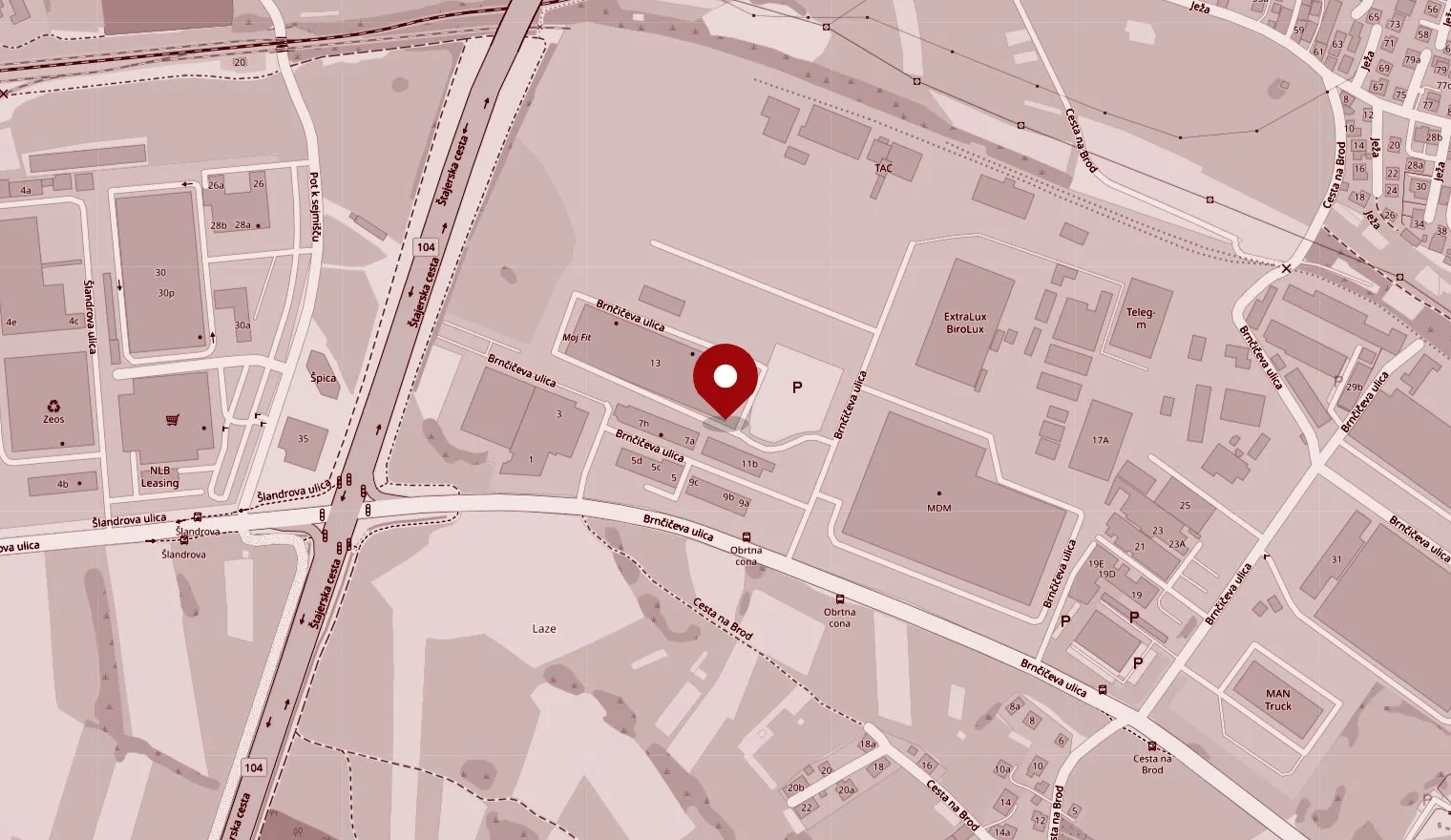
Campervan rental | Campervan.si
Brnčičeva ulica 13, 1231 Ljubljana, Slovenia
Show directions
Which chains are suitable for a campervan
A campervan is not a car. It is taller, heavier and often has a different ratio between tyre and bodywork, so chains that work perfectly on a family car are not necessarily the right choice. Three questions will help you choose.
Tyre size and vehicle model
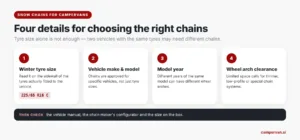
The first step is always the size of the winter tyres actually fitted to the vehicle. You will find the marking, for example 225/65 R16 C, on the tyre sidewall.
Merkur advises comparing the marking with the vehicle manual and the chain manufacturer’s instructions, as your winter set may be a different size from your summer tyres.
However, tyre size alone is not enough. The official
König snow chain configurator checks your choice by vehicle make, model and year, tyre size and any restrictions on wheel arch space. Two different vehicles can have the same tyre size, yet need different chains.
Wheel arch clearance
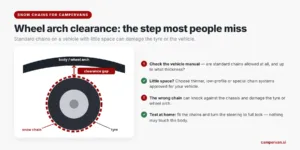
This is the point many people overlook.
Michelin Slovenia warns that standard chains on a vehicle with limited space can damage the tyre or parts of the vehicle. So check with the vehicle manufacturer whether standard chains are allowed at all, given the gap between the tyre and the bodywork. For vehicles with little space in the wheel arch, Merkur recommends thinner or special systems, as the wrong chain can knock against the chassis.
Type of chain
| Type |
Who it suits |
What to watch out for |
| Standard steel chains |
vehicles with enough wheel arch space, frequent driving on snowy mountain roads |
link thickness must match the vehicle’s weight; check whether the vehicle manufacturer allows them |
| Thinner or low-profile steel chains |
vehicles with little space between tyre and bodywork |
choose a model explicitly approved for your tyre size and vehicle |
| Chains for vans and light commercial vehicles |
taller and heavier campervans using tyres marked C |
reinforced links are designed for higher wheel loads |
| Textile snow socks |
occasional use and vehicles with very limited space |
check whether they are recognised as suitable equipment on your route |
In a campervan fully loaded with water, equipment and luggage, the load per wheel is higher than in a car, so specialist shops often offer chains with thicker links designed for vans and off-road vehicles. What always counts is the chain manufacturer’s approval for your vehicle and tyre size.
How to check whether chains fit your campervan
Before you buy chains or take them on a trip, do these checks in peace. They take less than half an hour and save a lot of frustration in a snowy car park.
- Read the marking on the sidewall. Write down the full size of the winter tyres fitted to the vehicle.
- Open the vehicle manual. In the chapter on wheels and tyres, the manufacturer states whether chains are allowed, on which wheels and up to what thickness.
- Use the chain manufacturer’s configurator or table. Enter the make, model, year and tyre size. If the configurator shows a wheel arch restriction, choose a model specifically designed for it.
- Check the packaging. Your tyre size must be listed on the box.
- Do a trial fitting at home. Fit the chains once on dry, level ground when nobody is rushing you. Check that the wheel does not touch the bodywork anywhere at full steering lock.
The last step may be the most valuable. Anyone who opens their chains for the first time at the roadside at minus five degrees, in gloves and in the dark, quickly discovers that the instructions on the box were not written for those conditions.
Which wheels to fit the chains to
Chains always go on the drive wheels, as these transfer power to the road. More precisely:
- Front-wheel drive: fit the chains to the front wheels.
- Rear-wheel drive: Michelin Slovenia advises fitting them to all four wheels, so prepare two pairs of chains for such a vehicle.
- Four-wheel drive: Michelin recommends chains on all four wheels. Under AVP rules, with permanent four-wheel drive the chains must be on at least one axle, and with selectable four-wheel drive at least on the permanently driven axle.
Check in the vehicle manual which drive your campervan has. Campervans of the same series can differ depending on the version, so do not rely on what applies to your neighbour’s motorhome at the campsite.
How to fit and tension chains correctly
Fitting is simple once you have tried it. With a campervan, which is taller and longer than a car, it is all the more important that you are visible and safe while doing it.
- Stop in a safe place. Choose a level surface as far from the traffic lane as possible, switch on your hazard lights and make sure you are clearly visible, for example with a high-visibility vest, as Merkur’s fitting guide advises.
- Apply the handbrake and switch off the engine. With an automatic gearbox, select P.
- Unroll the chain. Before placing it behind the wheel, untangle it so the links do not knot.
- Place the chain over the tread. Fasten the inner part, then the outer part, and spread the chain evenly over the whole tread of the tyre.
- Tension it according to the manufacturer’s instructions, depending on the system: with a pull cord, tensioner or ratchet wheel.
- Drive a few metres and check again. The chain settles during the first few turns, so stop, check the tension and tighten it further if needed.
A practical tip from the campsite: keep gloves, a head torch, a kneeling mat and a bag for storing wet chains after use within reach in the campervan. All of this belongs on the
campervan packing list you prepare before a winter trip.
Driving with chains: speed and safety
Driving with chains feels different, but with a few rules you quickly get the hang of it.
- Maximum 50 km/h. In Slovenia, with snow chains fitted you must not drive faster than 50 km/h. If the chain manufacturer specifies a lower speed, follow the lower one.
- Remove them on clear roads. When there is no more snow on the road, take the chains off. Driving on dry tarmac damages them and reduces safety.
- Drive smoothly. In its advice “Winter returns to the roads”, AVP recommends a lower speed, a greater safety distance, gradual acceleration and braking, and avoiding sudden steering movements, as grip is lower and unpredictable.
- Listen to the vehicle. If you hear knocking or scraping against the bodywork while driving, stop immediately in a safe place and check the chain tension.
A campervan is taller and heavier than a car, so on snowy roads plan more time and expect shorter daily stages.
What else belongs in a campervan’s winter kit
Chains are only part of winter preparation. In its guide
“How to prepare your vehicle for winter”, AVP lists a snow brush, ice scraper, de-icer, snow chains and, for more demanding conditions, a folding shovel as useful equipment.
For a campervan, a long-handled snow brush is especially important. The rules require you to remove snow and ice from the vehicle and clean the windows and mirrors before driving, otherwise you face a €200 fine. A lot of snow can build up overnight on the high roof of a campervan, which then slides onto the windscreen or the vehicle behind you when braking.
You will find more about preparing for a winter trip in our guides to
winter campervan rental and
campervan road safety, and for choosing campsites and places to stay, in our guide to
winter camping in Slovenia.
Chains when crossing borders
From Ljubljana you are at the Austrian or Italian border in a good hour, and in Croatia within a few hours. Each country has its own rules on winter equipment, the mandatory period and chains, which may differ from Slovenia’s, especially for heavier vehicles and on mountain passes. So before you leave, check the rules on the official websites of all the countries you will drive through and match them with what you have in your campervan. We have gathered what else to prepare for crossing a border with a rented vehicle in our guide to
crossing borders with a rented campervan.
Our view
Winter is one of the most beautiful seasons for campervan travel. Empty campsites, the snow-covered Julian Alps, morning coffee by a warm kitchen and views you would share with crowds in summer. But for such a break to be truly enjoyable, preparation starts with the wheels.
As a family business from Ljubljana, every winter we see that travellers worry most about driving on snow. Our answer is always the same: good winter tyres, checked chains and knowing how to fit them are the trio that gives you peace of mind. Chains are not only for extreme conditions; they are the piece of equipment that lets you drive out of the campsite without worry in the morning, even over fresh snow.
Our fleet is modern and compact, so it is comfortable to drive on narrower winter roads too. When booking a winter date, ask us about the vehicle’s winter equipment and the route you are planning. We are happy to advise which destinations in Slovenia, the Alps and neighbouring countries are most beautiful in winter and where you should expect snow. And on the road, 24/7 assistance is there for you.
Rok
A winter break in our campervan
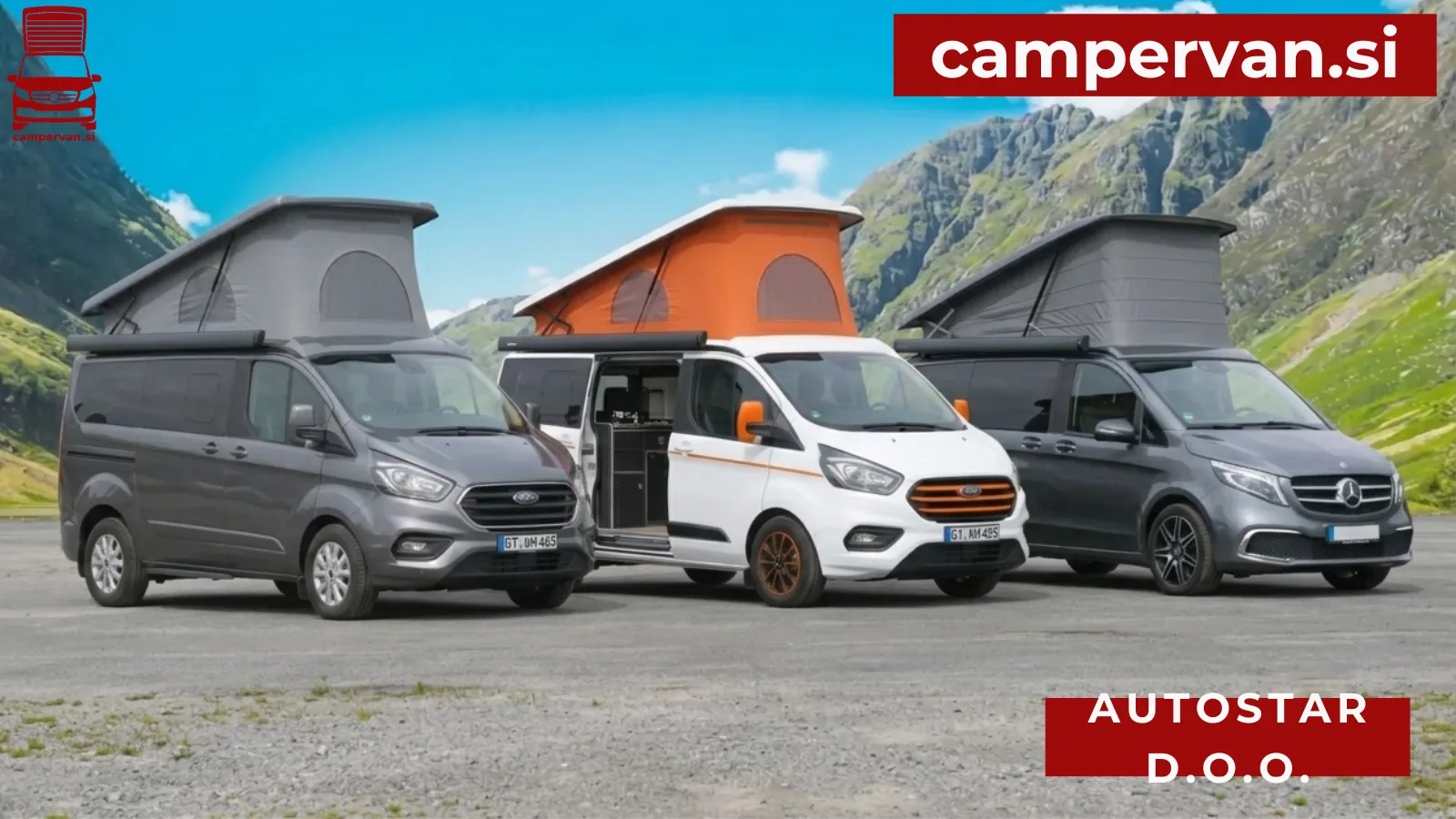
Would you rather experience the winter Alps without your own motorhome? In Ljubljana, the Mercedes V Marco Polo and the Ford Transit Nugget Plus are waiting for you, with equipment such as a kitchen, fixed toilet and beds for several people. Every rental includes basic insurance and 24/7 assistance.
- Mercedes V Marco Polo: daily rental from €125 per night, weekly rental from €110 per night. Check available dates.
- Ford Nugget Plus: daily rental from €125 per night, weekly rental from €110 per night. Book the Ford Nugget Plus.
- Final cleaning is €80 per rental.
Before booking, you can also read about our
experience with the Mercedes Marco Polo and our
experience with the Ford Nugget Plus.
Frequently asked questions
Do I need chains if I have winter tyres?
For M1 and N1 vehicles in Slovenia, winter tyres on all wheels count as winter equipment. Chains, however, are mandatory on sections marked with road sign 2307 without an additional plate for winter tyres, and they are a big help on packed snow and ice. So we recommend always carrying them in a campervan in winter.
What size of chains do I need for a campervan?
The size is determined by the winter tyre size on the sidewall and the vehicle’s make, model and year. The space in the wheel arch also matters and may require a thinner or special chain. Before buying, check the vehicle manual and the chain manufacturer’s table or configurator.
How fast can I drive with chains?
In Slovenia, you must not drive faster than 50 km/h with chains fitted. If the chain manufacturer specifies a lower speed, follow the lower one. When there is no more snow on the road, take the chains off.
Can I fit chains to just one wheel?
No. Always fit chains in pairs to both wheels of the drive axle; with rear-wheel and four-wheel drive, Michelin advises chains on all four wheels. Check in the manual which drive your vehicle has.
What is the fine for not having winter equipment?
AVP lists a €40 fine for inadequate winter equipment. If inadequate equipment causes you to obstruct or block other traffic, the fine is €500 and 5 penalty points.
CCampervan
Ask about a rental for a winter trip
Send us a question about renting a campervan in Ljubljana and let’s talk about the options for your trip around Slovenia.
Sources