20% off rentals until the end of March 2027 with code SNOW20•20% off rentals until the end of March 2027 with code SNOW20•20% off rentals until the end of March 2027 with code SNOW20•20% off rentals until the end of March 2027 with code SNOW20•
20% off rentals until the end of March 2027 with code SNOW20•20% off rentals until the end of March 2027 with code SNOW20•20% off rentals until the end of March 2027 with code SNOW20•20% off rentals until the end of March 2027 with code SNOW20•
Hungary by Campervan: Route, Vignette, Accommodation, and Destinations
November 23, 2026
Hungary is one of the most rewarding countries in Slovenia’s neighbourhood for a motorhome trip. You reach the border at Lendava by motorway in just over two hours, and then Lake Balaton, the thermal lake of Hévíz, Budapest on the Danube and the wine towns of Eger and Tokaj await. For a carefree trip you need to sort out three things: the digital vignette, which applies to all motorhomes from 2026, overnight stays at campsites or designated motorhome stopovers, and a comfortable vehicle with your kitchen and bed always on board. Ljubljana is an excellent starting point for this kind of trip, so renting a campervan from us is a natural first step: at pick-up you get a vehicle with basic insurance, 24/7 assistance and tips for the route you are planning.
Campervan
campervan.si
Explore Hungary in comfort
Rent a campervan in Ljubljana for your trip through Hungary, with basic insurance, 24/7 assistance and route-planning tips.
The most direct route takes the Slovenian A1 motorway towards Maribor, then the A5 towards Lendava (in Slovenian), and after the border you continue on the Hungarian M7 motorway towards Lake Balaton and Budapest. The total distance to the capital is about 464 km, with an estimated driving time by car of just under four hours without stops.
In a motorhome, allow more time. You drive a little more calmly, stop for coffee, lunch and a short walk, and children and four-legged travel companions are glad of every break. Realistically, plan five to six hours if you want to reach Budapest in one day. Even better, spend the first night at Lake Balaton, only about three hours’ drive from Ljubljana, and visit the capital well rested.
A few practical tips for day one:
Fill up before the border or just after it; service stations along the M7 on the Hungarian side are frequent.
Buy your vignette before joining the M7, as the toll section starts soon after the border (more in the next chapter).
Leave early in the morning for less traffic around Maribor and an easier time finding a spot at a lakeside campsite.
The season matters: in summer the campsites around Balaton are full, while in spring and autumn there is more space and prices are lower.
Motorhome vignette: what applies from 2026
Hungary has no toll booths. Use of motorways and expressways is covered by a digital vignette linked to your number plate (in Slovenian), which you don’t stick on the windscreen. Roadside cameras read the plate and check whether a valid vignette has been paid for it.
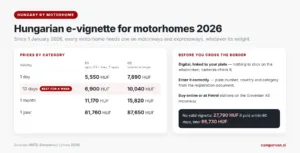
An important change has applied since 1 January 2026: all motorhomes need a vignette, regardless of weight. Motorhomes up to 3.5 t with a maximum of seven seats fall into category D1, and heavier or larger vehicles into D2. Prices according to AMZS (the Slovenian automobile association):
Validity
D1 (up to 3.5 t, up to 7 seats)
D2 (heavier or larger motorhomes)
1 day
5,550 HUF
7,890 HUF
10 days
6,900 HUF
10,040 HUF
1 month
11,170 HUF
15,820 HUF
1 year
61,760 HUF
87,650 HUF
For a typical week-long trip, the 10-day vignette makes the most sense. You can buy it online or while still in Slovenia, at Petrol service stations along the A5 Pomurje motorway, on your way to the border.
Be precise when you buy it. Enter the correct registration number, country of registration and vehicle category. Check the maximum permitted weight and number of seats in the registration document, because a vignette in the wrong category is not valid. Anyone driving on toll roads without a valid vignette pays a surcharge of 27,790 HUF (in Slovenian) if paid within 60 days, and 95,730 HUF after that. Keep the proof of purchase until the end of your trip.
Traffic rules you need to know
Hungarian rules are clear and consistently enforced. Before you leave, remember the following:
Alcohol: drivers are subject to zero tolerance, 0.0‰ (in Czech). So save that glass of Tokaji at dinner for when the motorhome is parked for the night.
Speed limits for motorhomes up to 3.5 t: 50 km/h in built-up areas, 90 km/h outside built-up areas, 110 km/h on expressways and 130 km/h on motorways.
Lights: outside built-up areas, drive with dipped headlights or daytime running lights on, even during the day.
Mandatory equipment: reflective vests for all passengers, a first-aid kit and a warning triangle. You must wear a reflective vest whenever you get out of the vehicle because of a breakdown or accident, and according to AMZS the fine for not having one is 30,000 HUF.
With 130 km/h allowed on motorways, here is a practical tip: a tall vehicle is more sensitive to crosswinds, which can pick up on the open Pannonian plain. Calmer driving at around 110 km/h is safer, uses less fuel and only costs you a few minutes.
Where to stay overnight with a motorhome legally and safely
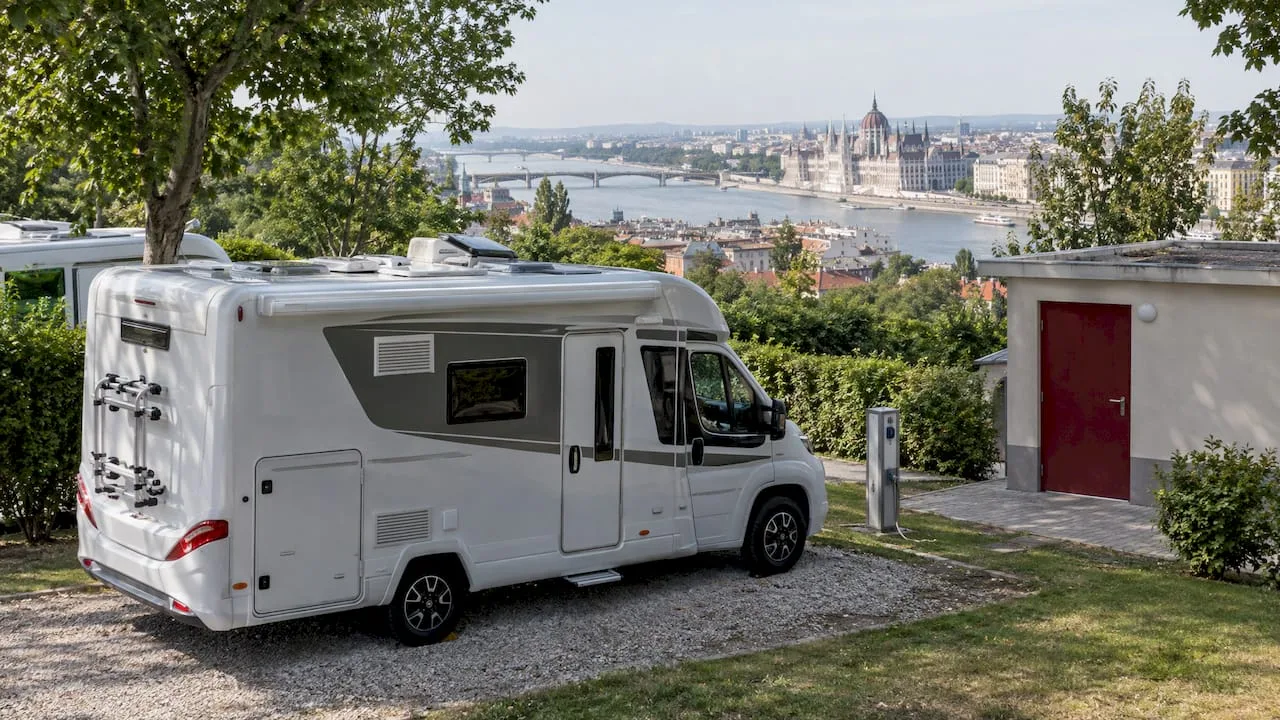
The first rule is simple: wild camping in Hungary is prohibited (in German) outside designated places, and official stopovers and campsites are the safest choice. The ban is especially strict in national parks and tourist areas such as the shores of Lake Balaton and the area around Budapest.
That said, there is no shortage of options. With a motorhome you can stay overnight at campsites, camper zones, car parks at thermal spas and aquaparks, on farms and vineyards that welcome motorhome guests, and in public car parks where overnight stays are not prohibited.
What to look for when choosing a campsite
Electricity: a hook-up lets you charge devices and makes evenings more comfortable, especially in spring and autumn.
Water and waste disposal: check whether you can fill up with fresh water and empty grey water and the toilet cassette.
Toilets and showers: after a day at the thermal baths or on the bike, hot showers are a real luxury.
Extra facilities: many campsites have a restaurant, shop or pool, which is the norm around Balaton and in spa towns.
Location: a campsite with a bus or tram connection to central Budapest saves you hunting for a parking space for a tall vehicle in the city.
If this is your first motorhome trip, take a look at our guide to choosing the right motorhome stopover and preparing your vehicle before you leave. The same principles apply in Hungary, and you can spend your first night still in Slovenia’s Prekmurje region. For an overview of the Slovenian rules, see our article camping rules in Slovenia.
Campervan
Start your Hungarian trip with us
When you pick up your campervan, you get basic insurance, 24/7 assistance and tips for the route you are planning.
Hungary is made for slow travel: distances are short, roads are good and there are plenty of campsites. Destinations recommended by road travellers include Budapest with Buda Castle and the Parliament, Lake Balaton, Eger, Szentendre (in Slovenian), as well as the UNESCO-listed Hortobágy National Park and the village of Hollókő.
Lake Balaton
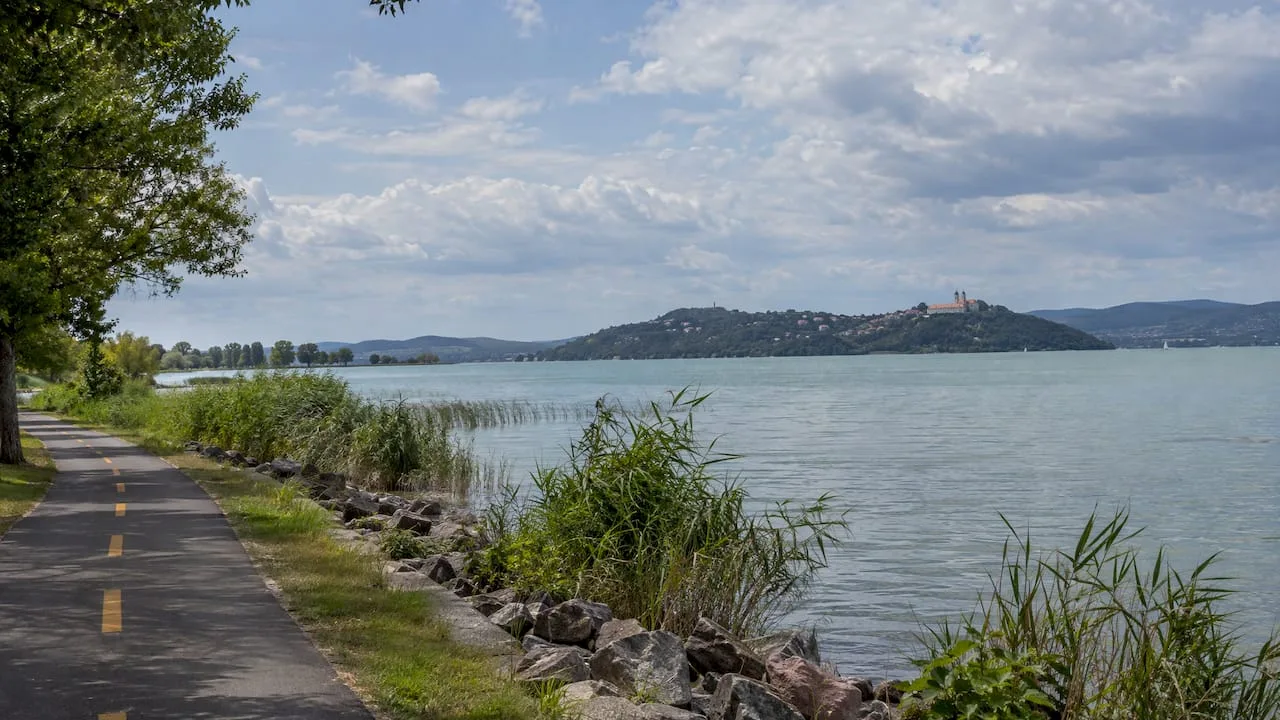
The largest freshwater lake in Central Europe is the first natural stop on the way from Slovenia. The south shore has shallow water that is ideal for families, while the north shore has vineyards, the Tihany peninsula and views of extinct volcanic hills. Lakeside campsites offer direct access to the water, and the cycle path around the lake is perfect for a day away from the wheel.
Hévíz
Just a few kilometres from the western end of Balaton lies Hévíz, known for the largest biologically active thermal lake in the world (in Czech), where you can swim all year round. That is a good reason to visit even in November or March, when camping elsewhere in Europe has already gone quiet or not yet started. After your swim you return to a warm vehicle, make a cup of tea and spend the night without packing a suitcase.
Budapest
Visit the capital from a campsite on the outskirts and travel into the city by public transport. Fisherman’s Bastion, Buda Castle, the Parliament on the Danube, the Széchenyi and Gellért thermal baths and an evening stroll across the Chain Bridge fill at least two days. A tall vehicle in the narrow streets of the old town is more of a burden than a help, so let it rest at the campsite for those two days.
Danube Bend: Szentendre and Visegrád
North of Budapest, the Danube turns through the hills. Artistic Szentendre with its colourful houses and the castle at Visegrád make a lovely half-day trip, and the riverside road is one of the most scenic in the country.
Eger, Tokaj and Hollókő
Baroque Eger is famous for its castle, its minaret and Bull’s Blood (Egri Bikavér) wine, which you can taste in the cellars of the Valley of the Beautiful Women. Further east lies Tokaj, home of the famous sweet wines, where some winemakers welcome motorhome guests. Hidden between the two is the village of Hollókő, with traditional Palóc architecture, a UNESCO World Heritage Site.
Pécs and Sopron
If you return by a different route, consider Pécs in the south, a city with Roman heritage and a Mediterranean atmosphere, or Sopron on the Austrian border, surrounded by vineyards and Lake Fertő (Neusiedl).
Suggested route: seven days in Hungary
This round trip is designed so that you drive a moderate distance each day and have plenty of time for swimming, sightseeing and food.
Day 1: Ljubljana–Lake Balaton. Around three hours’ drive on the A1, A5 and M7, an afternoon swim and dinner by the lake.
Day 2: Hévíz and the north shore of Balaton. The thermal lake in the morning, Tihany and wine cellars in the afternoon, overnight at a campsite.
Day 3: Balaton–Budapest. About two hours’ drive, settling in at the campsite and a first evening walk along the Danube.
Day 4: Budapest. The castle, Parliament, the Central Market Hall and a thermal bath.
Day 5: Danube Bend and Eger. Szentendre in the morning, then on to Eger and a tasting in the Valley of the Beautiful Women.
Day 6: Hollókő or Tokaj. Choose culture or wine, and stay overnight at a campsite or with a winemaker who welcomes motorhomes.
Day 7: back to Ljubljana. A longer driving day on the M3, M0 and M7, or an extra night at Balaton if you have a day to spare.
A 10-day D1 vignette is enough for this route, and there are campsites and stopovers all along the way. If you only have a long weekend, shorten the trip to Balaton, Hévíz and Budapest.
A campervan for Hungary from Ljubljana
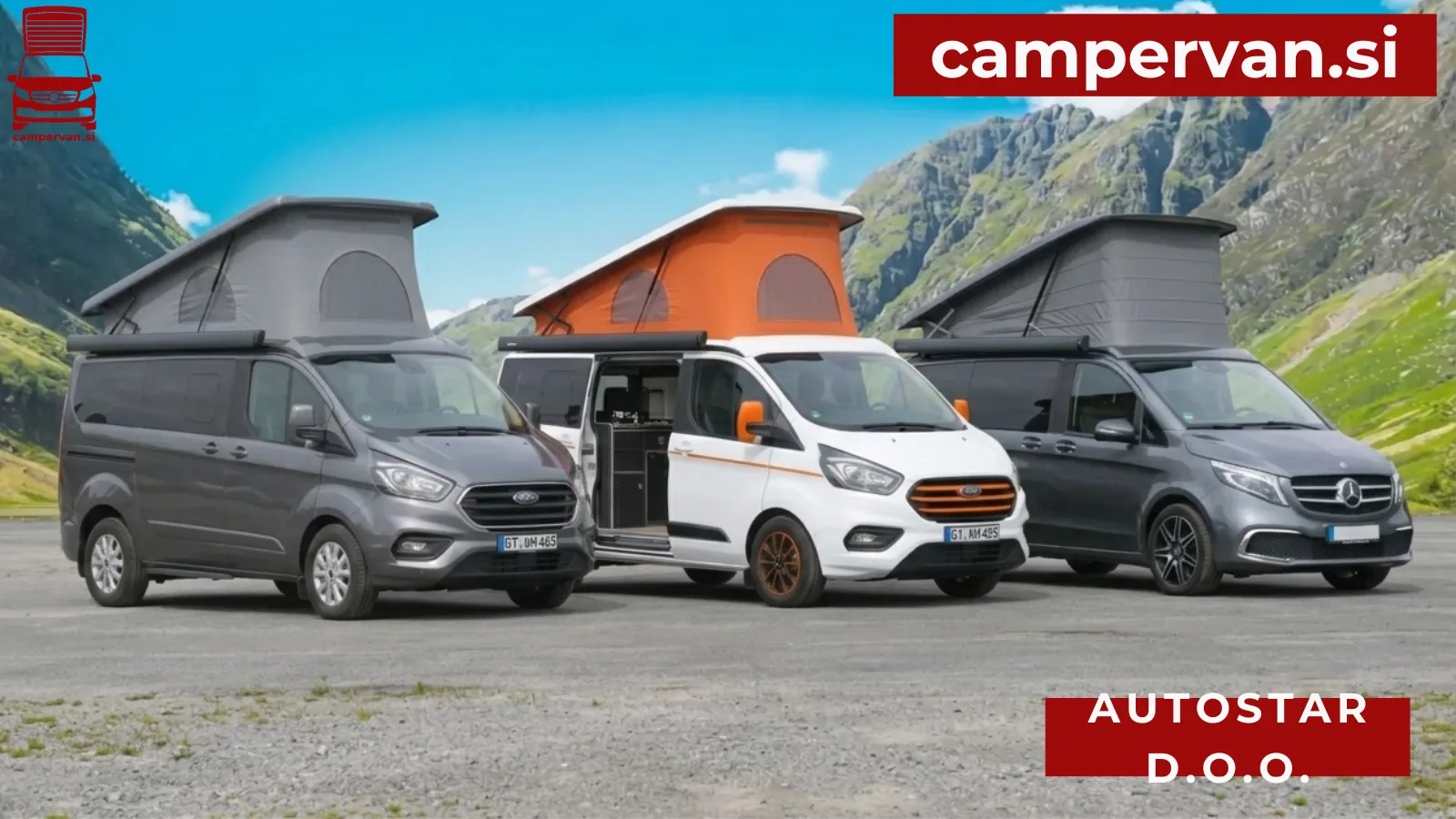
For a trip like this you need a vehicle that is compact enough for the campsites around Balaton and the car parks at the spas, yet well equipped enough for independent mornings and evenings. Our fleet includes the Mercedes V Marco Polo and the Ford Transit Nugget Plus, with a kitchen, beds for several people, basic insurance and 24/7 assistance, and vehicles with a fixed toilet are also available.
Rental prices:
Mercedes V Marco Polo: daily rental from €125 per night, weekly rental from €110 per night.
Ford Nugget Plus: daily rental from €125 per night, weekly rental from €110 per night.
Final cleaning: €80 per rental.
For the seven-day route described above, a weekly rental is the best value. Pick-up is possible on various dates, so you can fit your departure to your holiday. Check availability and book on our booking page.
Our take on Hungary by motorhome
Hungary is a country we Slovenians often drive through on the way somewhere else, or visit only for a weekend in Budapest. That’s a shame, because with a motorhome it is one of the friendliest destinations near us: close, affordable to travel and full of warm waters.
As a family business from Ljubljana, we are happy to advise our guests at pick-up on routes around Slovenia, the Balkans, the Alps and the neighbouring countries. For Hungary we recommend a simple rhythm: the first night at Lake Balaton, then the thermal waters of Hévíz, and only then the capital. That way you avoid a long first day at the wheel and start your trip with a break.
A campervan is the right choice for this route because you don’t have to pack up and look for rooms every day. Morning coffee by the lake, an afternoon swim in thermal water, dinner by a vineyard in Tokaj in the evening. All of it without suitcases and without booking a hotel in every town.
Our tip for a relaxed holiday: buy your vignette while still on the Slovenian side, stay overnight at campsites and stopovers, and explore the capital by public transport. Everything else is the joy of the road.
Rok
Frequently asked questions
Do I need a Hungarian vignette for a motorhome up to 3.5 t?
Yes. Since 1 January 2026, all motorhomes need a vignette, regardless of weight. Motorhomes up to 3.5 t with a maximum of seven seats use category D1, and a 10-day vignette costs 6,900 HUF.
Can I sleep in my motorhome by Lake Balaton outside a campsite?
No, wild camping is prohibited in Hungary, especially in tourist areas such as Balaton. There are plenty of campsites around the lake, and you can also stay overnight at motorhome stopovers and in car parks where it is explicitly allowed.
How long does it take to drive from Ljubljana to Budapest by motorhome?
The distance is around 464 km, and by car the drive takes just under four hours without stops. With a motorhome and breaks, allow five to six hours, which is why we recommend an overnight stop at Lake Balaton.
When is the best time to visit Hungary by motorhome?
Summer is the time for swimming in Balaton, while spring and autumn bring fewer crowds at campsites and pleasant temperatures for exploring towns and wine regions. The thermal lake in Hévíz is open for swimming all year round, so Hungary is a lovely destination in the colder months too.
What do I need to carry in a motorhome in Hungary?
Reflective vests for all passengers, a first-aid kit and a warning triangle are mandatory. Outside built-up areas, drive with your lights on even during the day, and the driver must have 0.0‰ blood alcohol.
CCampervan
Ask us about your motorhome trip
Write to us about renting a campervan for Hungary and ask about the vehicles you can choose for your trip.
 Rental prices: