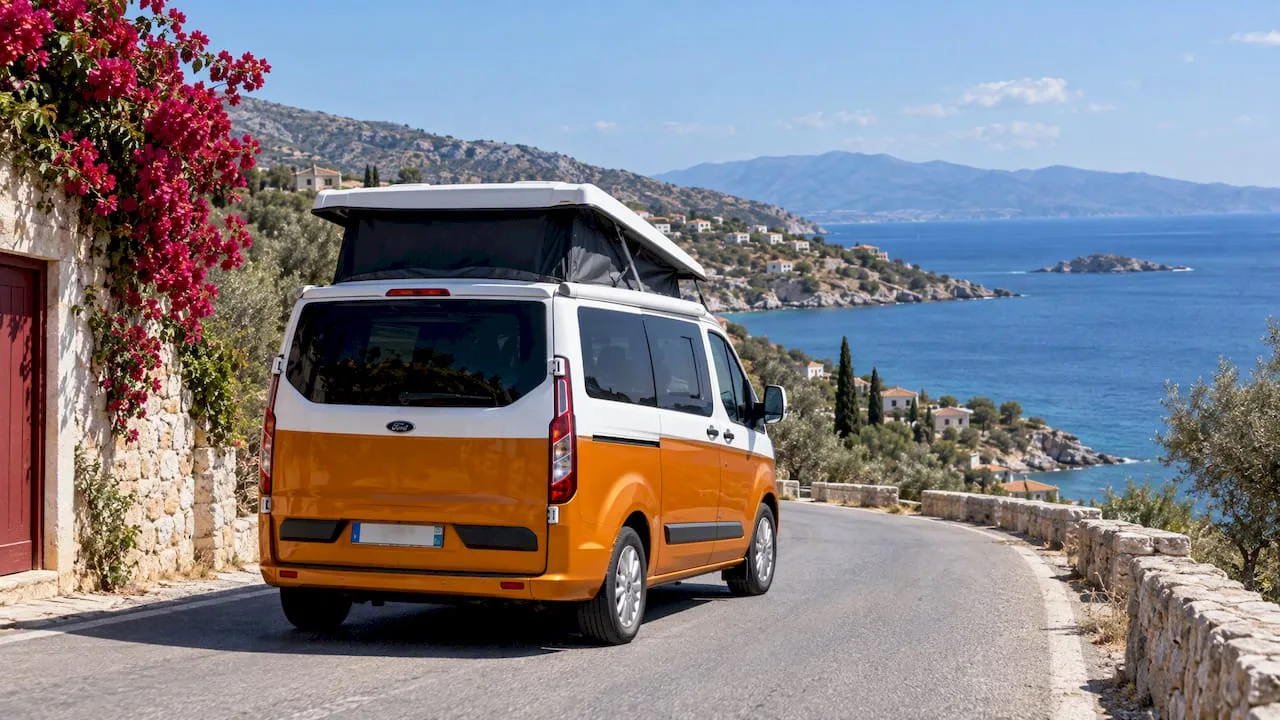
Greece by campervan is one of the most beautiful trips you can start in Ljubljana. Meteora, Delphi, the Peloponnese and Halkidiki are two to three days of relaxed driving away, or you can get there on an overnight ferry from Italy. In this guide we cover which route to choose, which documents you need for the countries along the way, where you are allowed to stay overnight and how much you will spend on fuel and tolls. We have also added a two-week plan that is about much more than time behind the wheel.
Campervan
Road trip to Greece in a campervan
Explore campervan rental options in Ljubljana for your trip to Greece and plan a route that suits you.
Check available dates
Key takeaways
- There are two overland routes: the shorter Balkan route through Serbia and North Macedonia, and the longer route through Hungary, Romania and Bulgaria, which stays entirely within the EU. The third option is a ferry from Italy.
- To drive through Serbia you need a Green Card. If the vehicle is not registered in your name, you also need the owner’s authorisation.
- In Greece, stay overnight at official campsites or in areas designated for motorhomes. Camping on beaches, in forests and near archaeological sites is not allowed.
- The best times to travel are spring and autumn, when it is less hot and less crowded, and conditions for hiking at Meteora are at their best.
- For two weeks, plan on at least 3,000 km of driving, so a compact, fuel-efficient campervan with a kitchen is a big advantage.
Table of contents
Overland or by ferry: how to get to Greece
On any trip to Greece, the first decision is whether to cross the Balkans or the Adriatic. All three options are good. They differ in time, cost and how many days of your holiday the journey itself takes.
The Balkan route through Serbia and North Macedonia
This is the most direct route: Ljubljana, Zagreb, Belgrade, Niš, Skopje, Gevgelija and then Thessaloniki. It is a good thousand kilometres, mostly on motorways. In a campervan you can comfortably split it into two days, with one overnight stop in Serbia or North Macedonia. Bear in mind that you cross two borders outside the Schengen Area, so expect queues in summer and during holidays.
To drive through Serbia you must have
a Green Card and the owner’s authorisation if the vehicle is not registered to the driver. With a rental vehicle, both documents must be in the vehicle before you reach the Bajakovo–Batrovci border crossing.
The route through Hungary, Romania and Bulgaria
If you want to avoid borders outside the EU, you can drive through Hungary, Romania and Bulgaria. This
route stays entirely within the EU, but it takes longer, so plan at least one extra day. It makes most sense if you want to combine the trip with Transylvania or the Bulgarian coast, or if you plan to return home by a different route from the one you came on.
Ferry from Italian ports
The third option is to drive to Italy and take a ferry to the Greek ports of Igoumenitsa or Patras. Instead of two days of driving, you spend a night on the ship and drive straight into Epirus or the Peloponnese in the morning. A
comparison of the ferry and the Balkan route shows that the ferry pays off most when your destination is western Greece or the Peloponnese. The overland route is better if you are heading to Halkidiki or Thessaloniki.
When booking a ferry, check the length and height of your vehicle, as the vehicle fare often increases with length. A compact campervan like our models usually falls into a lower category than a classic semi-integrated motorhome. Some operators also offer “camping on board”, staying in your motorhome on the open deck, which is cheaper than a cabin. Always check this option and its conditions with the operator when booking.
If you are driving to the port of Venice or Ancona, see our guide on
how to plan realistic daily distances in Italy. You might take an extra day to reach the ferry and stay overnight at Lake Garda. In that case, this overview explaining the
types of campsites at Lake Garda will help you choose a pitch that suits your vehicle.
| Option |
Best for |
Advantages |
What to watch out for |
| Balkan route (Serbia, N. Macedonia) |
Halkidiki, Thessaloniki, northern Greece |
Shortest overland route, mostly motorway |
Green Card, owner’s authorisation, border queues |
| EU route (Hungary, Romania, Bulgaria) |
Those who want to avoid non-EU borders |
No border crossings outside the EU |
Longer route, one extra day of driving |
| Ferry from Italy |
Epirus, the Ionian coast, the Peloponnese |
Rest instead of driving, arrival in western Greece |
Price depends on vehicle length, book ahead in season |
Many travellers combine both options. They drive to Greece overland through the Balkans and return by ferry from Patras or Igoumenitsa. This way they make a loop, never drive the same road twice and spend the last day of their holiday on a ship rather than at a border.
Documents and insurance before you leave
Greece is an EU member state, so a Slovenian (or any EU) driving licence is valid there. You need to pay attention to the countries along the way. You may drive through a country that does not issue licences under the Vienna Convention or whose licence categories are not comparable with Slovenian ones. In that case,
check whether you need an International Driving Permit. For a campervan such as the Marco Polo or Nugget Plus, a category B licence is usually sufficient.
Before you leave, have the following ready in the vehicle:
- a valid ID card or passport for all passengers,
- your driving licence and, if needed, an International Driving Permit,
- the vehicle registration document and a Green Card if you are travelling through Serbia or North Macedonia,
- the owner’s authorisation if the vehicle is not in your name,
- a European Health Insurance Card (EHIC) and, optionally, additional travel insurance,
- a roadside assistance contact number.
If you rent a vehicle from us, tell us when booking that you are planning Greece and which route you will take. Together we check what you need for the countries along the way and prepare all the documents before you pick up the keys. You will find more about preparing for border crossings in our guide to
documents, licences and insurance.
Campervan
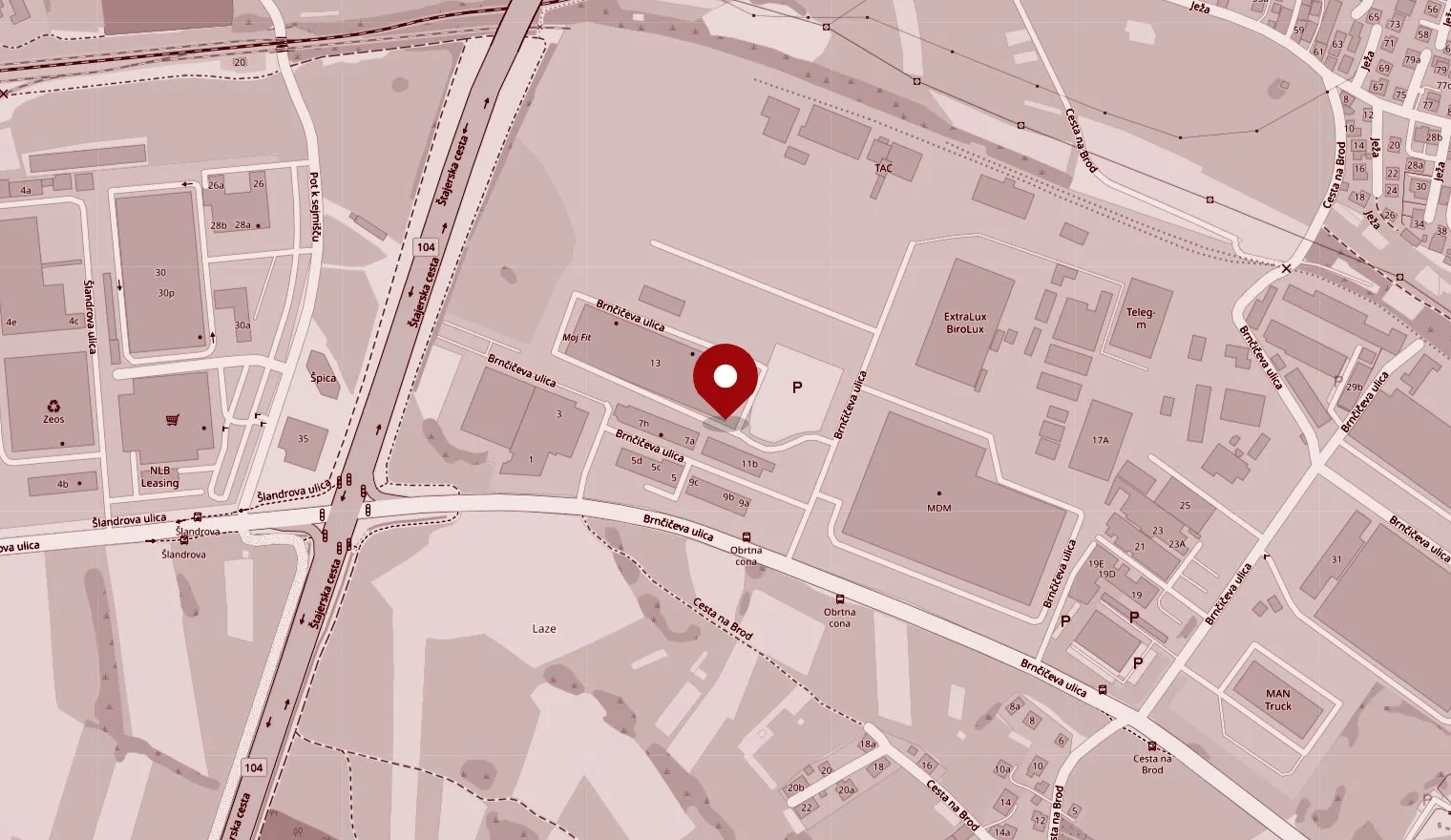
Start your Greek adventure in person
Brnčičeva ulica 13, 1231 Ljubljana, Slovenia
Where to stay overnight in a campervan in Greece
Greece has a dense network of campsites, from simple family-run sites among olive groves to larger beachside campsites with a restaurant and shop. For overnight stays, choose official campsites or areas explicitly designated for motorhomes. Greece has tightened its rules in recent years: camping on public land, beaches, in forests and near archaeological sites is not allowed. In summer, checks at popular beaches are common.
Parking a campervan is not prohibited in itself, as long as traffic rules allow it. However, once you set out chairs and a table or roll out the awning, it counts as camping. So the rule is simple: park during the day where it is permitted, and spend the night at a campsite.
How to choose a good campsite:
- Location: a campsite close to a main sight saves you a morning drive and searching for parking. Below Meteora, for example, that is the village of Kastraki.
- Shade: in summer, shade under trees is almost as important as electricity.
- Access: narrow gravel roads to seaside campsites are much friendlier in a compact campervan than in a large motorhome.
- Opening times: outside the main season some campsites are closed, so check before you leave that the campsite is open on your dates.
- Services: check whether you can empty grey water and the chemical toilet and fill up with fresh water.
You can search for campsites using popular motorhome apps, which also include reviews from other travellers and opening information. If you are curious how the rules work back home, read our overview of the
camping rules in Slovenia.
Stops you should not miss
Greece offers more than you can see in one holiday. The stops below are listed from north to south, so you can link them into a single loop.
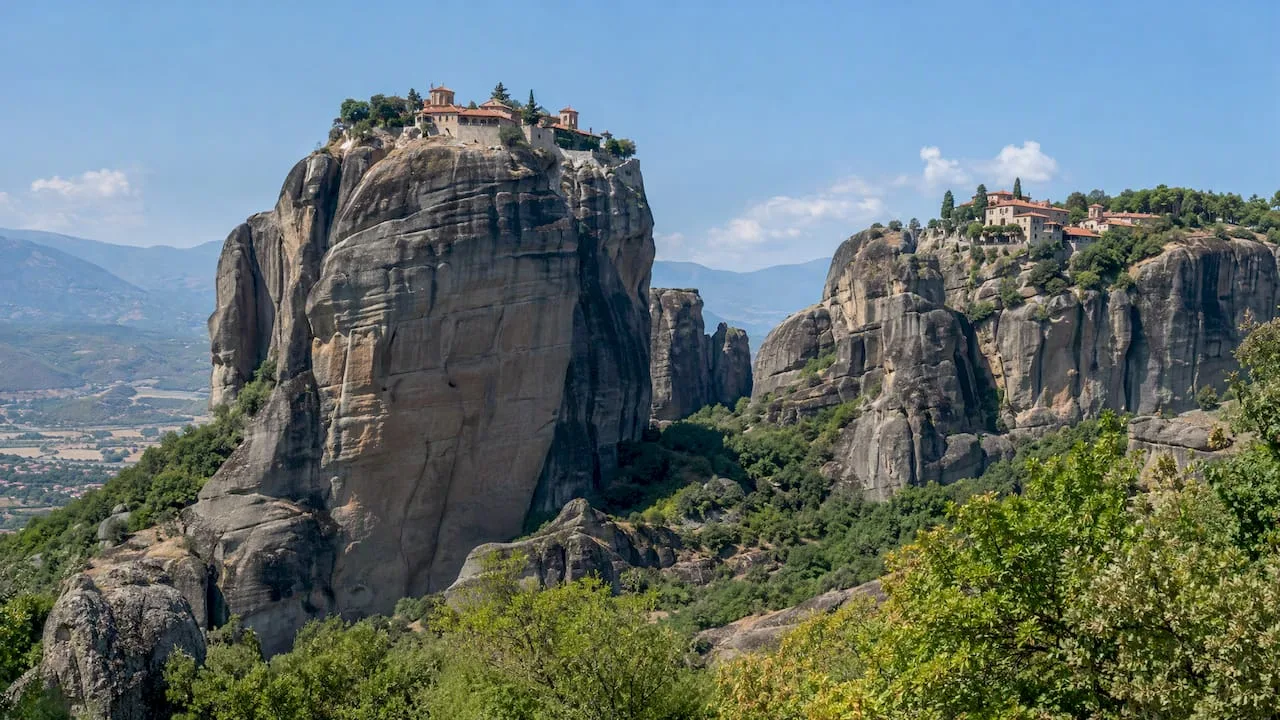
Meteora and Kalambaka
Rock pillars topped with monasteries make one of the most dramatic sights in Europe.
Meteora is a UNESCO mixed World Heritage Site, and six monasteries are still active in the complex today. Stay overnight at a campsite below the rocks and walk up to the monasteries in the morning or take the local bus. This way you avoid hunting for a parking space on the narrow roads by the monasteries.
Delphi, Olympia and the ancient Peloponnese
The
UNESCO World Heritage List includes a number of ancient sites in Greece that you can visit by campervan without organised tours: Delphi, Olympia, Epidaurus, Mycenae and Tiryns, and Mystras. Park in the designated car parks at the sites. Visit early in the morning, when it is cooler and there are fewer coaches.
The Peloponnese from Mani to Messenia
The Peloponnese is made for campervan travel. Driving stages are shorter, there are plenty of campsites and the coastline changes every few kilometres. On the Mani Peninsula, include Areopoli, Limeni, Kardamyli, the Diros Caves and Cape Tainaron. In the west, visit Pylos, Voidokilia Beach, the fortresses of Methoni and Koroni, and ancient Messene.
Distances on the Peloponnese are short but the days are full, so make time to rest too. When you change location every day, practical tips on how to maintain
comfort on a long trip come in handy.
Halkidiki and Sithonia
If you arrive overland, Halkidiki is almost on your doorstep. Sithonia, the middle “finger” of the peninsula, is very popular with campervan travellers from Slovenia. They are drawn by pine forests by the sea, crystal-clear water and campsites right on the beach. It is ideal as a first or last stop, when after a long drive you want a few days of nothing but sea and fresh local food.
Sample two-week itinerary
On this loop you travel to Greece overland and return home by ferry, so you never drive the same road twice.
| Day |
Route |
Highlight |
| 1–2 |
Ljubljana – Belgrade – Thessaloniki |
Motorway driving, overnight in Serbia or N. Macedonia |
| 3–4 |
Halkidiki, Sithonia |
Sea and rest after the drive |
| 5–6 |
Meteora, Kalambaka |
Monasteries, hikes, campsite in Kastraki |
| 7 |
Delphi |
Ancient sanctuary and views over the Gulf of Corinth |
| 8–9 |
Nafplio, Mycenae, Epidaurus |
Nafplio old town and ancient theatres |
| 10–11 |
Mystras, Mani, Limeni |
Stone villages and the Diros Caves |
| 12 |
Pylos, Voidokilia |
One of the most beautiful beaches in the Peloponnese |
| 13–14 |
Olympia – Patras – ferry – Italy – Ljubljana |
Overnight crossing and the drive home |
If you only have ten days, skip Halkidiki and Mani and focus on Meteora, Delphi and the Argolis. For three weeks, add an island reached by a shorter ferry, or Epirus and the hinterland of Igoumenitsa.
How much does a campervan trip to Greece cost
The biggest costs are fuel, tolls, the ferry, campsites and the vehicle. Fuel in Greece is not cheap.
AMZS lists prices for Greece of €2.22 per litre of diesel, €2.21 for unleaded 95 and €2.45 for 98-octane petrol (2026 data). Over 3,000 kilometres, a campervan with moderate consumption saves a noticeable amount compared with a large motorhome.
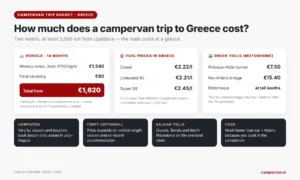
Greek motorways are tolled, and you pay at toll booths. On the loop above you will almost certainly use two sections that are priced separately. For a motorhome, AMZS lists €7.50 for the Preveza–Aktio tunnel and €15.40 for the Rio–Antirio bridge, which links the mainland with the Peloponnese.
Example vehicle cost for two weeks with our campervan, based on published prices:
- weekly rental of the Mercedes V Marco Polo or Ford Nugget Plus costs from €110 per night, so from €1,540 for 14 nights,
- final cleaning costs €80 per rental,
- in total you pay from €1,620 for a vehicle that is your transport, kitchen and bedroom all in one.
Add to this fuel, tolls in the Balkans and Greece, campsites and the ferry if you choose it. Because you can cook in the campervan, food costs are much lower than when travelling by car and staying in hotels. For a more detailed breakdown of costs by category, see
how much a campervan trip really costs, using Italy as an example. You can work out the costs for Greece in the same way.
When to go
Spring and autumn are the best seasons for Greece by campervan. At Meteora,
spring and autumn are ideal for hiking. In summer temperatures are high, and in winter the paths can be slippery. The monasteries that are open to visitors are open all year.
- April and May: the countryside is in bloom and temperatures are pleasant, but the sea is still cold for swimming.
- June: the sea is warm and campsites are not yet full. It is an excellent month for Halkidiki.
- July and August: hot and very crowded. Book seaside campsites in advance and visit archaeological sites early in the morning.
- September and October: many consider this the best time. The sea is warm, campsites are quiet and the days are pleasant for sightseeing.
- Winter: most seaside campsites are closed. Travelling is possible but requires more planning.
Our view on Greece by campervan
We always love introducing Greece to our guests in Ljubljana, because it combines everything that is best about campervan travel: the open road, spectacular scenery and evenings by the sea. As a family business, we talk to travellers about their route and destinations before they leave. For Greece, our most frequent advice is the same: do not underestimate the distances. Greece is bigger than it looks on the map, and the roads in the Peloponnese and the mountains are slower than motorways.
That is why we recommend a compact campervan. With the Mercedes V Marco Polo or Ford Nugget Plus you can drive into the narrow streets of Kardamyli and park in an ordinary car park at Delphi. You can also take a gravel road down to a beach campsite without worry. At the same time you have a kitchen and beds for several people, so you are not dependent on restaurants and hotels.
Our advice for a first trip: go to Greece overland and come home by ferry. Stay at least two nights at each main stop. Apart from arrival and departure days, no day should involve more than five hours of driving.
— Rok
Campervan rental in Ljubljana for a trip to Greece
If you are planning Greece, we will have a modern campervan ready for you in Ljubljana that is up to a long journey. You can choose between the Mercedes V Marco Polo and the Ford Nugget Plus. Equipment includes a kitchen, beds for several people and, depending on the model, a fixed toilet. Every rental includes basic insurance and 24/7 assistance.
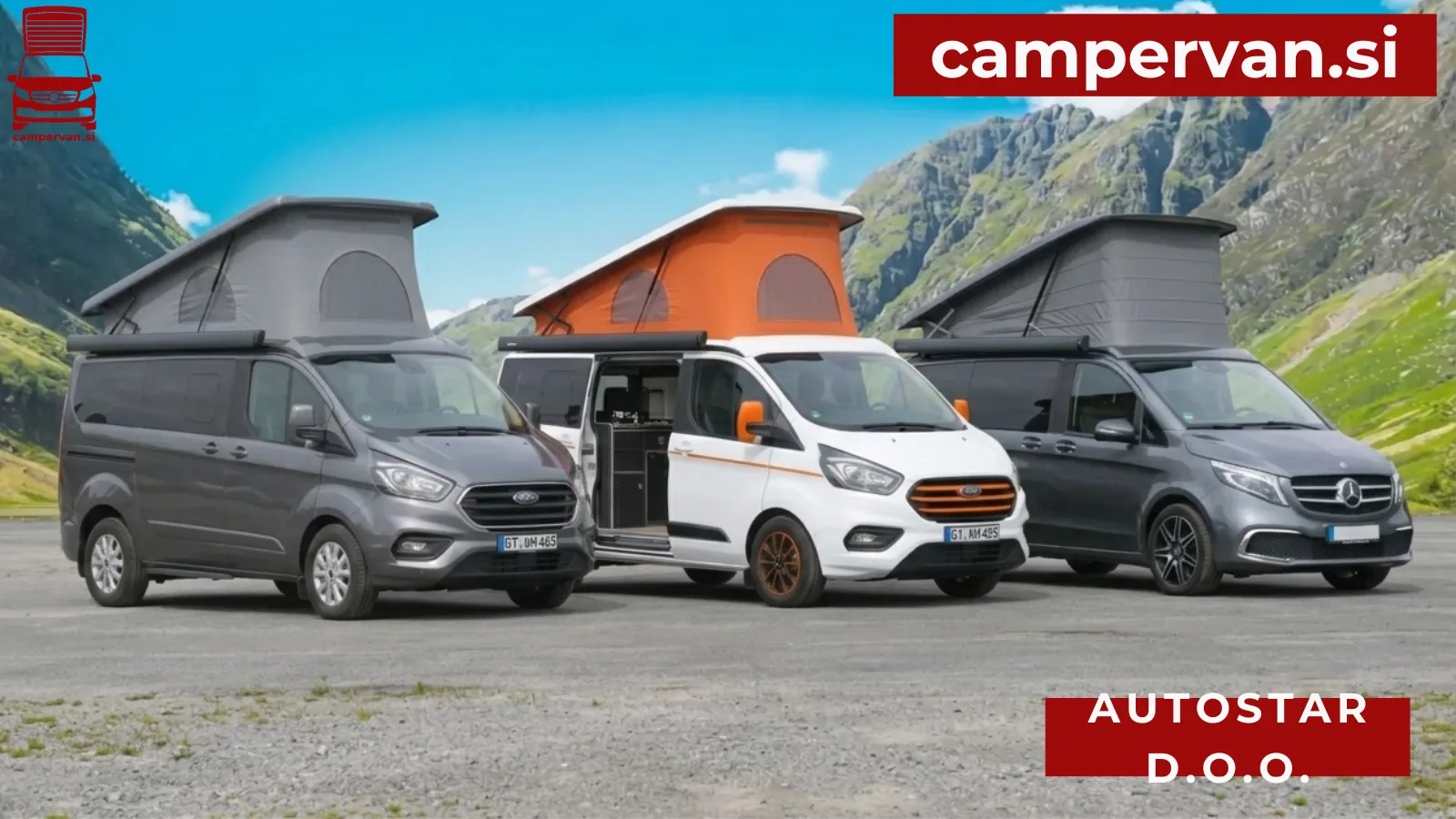
Weekly rental costs from €110 per night, and shorter rentals from €125 per night. Take a look at
Ford Nugget Plus rental or
Mercedes V Marco Polo rental, then choose your dates in our
booking form. We are also happy to advise you on the route through the Balkans and on choosing your stops.
Frequently asked questions
How many days do I need for Greece by campervan?
For a worthwhile loop from Ljubljana we recommend at least 14 days, as getting there and back takes two to three days. In ten days you can focus on northern and central Greece. For the Peloponnese and the islands, allow three weeks.
Can I stay overnight on a beach in Greece?
No. Camping on beaches, in forests, on public land and near archaeological sites is not allowed. Stay overnight at an official campsite or in an area designated for motorhomes.
What do I need to drive through Serbia?
You need a valid ID, a driving licence and a Green Card. If the vehicle is not in your name, you also need the owner’s authorisation. If you rent a vehicle from us, we arrange these documents together before pickup.
Is the ferry more expensive than driving overland?
The ferry is usually more expensive than the fuel and tolls on the overland route, but it saves you a day or two of driving and one overnight stay. The price depends on the season, the length of the vehicle and the type of on-board accommodation. Check the price for your dates with the operator.
Sources
CCampervan
Ask us about a trip to Greece
Get in touch about renting a campervan for your trip to Greece and find out which vehicles are available for your plans.