20% off rentals until the end of March 2027 with code SNOW20•20% off rentals until the end of March 2027 with code SNOW20•20% off rentals until the end of March 2027 with code SNOW20•20% off rentals until the end of March 2027 with code SNOW20•
20% off rentals until the end of March 2027 with code SNOW20•20% off rentals until the end of March 2027 with code SNOW20•20% off rentals until the end of March 2027 with code SNOW20•20% off rentals until the end of March 2027 with code SNOW20•
Driving on Mountain Roads in Slovenia: Tips for Campervans
October 22, 2026
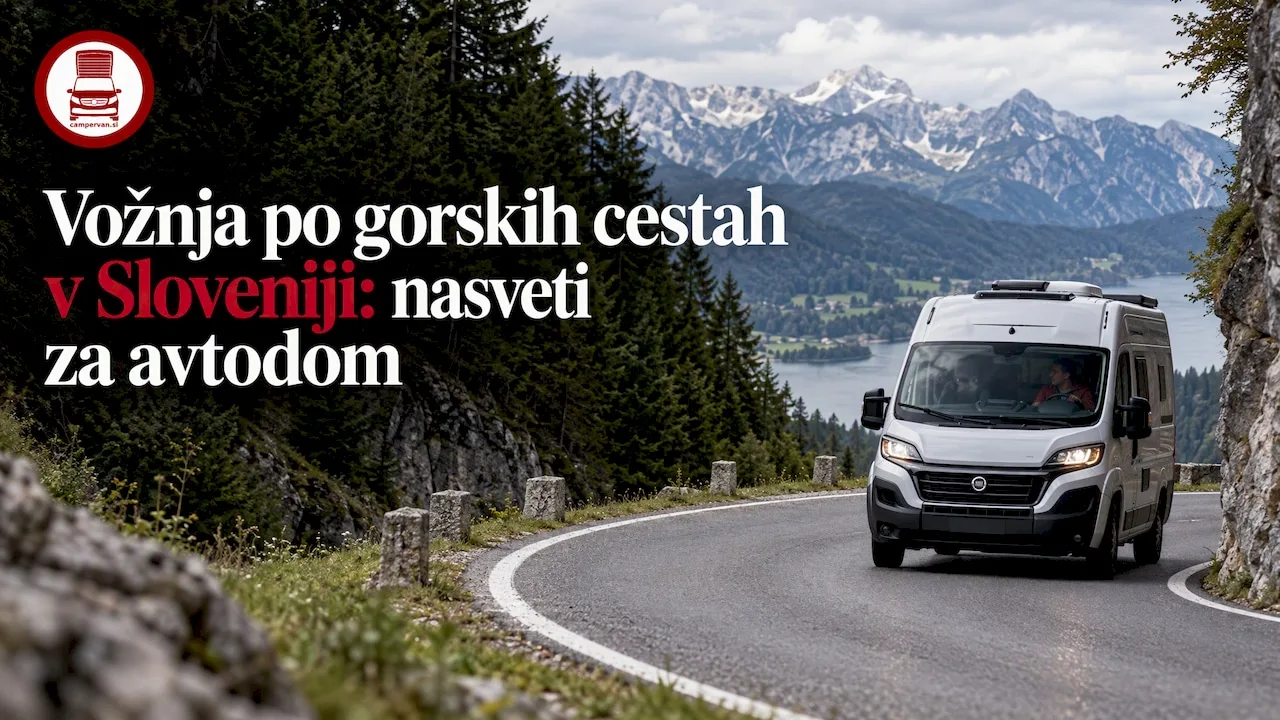
Driving along Slovenia’s mountain roads is one of the most beautiful parts of a campervan trip: spectacular hairpin bends, views of the Julian Alps and the Karawanks, stops at mountain huts, and valleys that open up around every corner. However, with a vehicle that is taller, longer and heavier than a passenger car, these roads require more preparation. Below, we explain what to check before setting off, how to drive uphill and downhill, what applies on the Vršič Pass this year, and when it is better to skip a mountain road altogether. We’re based in Ljubljana, where our guests set off for the Alps every week.
Campervan
campervan.si
Make mountain roads easier
A compact campervan is easier to drive on narrow Alpine roads. Here in Ljubljana, you can choose between two models.
Check road conditions and the weather before setting off: mountain passes are often closed, and conditions can change overnight. Check promet.si for traffic updates and ARSO for the weather forecast.
Use engine braking on descents, not your brakes: select a low gear at the top and use the brakes only for brief speed adjustments.
Vršič is different this year: a new traffic regime applies at the summit, parking is unavailable, and roadworks are disrupting traffic, with works scheduled until 16 November 2026.
From 15 November to 15 March is the winter road maintenance period, and vehicles must have appropriate winter equipment.
A compact campervan is much easier to drive on narrow Alpine roads than a large integrated motorhome.
On the same road that you might drive without a second thought in a passenger car, almost everything changes when you are behind the wheel of a motorhome. According to experts quoted by 24ur, conventional motorhomes are generally between six and eight metres long, around 2.3 metres wide and approximately three metres tall. The same report warns that the greater weight means drivers must brake earlier, while blind spots are larger than those of a passenger car.
On mountain roads, this means:
Hairpin bends require a wider turning arc. A longer vehicle needs more room on a narrow bend, and its rear end cuts further inside than you might expect.
Weight matters on steep gradients. Uphill progress is slower, while descents put considerably more strain on the brakes than driving a car would.
Height matters. Branches, rock overhangs, covered structures and low tunnels are more common on rural mountain roads than on motorways.
Crosswinds on exposed mountain passes can noticeably push a tall vehicle sideways, especially on ridges and bridges.
That is why, when you collect your vehicle, we always recommend taking the first few kilometres to get familiar with it: how it behaves when braking, where the blind spots are and how much space it needs around bends. The compact design of campervans such as the Mercedes V Marco Polo and Ford Transit Nugget Plus is a major advantage, as they feel more like driving a passenger van than a truck.
Before setting off: roads, weather and your vehicle
Much of safe mountain driving comes down to planning before you leave. Mountain passes in Slovenia are often closed because of roadworks, events or weather conditions. For example, the promet.si portal announced a full closure of the Vršič Pass from 4:00 a.m. on 24 August 2026 until 6:00 a.m. on 25 August 2026 for resurfacing, with alternative dates depending on the weather. For a motorhome, such a closure can mean a lengthy detour, so check conditions on the morning of your drive rather than relying on information from the previous week.
Pre-climb checklist
Road conditions: check promet.si for closures, roadworks and restrictions on your chosen pass and any alternative routes.
Navigation: enter your vehicle’s height, width and length into your navigation app. Without this information, the “shortest” route might take you along a road unsuitable for a motorhome.
Fuel: fill up in the valley. There are few petrol stations on mountain roads, and fuel consumption increases on climbs.
Luggage: store heavy items low down and secure all cupboards, drawers and the fridge. Anything unsecured can move around on hairpin bends.
Departure time: set off early for popular mountain passes. There is less traffic, fewer cyclists and motorcyclists, and in summer you can avoid afternoon thunderstorms.
If you are still putting your route together, take a look at our guide to planning a motorhome trip around Slovenia, which covers daily driving sections, stops and tips for choosing overnight locations.
Mountain weather is not just information; it determines your plans
Our rule is simple: if the forecast predicts thunderstorms in the afternoon, cross the pass in the morning or leave it until the next day. Wet roads, fog and hail on narrow hairpin bends are not challenges you need on holiday when driving a tall vehicle. The same principle applies elsewhere in Europe. Anyone exploring, for example, the scenic roads around Brașov in Romania in a motorhome should also plan their mountain day around the weather rather than a fixed schedule.
How to drive uphill, downhill and around hairpin bends
Uphill
Select your gear before the gradient gets steepest. If the engine starts losing power halfway through a bend, changing gears on a steep slope becomes more difficult and less safe.
Maintain a steady pace. Do not force overtakes. Let traffic behind you pass at the first safe passing place. This is part of mountain-road courtesy and reduces pressure on the driver.
Monitor the engine temperature, especially on hot summer days and during long climbs.
Downhill
This is the part many drivers underestimate. When driving a motorhome downhill, never rely on the brakes continuously.
Select a low gear at the top, generally the same gear you would need to climb the same gradient. With an automatic transmission, use manual mode or a downhill driving programme.
Brake firmly and briefly, then release the brake. Continuous light braking overheats the brakes and reduces their effectiveness.
If you smell overheated brakes, stop in a safe place and wait for them to cool down.
Adjust your speed before the bend, not while you are already in it.
Hairpin bends and passing oncoming traffic
On a narrow bend, take a slightly wider line so the rear of your vehicle does not hit the kerb or a rock on the inside.
Slow down before blind bends and keep to the right. A bus, cyclist or tractor may be coming the other way.
Where the road is too narrow for two vehicles to pass, the driver closest to a passing place will generally pull in. If you need to reverse, ask your passenger to guide you from outside the vehicle.
Do not stop for photos in the middle of the road or on a bend. Wait for a designated stopping area or viewpoint.
Vršič Pass in 2026: what applies right now
At 1,611 metres, Vršič is Slovenia’s highest road pass, connecting the Gorenjska region with Primorska. The route between Kranjska Gora and Trenta is around 24 km long and takes approximately 40 minutes in normal traffic, but allow more time when driving a motorhome. Several things have changed at the pass this year.
Topic
Current situation
Source
Altitude and gradient
1,611 m, gradients of up to 15%; considered a challenging road and not recommended for vehicles towing trailers
When access restrictions apply, vehicles may enter only while parking spaces remain available; a free public bus runs across the pass during the 2026 season
What does this mean for you? A campervan weighing up to 3.5 tonnes is generally allowed on Vršič, but do not count on stopping at the summit this year. Treat the pass as part of the drive from Kranjska Gora into the Soča Valley, or vice versa. For viewpoints and walks, choose one of the passing areas along the route or a car park in the valley. Roadworks have frequently affected Vršič in recent years. In addition to the August 2026 closure, there were daytime weekday closures in autumn 2025, so check promet.si on the morning of your departure.
Other mountain roads along your route
Vršič is not the only mountain road you may encounter while driving around Slovenia. A circular route through the north of the country often includes:
Predel Pass, which connects the Soča Valley near Bovec with Italy and can be combined with Vršič or a drive towards Tarvisio.
Wurzen Pass (Korensko sedlo), near Kranjska Gora, crossing into Austria’s Carinthia region.
Loibl Pass (Ljubelj), the road from Tržič towards Austria, climbing through the forest.
Jezersko and Pavlič Pass, in the far north, offering quieter routes along the Kamnik–Savinja Alps.
Roads to high mountain plateaus and villages, which are often narrower than the passes themselves and may have no passing places.
The same advice applies to all of them: check vehicle restrictions, possible closures, the road’s difficulty rating and whether there is enough space to park a motorhome at your destination. If the road leads to a popular excursion spot, it is often wiser to leave your vehicle in the valley and continue on foot or by bus. We cover places to stay between mountain passes in our overview of motorhome stopovers in Slovenia.
Campervan
Start your Alpine journey with us
Choose a campervan in Ljubljana for your trip around Slovenia, then plan your drive towards the Alpine roads.
Winter road maintenance on Slovenia’s main and regional roads runs from 15 November to 15 March, and vehicles must be equipped with appropriate winter equipment during this period. The country has up to 951 workers and 419 snowploughs available to maintain 6,133 km of roads. That sounds like a lot, but on mountain roads snowfall can sometimes outpace snow clearing.
At the start of the winter season, the Slovenian Infrastructure Directorate warns that roads cannot always be guaranteed to remain passable. Road users themselves play a key role by ensuring their vehicles are properly equipped. A vehicle without suitable equipment that gets stuck on a slope can bring all traffic to a standstill, and help may not arrive quickly because road crews are already working elsewhere.
In winter, we therefore recommend:
drive over mountain passes only when the forecast is clear, and travel during daylight;
check before setting off whether the pass is open and what restrictions apply;
have an alternative route through the valley, even if it is longer;
carry warm clothing, a blanket, water and some food in case you need to wait.
Where you cannot drive a motorhome: forest tracks and natural environments
Forest and gravel roads branching off paved mountain roads can be tempting. However, remember that driving motor vehicles in natural environments is prohibited, particularly in protected areas such as nature reserves and landscape parks. The fine ranges from €40 to €1,000, and in more serious cases the police may also seize the vehicle.
There is also a practical consideration: gravel, a narrow forest road with no turning area, or a steep section can pose a serious risk for a motorhome. Turning around on such a road may be impossible, while recovery can be expensive and slow. If a road is not marked as public and suitable for your vehicle, do not drive onto it.
Our perspective: the mountains are a destination, not a test
When we hand over the keys to our guests in Ljubljana, they often ask whether they should attempt the Vršič Pass. Our answer is almost always yes, with a few conditions. Mountain roads are one of the reasons many people choose a campervan instead of a hotel: wake up in Kranjska Gora, have lunch beside the Soča, and spend the evening by the sea. But driving in the mountains is not a race. The best days our guests tell us about when they return are the ones when they took their time, crossed the pass early and stopped where there was space and peace.
From experience, we know that the road itself rarely causes problems. More often, the causes are rushing, using navigation without entering the vehicle’s dimensions, or failing to check the weather. Before departure, we therefore quickly review each guest’s planned route, suggest which sections are best driven in the morning, and point out good places to stop. This is precisely why we built our fleet around compact campervans: on hairpin bends, in villages with narrow streets and in smaller car parks, they are a much more relaxed choice than a large motorhome. If something does go wrong on the road, 24/7 assistance is available, but our goal is for you not to need it.
— Rok
A campervan for Alpine roads, starting in Ljubljana
If you are planning a trip across Slovenia’s mountain passes, through the Alps or further towards the Balkans, our Mercedes V Marco Polo and Ford Transit Nugget Plus are ready for the journey. Both have a kitchen and sleeping space for several people, while the Nugget Plus also has a fixed toilet. Basic insurance and 24/7 assistance are included in the rental, and we will be happy to advise you on routes and destinations when you collect your vehicle.
Yes. The restrictions apply to goods vehicles with a maximum authorised mass above 7,500 kg and buses longer than 12.5 m, not to ordinary campervans. The road is steep and challenging, and is not recommended for vehicles towing trailers. Parking at the summit is unavailable this year, so plan to cross the pass rather than stop there.
How can I prevent the brakes from overheating on a descent?
Select a low gear at the top and let the engine slow the vehicle down. Use the brakes firmly and briefly rather than continuously. If you smell overheated brakes, stop somewhere safe and wait for them to cool.
Where can I check whether a mountain road is open?
Closures, roadworks and restrictions, including those affecting mountain passes, are published on promet.si. Check conditions on the day you travel, as they can change overnight. For the weather, use the ARSO forecast.
Do I need winter equipment if I travel to the mountains in autumn?
The winter road maintenance period and mandatory winter equipment requirements run from 15 November to 15 March. Snow can fall at high altitudes earlier than that, so pay particular attention to the forecast in late autumn. If snow is predicted, choose a route through the valley.

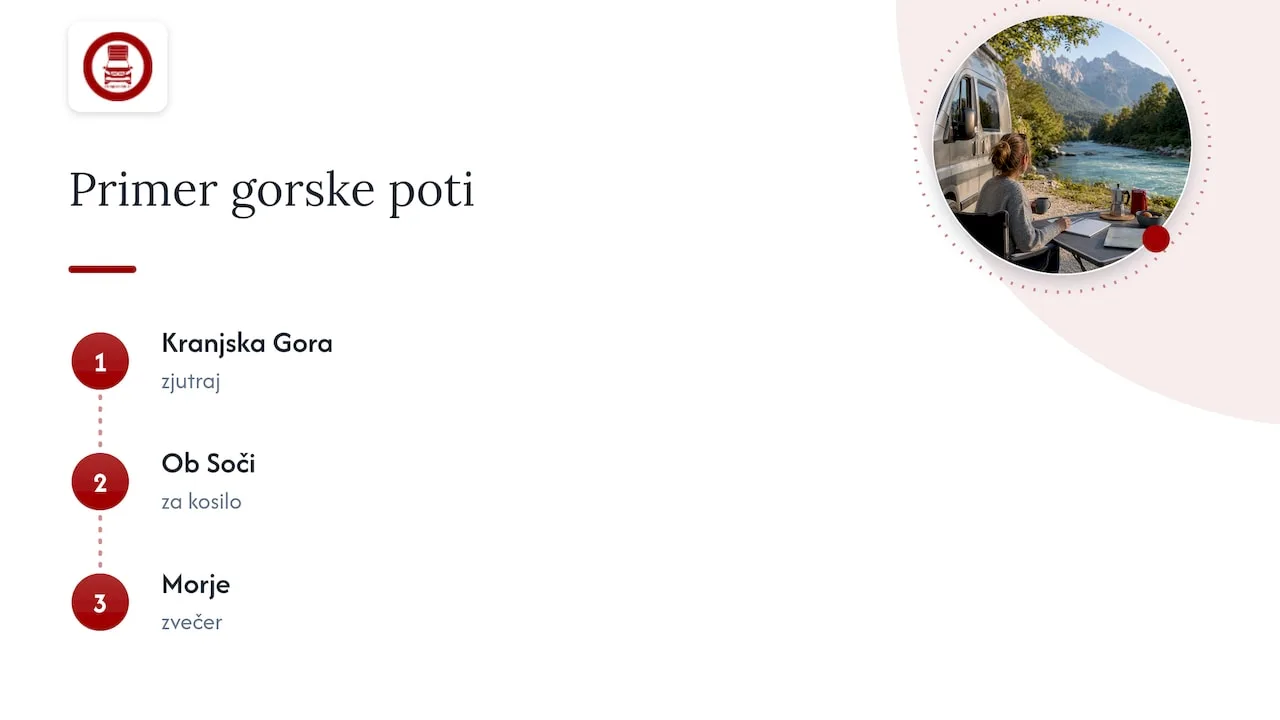 When we hand over the keys to our guests in Ljubljana, they often ask whether they should attempt the Vršič Pass. Our answer is almost always yes, with a few conditions. Mountain roads are one of the reasons many people choose a campervan instead of a hotel: wake up in Kranjska Gora, have lunch beside the Soča, and spend the evening by the sea. But driving in the mountains is not a race. The best days our guests tell us about when they return are the ones when they took their time, crossed the pass early and stopped where there was space and peace.
From experience, we know that the road itself rarely causes problems. More often, the causes are rushing, using navigation without entering the vehicle’s dimensions, or failing to check the weather. Before departure, we therefore quickly review each guest’s planned route, suggest which sections are best driven in the morning, and point out good places to stop. This is precisely why we built our fleet around compact campervans: on hairpin bends, in villages with narrow streets and in smaller car parks, they are a much more relaxed choice than a large motorhome. If something does go wrong on the road, 24/7 assistance is available, but our goal is for you not to need it.