Check the maximum permissible mass (MPM) stated in the vehicle registration document and calculate the available payload. This immediately tells you whether the campervan has enough capacity for safe travel. If the vehicle’s mass in running order is already close to the maximum permissible mass, there is little room left for equipment, water and passengers. The quickest solution is a simple calculation on paper, but ideally you should weigh the fully loaded vehicle on a public weighbridge before departure.
In brief:
- If the vehicle’s mass in running order is already close to the maximum permissible mass, there is very little capacity left for additional cargo, making an accurate calculation or weighing essential before departure.
- The difference between the maximum permissible mass and the mass in running order determines the available payload, which must be carefully planned around passengers, equipment and water.
- When packing, remember to account for the weight of additional equipment, water and passengers, as the total can exceed the limits even when everything appears to match the manufacturer’s specifications.
- Special attention should be paid to additional equipment, gas and water, as these can be among the biggest users of your available payload.
- Driving a motorhome over 3,500 kg requires the appropriate driving licence category, which should always be checked before renting or purchasing the vehicle.
Choose a campervan for your trip
Check available campervans in Ljubljana and choose a model that suits your travel plans.
Check availability
Table of Contents
What maximum permissible mass, mass in running order and payload mean
Campervan weight and loading revolve around three key figures that you can find in the vehicle registration document or technical specifications. The maximum permissible mass (MPM) is the upper weight limit that the vehicle must never exceed, regardless of what you are carrying or how heavily it is loaded. The mass in running order is the weight of the vehicle ready to drive, without passengers and luggage but with the specified operating fluids included.
AMZS explains that, under the European standard, mass in running order includes a driver with a standard mass of 75 kg as well as partially filled operating fluids such as fuel, oil and coolant. This means that the manufacturer’s “empty” weight is not actually completely empty, but already includes a significant part of the vehicle’s operating load.
The difference between the maximum permissible mass and the mass in running order is the available payload – everything you add yourself:
- passengers, except the driver who is already included,
- luggage, equipment and food,
- full water and gas tanks,
- additional equipment such as awnings, bicycles or solar panels.
For some models, manufacturers also specify a minimum payload requirement because sufficient capacity must remain for normal use of the vehicle. In addition to the total weight, axle-load limits also apply. The axle load determines how much weight can be carried by the front and rear axles, and for some campervans this can be a stricter limitation than the overall maximum permissible mass.
How to calculate campervan payload step by step
The formula is simple:
payload = maximum permissible mass minus mass in running order. Both figures can be found in the vehicle registration document (mass in running order under item G and maximum permissible mass under item F.1) or in the manufacturer’s technical specifications.
For a practical calculation:
- Find the maximum permissible mass in the vehicle registration document.
- Find the mass in running order for your exact vehicle configuration, rather than relying on a generic brochure figure.
- Subtract the second figure from the first to calculate the available payload.
- Subtract any additional permanently installed equipment that was not included in the homologated weight.
- Allocate the remaining payload between passengers, water, gas and luggage.
Večer gives a practical example: a motorhome with a mass in running order close to 3 tonnes can have a relatively limited amount of available payload. For a family of four travelling with luggage, bicycles and a full water tank, that capacity can disappear surprisingly quickly.
Professional tip: Manufacturing variations in series production can shift the actual vehicle weight upwards by several dozen kilograms compared with the catalogue figure. For this reason, motorhome equipment specialists recommend weighing the vehicle on a weighbridge before taking delivery rather than relying exclusively on the published figure.
How much does the equipment you take with you weigh?
Some items consume your available payload much faster than you might expect. A spare wheel, electric bicycle, full gas cylinder and folded awning can all add significant weight that needs to be considered when packing.

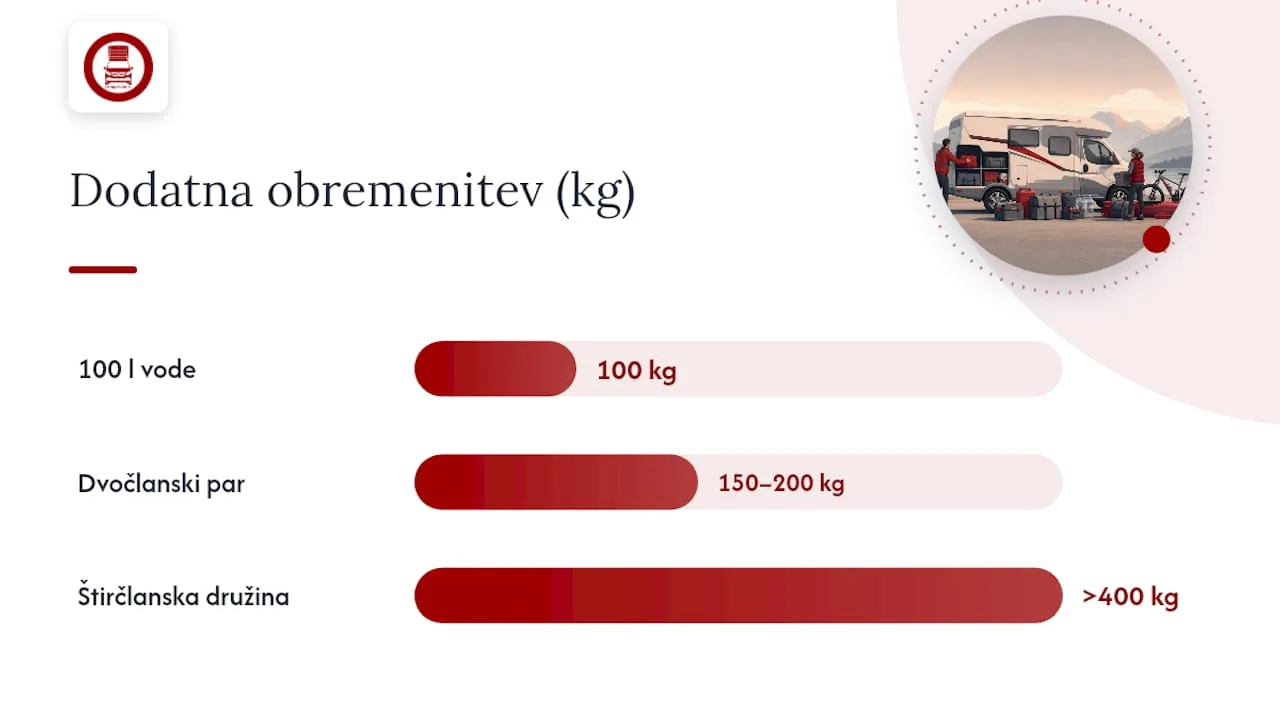
Water is the biggest hidden consumer of payload: a tank containing 100 litres weighs 100 kg because one litre of water weighs exactly one kilogram. For a couple travelling with a half-full water tank, a bicycle and basic luggage, an additional 150 to 200 kg can accumulate quickly. For a family of four travelling with a full tank, two e-bikes and a week’s worth of luggage, the additional load can exceed 400 kg before the passengers themselves are even included.
To reduce weight, check how much water you actually need for your journey. Our
seasonal guide to managing water in a campervan can help you estimate your real requirements without carrying unnecessary weight. Also review what you genuinely need to pack and use our
practical campervan packing list to make it easier to decide what can stay at home.
Which driving licence do you need based on vehicle weight?
Category B covers vehicles with a maximum permissible mass of up to 3,500 kg, which includes most compact campervans and vans. Once a motorhome exceeds this limit, you need a different licence category or additional training.
- Category B: maximum permissible mass up to 3,500 kg, with no additional requirements for a standard driver.
- Code 96: additional training for vehicle combinations between 3,500 and 4,250 kg that can be completed by drivers holding category B.
- Category C1: required for vehicles over 3,500 kg when Code 96 is not sufficient or does not apply.
EU legislation adopted in 2025 provides mechanisms that are intended to make it easier for category B licence holders to drive heavier motorhomes up to 4,250 kg, but the final implementation of the required training will be determined by each member state. Before renting or purchasing a vehicle over 3,500 kg, always check the exact maximum permissible mass in the registration document, as the same body style can be homologated at different weights depending on the configuration.
Overloading fines and roadside checks
Slovenian police can weigh a motorhome on the road using portable scales or direct you to the nearest road or commercial weighbridge. If the vehicle is overloaded, you may be required to unload cargo immediately. In more serious cases, further driving can be prohibited until the vehicle’s weight has been reduced below the permitted limit.
A comparison across Europe shows that fines for overloaded motorhomes vary considerably between countries. Checks are particularly common during summer on major transit routes towards the coast and mountain regions. Enforcement is not merely a formality: an overloaded vehicle has a longer stopping distance and reduced stability when cornering, increasing the risk of an accident as well as the risk of a fine.
How to prepare for weighing before departure
Preparing before departure takes less time than you might expect and can prevent problems during your journey.
- Find a public weighbridge in your area, such as one operated by a towing company, construction company or municipal service.
- Weigh the fully loaded vehicle with water, gas and all passengers on board.
- If possible, weigh each axle separately and compare the results with the axle-load limits in the vehicle’s homologation documents.
- Check tyre pressure according to the actual loaded weight, as underinflated tyres can overheat more quickly and handle poorly when the vehicle is fully loaded.
- Keep a simple record of the vehicle’s weight after each rental so you know how much payload reserve you have for your next trip.
Professional tip: When planning your route, also check for potential restrictions on bridges or narrow mountain roads. Our Slovenia route-planning guide can help you choose routes suitable for your vehicle’s weight and dimensions.
Rental provider perspective: what Campervan shows at pickup
At vehicle pickup in Ljubljana, we always show renters where to find the maximum permissible mass and mass in running order in the vehicle documents – not just where the steering wheel and light switches are. The pickup process takes between 20 and 45 minutes, giving us enough time to discuss how much water, equipment and bicycle gear makes sense to take depending on your planned route.
Slovenian weight regulations are strict but straightforward once you understand the three key figures: maximum permissible mass, mass in running order and payload. The conventional advice to “just don’t overload it” is too general. It is more useful to understand that half a tank of water and two e-bikes can consume a substantial part of your available payload before you have even packed a suitcase. Proper preparation starts with a calculation, not with weighing the vehicle only when you reach the border.
— Rok
Book a campervan that matches your weight and trip
When you rent from Campervan.si in Ljubljana, you do not have to leave the payload calculation to guesswork. Instead of estimating how much payload capacity remains, we explain the relevant figures for each vehicle in our fleet during pickup.
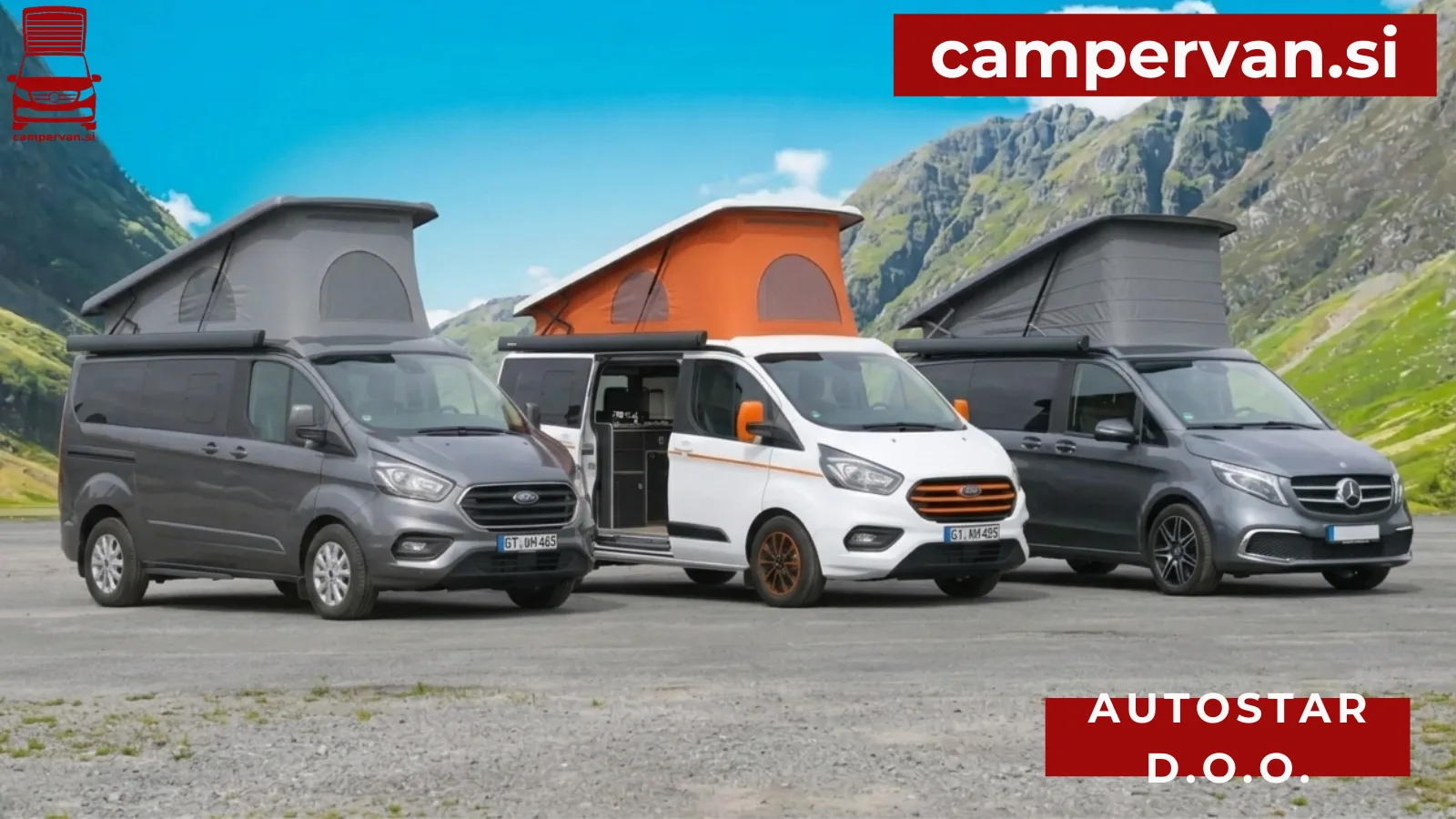
The
Mercedes V Marco Polo and
Ford Nugget Plus are available from €110 per night for weekly rentals, or from €125 per night for daily rentals. Final cleaning costs €80. As a family-run campervan rental company based in Ljubljana, we are familiar with Slovenian roads and the border crossings towards the Balkans and the Alps, and during pickup we also show you how to read the manufacturer’s weight specifications for the specific vehicle you have chosen. Check available dates and book a campervan that suits your family and planned route.
Sources
For more detailed information, see the EU legislation on driving licences, the AMZS explanation of vehicle weight and this
overview of motorhome regulations from Avto-magazin. The Večer article and the overview of overloading fines from AVTOKAMPI.si also provide useful practical examples.
Frequently Asked Questions
What is the maximum permissible mass of a motorhome?
The maximum permissible mass is the upper weight limit that the vehicle must never exceed. It can be found in the vehicle registration document under item F.1. Comparing it with the mass in running order shows how much payload capacity remains available in practice.
How much payload does an average motorhome have?
This varies considerably depending on the model and configuration, but practical examples show how quickly the available space for luggage can disappear in a vehicle with a mass in running order close to 3 tonnes. Always check the exact figure for your particular motorhome, as it can differ significantly between configurations.
Which driving licence do I need for a motorhome over 3,500 kg?
For vehicles between 3,500 and 4,250 kg, Code 96 may apply alongside a category B licence, while heavier vehicles require category C1. EU legislation provides for easier access to these higher weight limits, but the final implementation is determined by each member state.
Where can I weigh a motorhome in Slovenia before departure?
Public weighbridges are available at some municipal services, construction companies and towing companies across Slovenia. For a practical assessment of the vehicle’s available space and capacity, you should also review the equipment and luggage you intend to carry. At Campervan.si, we help you understand where to find your vehicle’s weight information during pickup and advise you on how to estimate the load without having to weigh the vehicle yourself.
How much does campervan rental at Campervan.si cost?
The Mercedes V Marco Polo and Ford Nugget Plus are available from €110 per night for weekly rentals or from €125 per night for daily rentals. Current availability can be checked on the booking page. Final cleaning costs €80.
CCampervan
Ask us about campervan weight
Contact us about campervan or motorhome rental in Ljubljana and planning your trip around Slovenia.