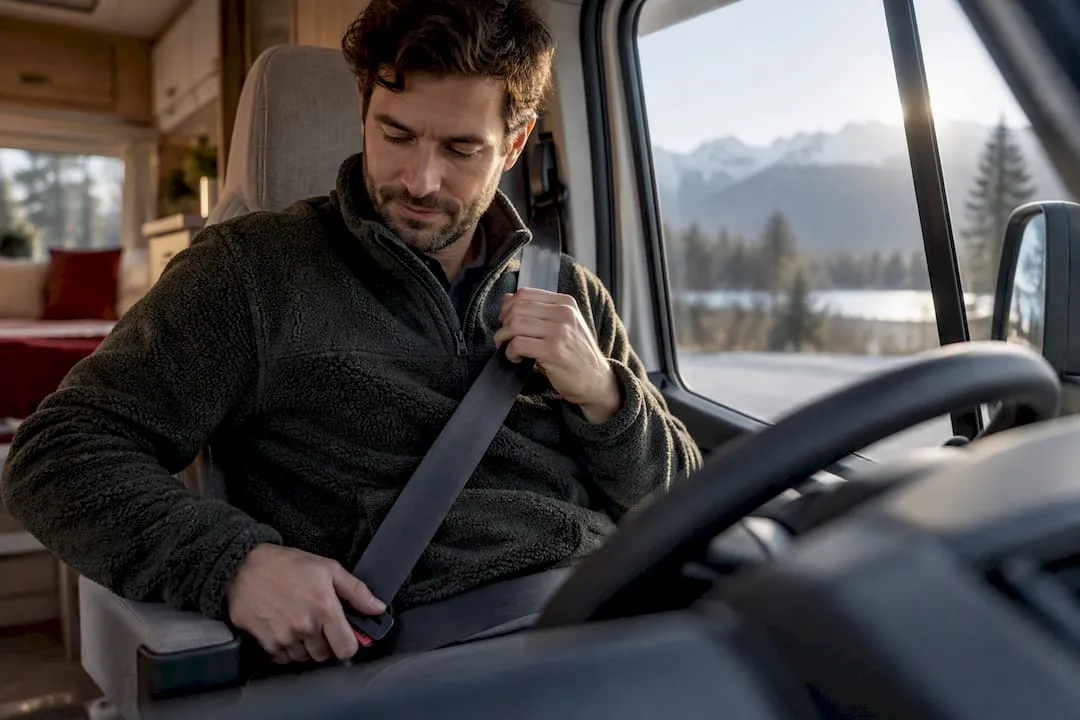
For safe motorhome travel, follow three basic rules: all passengers must sit in designated seats and wear seat belts, the vehicle must be in good technical condition, and you must drive with an awareness of its greater dimensions and longer braking distance. These are not recommendations you can simply skip when you are in a hurry. Before every departure, check the vehicle’s technical condition, load distribution and weather conditions, and adjust your speed to the motorhome’s weight and length while driving.
In brief:
- When planning a motorhome journey, check tyre pressure, the condition of the spare tyre and the load’s centre of gravity to reduce risks on the road.
- Start braking earlier and combine the service brake with engine braking because of the longer stopping distance, especially in difficult conditions.
- When stopping, choose a safe location, lock all equipment and secure loose items, as break-ins can happen even at monitored locations.
- Before departure, carry out a systematic technical inspection, including tyres, fluids, lights and the distribution of the vehicle’s load.
Campervan
Travel more safely with the right campervan
Explore our campervans for travelling around Slovenia and find out which model best matches your plans and travel style.
Check availability
Table of Contents
Pre-drive checklist: technical checks and proper loading
Before turning the key, take ten minutes for a systematic inspection. A motorhome is considerably heavier and taller than a passenger car, so a small loading mistake or overlooked tyre issue can quickly become a serious risk on the road.
- Exterior inspection – make sure the awning is retracted, steps are closed, the antenna is lowered and nothing protrudes beyond the roofline.
- Tyres – check the pressure according to the manufacturer’s recommendations for a fully loaded vehicle, inspect tread depth and check the condition of the spare tyre. AVP advises replacing motorhome tyres well before the legal minimum because the load is significantly greater than in a passenger car.
- Brakes, fluids, battery and lights – check the oil and coolant levels and carry spare bulbs where applicable.
- Weigh the vehicle – if you are close to the permitted maximum weight, visit a weighbridge. Place heavier items low down and as close to the axle as practical so that the centre of gravity remains stable.
- Interior – lock cupboards and secure glasses and loose items in drawers, as they can become dangerous projectiles during braking.
Professional tip: Take a photo of the loaded storage area before every longer journey. In the event of a breakdown or damage, it will provide a clear record of what was secured and how, which can make communication with roadside assistance easier.
Driving tips on the road: crosswinds, braking, overtaking and blind spots
A motorhome behaves differently from a passenger car, and this is not simply a matter of sitting higher.
AMZS points out that motorhomes require a significantly different driving approach and recommends safe-driving courses and training-ground exercises where drivers can learn how the vehicle reacts when it loses stability.
Practical experience on training grounds shows that the braking distance of a fully loaded motorhome is noticeably longer than that of a passenger car. This means you need to start braking considerably earlier and combine engine braking with firm, controlled applications of the brake pedal, particularly on long downhill sections in mountainous areas.
Here are some practical driving rules worth making second nature:
- Keep at least a three-second gap from the vehicle ahead; on motorways at higher speeds, four seconds is preferable.
- When overtaking trucks or buses, expect a sudden air movement that can push the motorhome slightly off course.
- In strong crosswinds, reduce your speed and keep a firm grip on the steering wheel with both hands.
- Before changing lanes, physically check the blind spot rather than relying only on the mirrors, as the rear area of a motorhome can be difficult to see clearly.
- On long journeys, take a break at least every two hours.
The last point is not simply about comfort. Through preventive campaigns at motorway rest areas, AVP has repeatedly highlighted that regular breaks, hydration and short periods of rest can reduce the risk of fatigue, which can become particularly relevant during long motorhome journeys.
What to do in case of a breakdown or accident and how to handle bad weather
When something unexpected happens, acting quickly and methodically are equally important.
- Secure the scene – switch on the hazard lights, place the warning triangle far enough behind the vehicle and put on a reflective safety vest.
- Protect the passengers – move everyone to a safe location away from the roadway and provide basic first aid if necessary.
- Call for assistance – in an accident, call 112; in the event of a breakdown, contact your roadside assistance provider. Have the vehicle details, such as make and registration number, your exact location and a brief description of the problem ready.
- Stay calm during aquaplaning or a severe storm – avoid sudden braking, ease off the accelerator and allow the vehicle to stabilize before making gentle steering corrections.
Save the key contact numbers in advance: AMZS roadside assistance, your insurance company’s assistance number and the local police. AVP warns that motorhome breakdowns can be more complicated to resolve than passenger-car breakdowns, so it is worth checking whether your assistance package covers the recovery or transport of larger vehicles.
Motorhome security during stops: choosing a stopover and preventive measures
Where you spend the night has an important impact on the safety of both the vehicle and its occupants.
The Slovenian Police emphasize that designated motorhome stopovers and organized campsites are generally a safer choice than random motorway rest areas or isolated car parks, as they are often illuminated, monitored and frequented by other travellers.
- Choose a stopover with lighting and at least a few other motorhomes nearby.
- Before going to sleep, remove visible items from the dashboard and lock all doors and windows.
- Secure bicycles and additional equipment mounted on carriers with a chain or lock, as they can be more attractive targets for theft than the motorhome itself.
- Activate the alarm or motion sensors if your vehicle is equipped with them.
Professional tip: An alarm or motion sensor is a useful addition, but it does not replace basic security habits. Police experience shows that although break-ins in Slovenia are relatively uncommon, locked doors and removing visible valuables remain among the most effective preventive measures. When stopping abroad, take extra care in areas where local police report more frequent vehicle break-ins and prefer a monitored campsite over unrestricted parking.
Legal requirements and documents for driving a motorhome in Slovenia
The driving licence category you need depends primarily on the vehicle’s maximum permitted mass, not on whether you are driving a rental or privately owned motorhome.
- A Category B licence is sufficient for motorhomes with a maximum permitted mass of up to 3,500 kg, which covers most models suitable for rental.
- For heavier motorhomes above this limit, a C1 or C licence is required, depending on the vehicle’s maximum permitted mass.
- Insurance with international coverage and roadside assistance is recommended, particularly if it also covers the recovery or transport of larger vehicles.
- Required documents include the vehicle registration document, insurance documents, identification documents for all drivers and, where applicable, authorization to drive the vehicle abroad.
- Camping outside designated campsites and stopovers is restricted in many parts of Slovenia, while a short rest stop in a parking area is generally not an issue. Empty the chemical toilet cassette only at designated disposal points in campsites or motorhome stopovers.
Practical experience: checklists and quick guides from Campervan.si
At Campervan.si, based on our rental experience in Ljubljana, we know that most mistakes happen during vehicle pickup, before the driver has even started the journey. That is why every rental includes a short but thorough vehicle inspection.
Key points for your pre-departure checklist
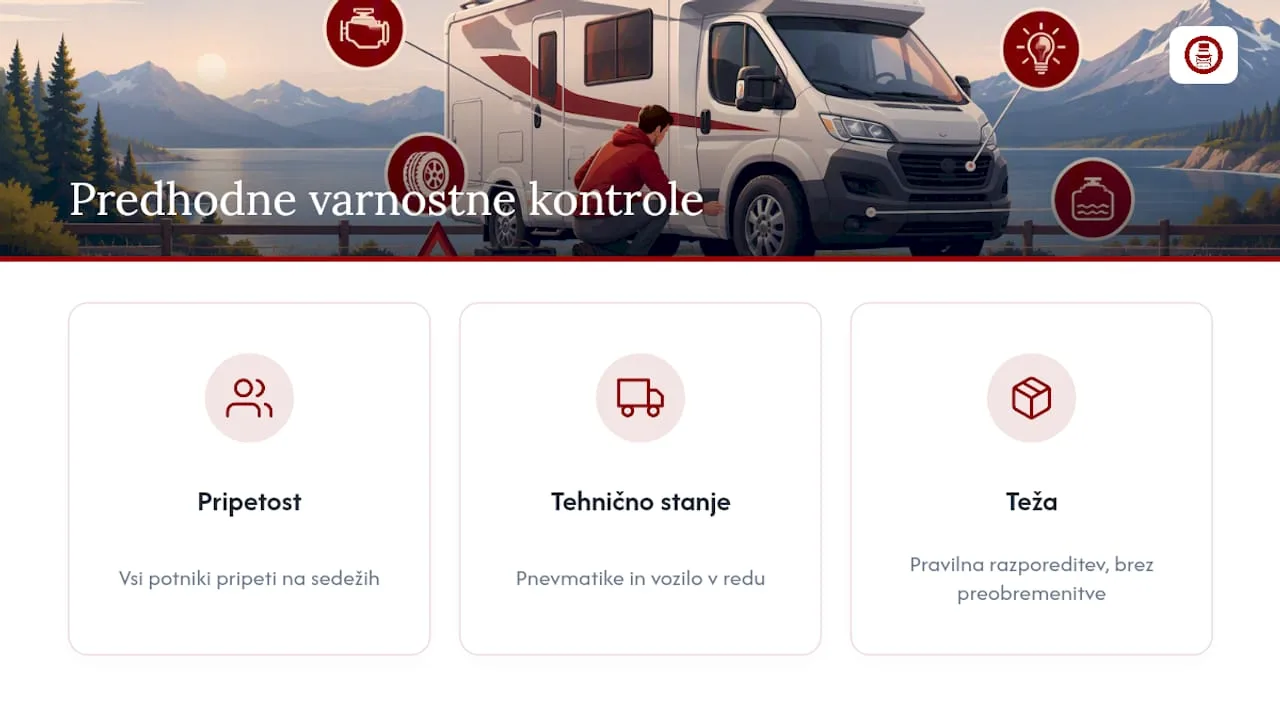
Always check three things: everyone is seated and wearing a seat belt, the tyres and technical condition are in order, and the load is properly distributed without exceeding the vehicle’s permitted weight. For additional confidence, consider taking a safe-driving course with AMZS. If you are unsure about the vehicle pickup or trip preparation, review reliable guides before your next departure.
What motorhome safety issues are most often underestimated
The biggest mistake I see among motorhome drivers is not a lack of knowledge about the rules, but the assumption that experience with a passenger car automatically transfers to a larger vehicle. A braking distance that increases by a third is not an abstract number; it can be the difference between stopping in time and not stopping in time. Conventional advice focuses too heavily on equipment checklists and not enough on driving habits such as braking earlier or physically checking blind spots.
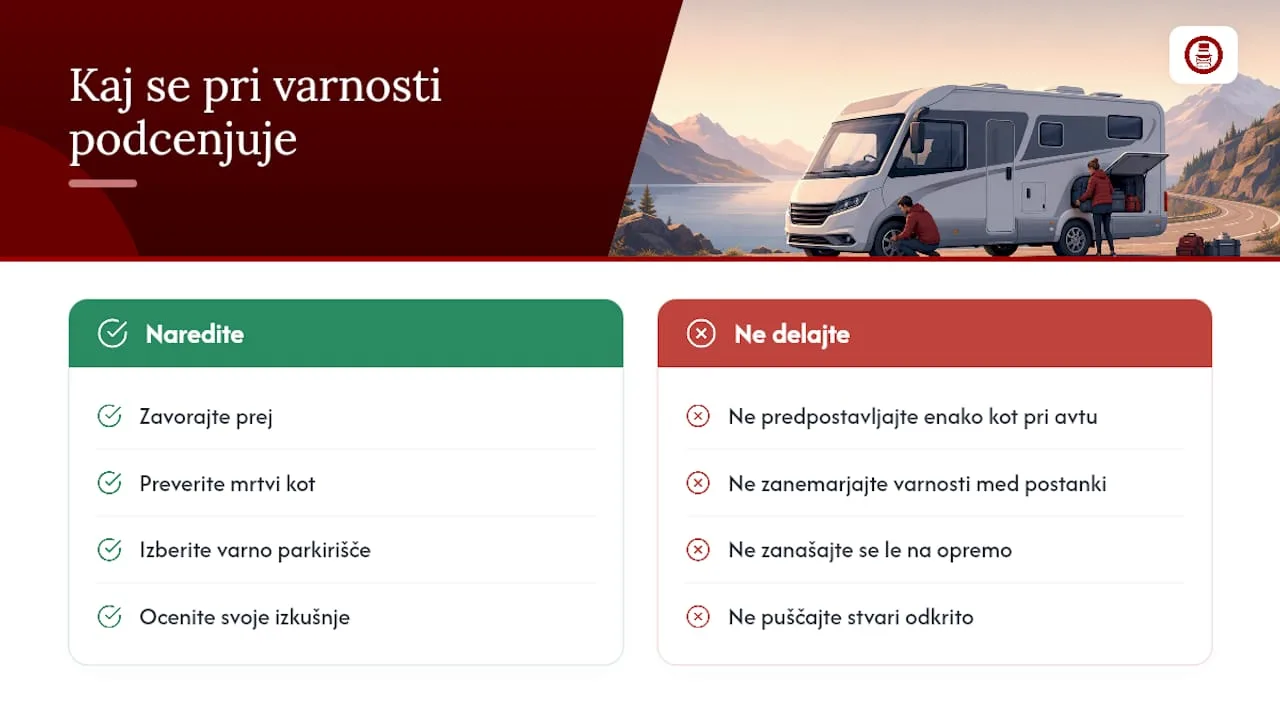
Another thing people underestimate is security during stops. Everyone thinks about alarms and locks, but few people consider that choosing the right overnight location can be more important than technical security equipment. Police data indicate that break-ins are relatively uncommon, but that does not mean precautions are unnecessary. Rather, it shows that basic measures such as locking the doors and removing visible items can be highly effective.
If I had to recommend one priority above everything else, it would be an honest assessment of your own driving experience. A safe-driving course or a short test trip before a long journey is not a sign of uncertainty; it is one of the simplest and most affordable forms of preparation you can choose.
— Rok
Sources
Frequently Asked Questions
What driving licence do I need for a motorhome?
A Category B licence is sufficient for motorhomes with a maximum permitted mass of up to 3,500 kg. Heavier motorhomes require a C1 or C licence, depending on the vehicle’s maximum permitted mass.
How often should I check the tyres on a motorhome?
Check tyre pressure and tread depth before every longer journey because motorhomes are more heavily loaded than passenger cars. AVP recommends replacing tyres before they reach the legal minimum because of the higher load they carry.
Do all passengers have to wear seat belts while driving?
Yes. All passengers must sit in designated seats and wear a seat belt.
Generali points out that moving around the living area while the vehicle is in motion is strictly prohibited.
Where is the safest place to stay overnight in a motorhome in Slovenia?
Designated motorhome stopovers and organized campsites are generally safer choices than random parking areas. The Slovenian Police advise avoiding isolated locations and using well-lit, populated places.
What should I do if my motorhome breaks down on the road?
Secure the scene with a warning triangle and safety vest, then contact roadside assistance with your vehicle details, location and a description of the problem. In a serious accident, call 112 first and make sure all passengers are safe.
CCampervan
Ask us about safe campervan travel
Tell us about your travel plans and let us help you choose the right campervan rental in Ljubljana.