A good campervan checklist has five parts: preparing at home, documents and mandatory equipment, the inspection at pickup, a quick daily check on the road, and getting the vehicle ready before you return it. Below is the same checklist we hand to our own guests here in Ljubljana. Print it or save it on your phone, tick it off item by item, and set off on your trip relaxed, knowing you have thought of everything.
Campervan
Hit the road in a well-prepared campervan
Choose a campervan for your trip around Slovenia and check available rental dates in Ljubljana.
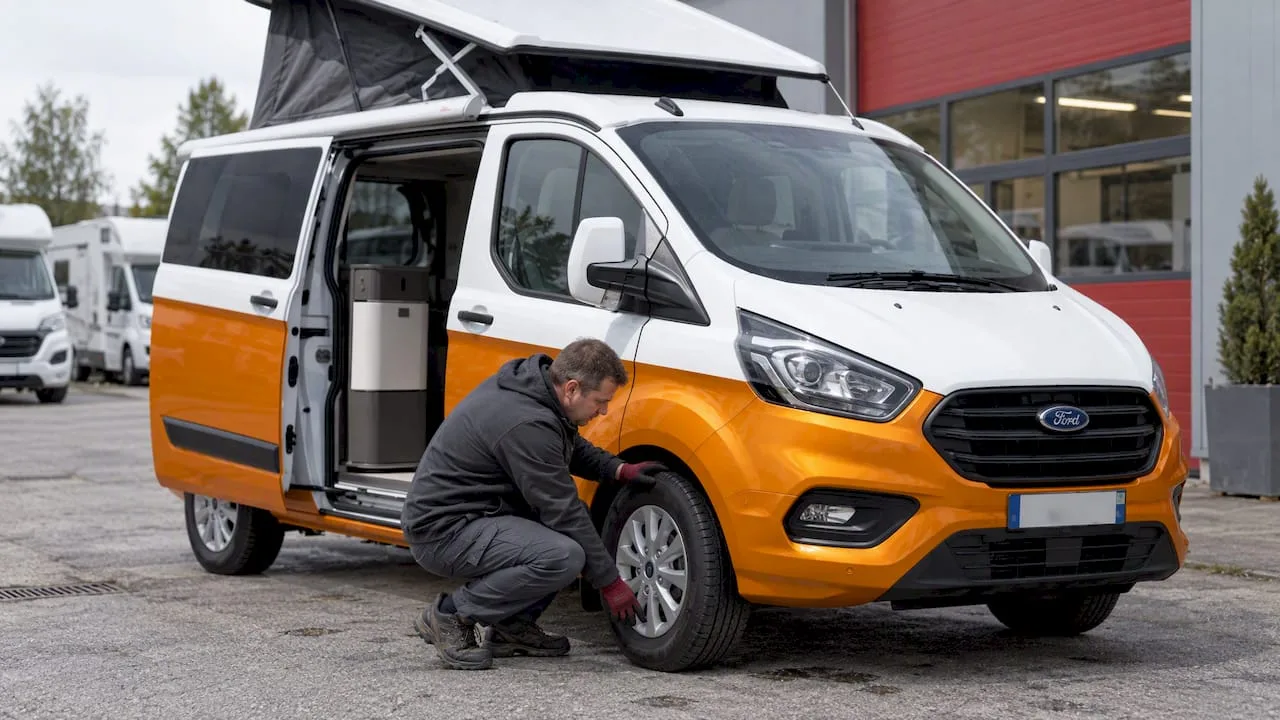
- ✓Mercedes V Marco Polo
- ✓Ford Transit Nugget Plus
- ✓Live availability check
Check available dates
Key takeaways
- Documents come first: ID or passport, driving licence, vehicle registration, insurance policy and e-vignette. A standard category B licence is enough for a campervan up to 3,500 kg.
- Photograph everything at pickup: every scratch, the fuel level, the mileage and the equipment. Anything you notice should be written into the handover report.
- A campervan is heavier than a car, so tyres, brakes and correct loading matter twice as much.
- The living area has its own checklist: water, gas, electricity, toilet and latched cupboards before you drive off.
- The return starts the day before: empty waste-water tanks, a tidy kitchen and a full tank of fuel save you time and unnecessary costs.
Table of contents
One week before departure: planning and bookings
The best campervan trips start at the kitchen table. A week before you leave is the right time to check your route, overnight stops and anything that might catch you out along the way.
- Plan a rough route, not a strict timetable. A campervan invites you to stop by a lake or on a scenic mountain pass, so leave a few spare hours in every day.
- Check where you are allowed to stay overnight. Wild camping is not permitted everywhere in Slovenia, so read up on the camping rules in Slovenia and choose campsites or motorhome service areas in advance.
- Book campsites ahead in summer, especially by the lakes and on the coast, where free pitches are scarce in July and August.
- Check parking in the towns you want to visit. For the capital, we have put together a guide on where to park a campervan in Ljubljana.
- Read the rules for other countries if you plan to cross a border: vignettes, tolls, mandatory equipment and winter rules differ from country to country.
- Share out the tasks. If you are travelling in a larger group, one shared list with clear responsibilities pays off, much like the one organisers use for a group travel packing list: who handles the documents, who sorts the food and who navigates.
If you are looking for inspiration on how to build a list for a longer road trip, a good example is this
road trip checklist, which splits the trip into planning, packing and departure-day tasks. Our checklist below follows the same logic.
Documents and mandatory equipment
To drive in Slovenia you must carry
a valid ID, driving licence, vehicle registration document, insurance policy and e-vignette, and the vehicle must have a warning triangle, a first-aid kit and a high-visibility vest. With a rental vehicle, the registration document and insurance policy are usually provided by the rental company, but check that they really are in the glovebox before you drive off.
The licence rule is simple:
a category B licence is enough for campervans up to 3,500 kg, while heavier vehicles require a C1 or C licence. You will find the vehicle’s maximum permitted weight in the registration document, and when you rent from us we tell you at the time of booking.
| What |
Why |
Where to keep it |
| ID card or passport |
identification, campsite check-in |
with the driver |
| Driving licence |
mandatory for the driver, category B up to 3,500 kg |
with the driver |
| Vehicle registration document |
proof of vehicle registration |
in the vehicle |
| Insurance policy |
mandatory insurance, roadside assistance phone number |
in the vehicle |
| E-vignette |
required on Slovenian motorways |
check before your first motorway |
| Rental agreement and handover report |
proof of the vehicle’s condition at pickup |
in the vehicle, plus a photo on your phone |
| Warning triangle |
mandatory equipment |
reachable without unloading luggage |
| High-visibility vest |
mandatory equipment |
in the cab, within arm’s reach |
| First-aid kit |
mandatory equipment |
in the cab |
| Winter equipment (15 November to 15 March) |
mandatory during the winter period |
on the vehicle or in the boot |
Slovenia’s winter period is precisely defined:
between 15 November and 15 March you must have winter tyres on all wheels. If the vehicle has summer tyres with at least 3 mm of tread, which are allowed only on certain coastal sections, snow chains for the drive wheels must also be carried. For autumn and spring trips to the Alps, this means always checking the winter equipment, whatever the weather is like when you set off.
Besides the mandatory equipment, we recommend a few extras in case of a breakdown:
a tyre repair spray, jump leads and a toolbox are small and light, yet worth their weight in gold at the critical moment. Add a head torch, work gloves and an in-car phone charger.
Inspection when picking up a rental campervan
Pickup is the moment to take your time. A thorough twenty-minute check protects you from misunderstandings at return, and you get to know the vehicle before you find yourself on the motorway.
- Walk around the vehicle with your phone in hand. Record a short video and photograph all four sides, the wheels, bumpers, windscreen and the roof, if you can reach it.
- Note every scratch or dent in the handover report. Even the smallest. Anything not written down is hard to prove at return.
- Record the mileage and fuel level. A photo of the dashboard with the ignition on is the simplest proof.
- Inspect the interior: seats, beds, upholstery, kitchen surfaces and the fridge.
- Check the equipment against the list: pots and pans, cutlery, bedding, outdoor chairs and table, hook-up cables and the water hose.
- Ask to be shown every system: how the roof or pop-top opens, where to fill up with water, how the stove works, where the main switch for the living area is and how to empty the toilet.
- Read the agreement and the insurance terms. You need to know what the basic insurance covers, how high the excess is and whom to call in case of a breakdown.
- Check the tyres and winter equipment if you are travelling in the winter period or into the mountains.
Pay attention to any extra charges on the agreement. The European Consumer Centre advises that if a rental company insists on additional insurance you do not want, you should
pay under reservation and clearly note your disagreement on the contract. We do our best to make our terms clear at the time of booking, but reading the agreement before signing is a good habit with any rental.
Campervan
See our campervans before you set off
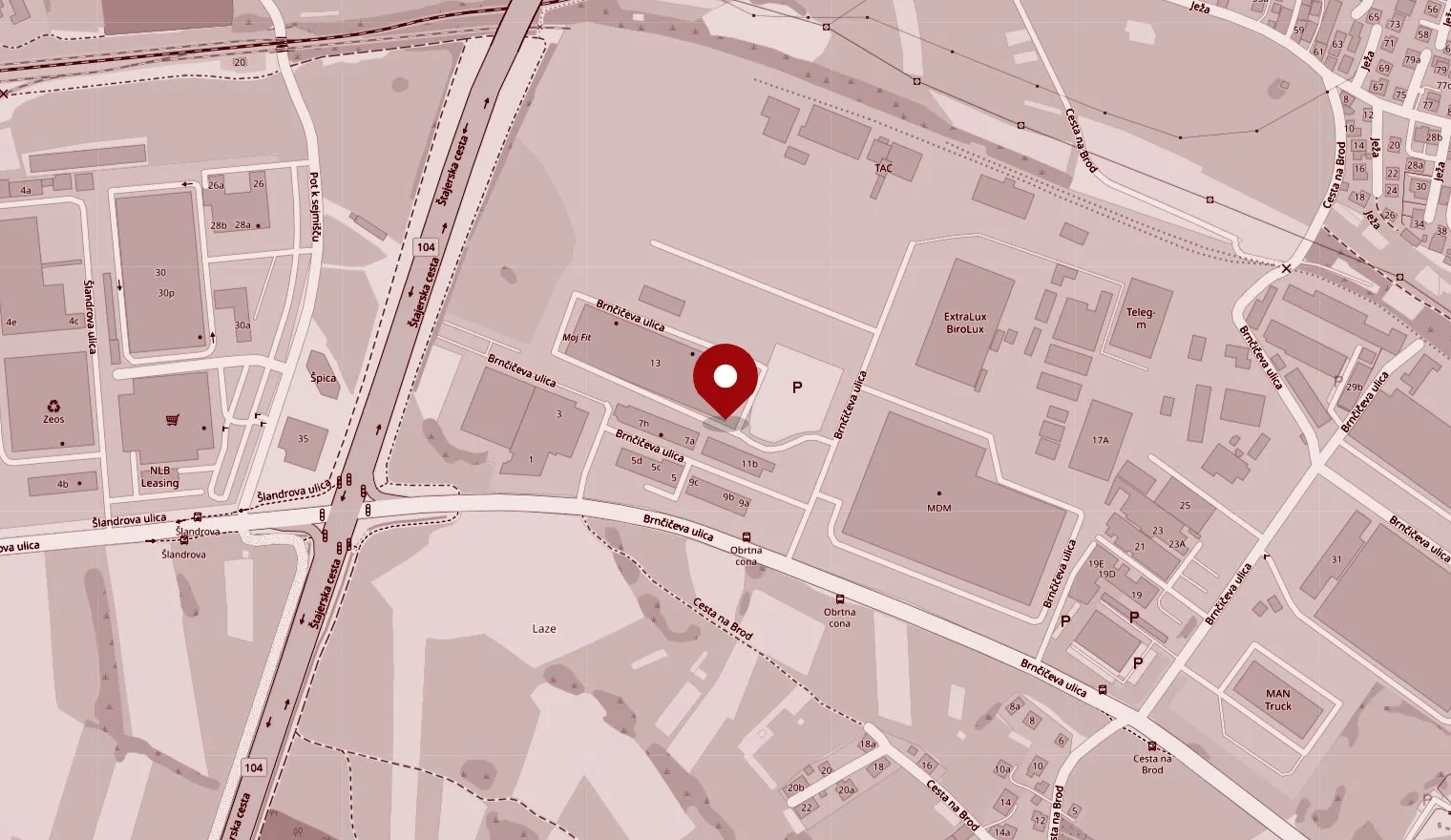
Visit us in Ljubljana to view our campervans and choose the right vehicle for your trip around Slovenia.
Campervan rental | Campervan.si
Brnčičeva ulica 13, 1231 Ljubljana, Slovenia
View location
Technical check before every departure
Whether the campervan is your own or a rental, take five minutes for a basic check before a longer journey. For your own vehicle, AMZS (the Slovenian automobile association) advises that
a service visit before a long trip is a smart decision that saves a lot of trouble on the road. A
regular roadworthiness test is not a formality either, but part of driving safely.
Tyres
- Check the pressure while the tyres are cold. The recommended pressure for different loads is shown on the driver’s door or in the service book. For a fully loaded campervan it is usually higher than for an empty one.
- Inspect the tread and sidewalls: cracks, bulges or uneven wear are a sign to stop at a tyre shop.
- Find out where the spare wheel or repair kit is and how to use it.
Lights and signals
- Switch on the entire lighting system: dipped and main beam, indicators, brake lights, reversing lights and number plate light.
- Check the light units for cracks while you are at it. A travel companion will help you check the rear lights.
Fluids
- Check the engine oil and coolant levels, and top up the screenwash if needed. In summer a bug-removing screenwash comes in handy; in winter use a winter mix.
- Look at the ground under the vehicle: a patch of oil or coolant is a warning you should not ignore.
Brakes and chassis
A campervan is heavier than a car, which is why mechanics stress that
brakes, suspension and wheel alignment deserve special attention. In the first kilometre, test the brakes at low speed and listen for any unusual noises.
Living area: water, gas, electricity and toilet
The living area is what sets a campervan apart from a car, and it is also the part people most often forget to check.
- Fresh water: fill the tank before you leave and check that the tap and pump work.
- Waste water: the grey-water tank should be empty when you set off.
- Gas: if the vehicle cooks on gas, check that the bottle is full enough, that the valve is closed while driving and that the stove lights without trouble.
- Electricity: check the leisure battery charge and make sure you have the hook-up cable for campsite power.
- Fridge: switch it on a few hours before loading food so it has time to cool down.
- Toilet: a fixed toilet should be emptied and ready before departure, with chemical toilet fluid and biodegradable paper.
- Cupboards and drawers: check they are closed and latched every time before you pull away. A drawer flying open on the first bend is a classic of first trips.
- Roof and windows: the pop-up roof, skylights and step must be closed or stowed.
Loading: weight and distribution
Luggage affects how a campervan drives more than you might think. Pack heavier items such as drinks, tins and tools as low as possible and between the two axles, and lighter items such as clothes and towels in the upper cupboards. This keeps the centre of gravity low and makes the vehicle more stable in corners and in crosswinds.

With a compact campervan there is one more rule: take less than you think you need. Soft bags pack more easily than hard suitcases, and bikes on a rack add to the vehicle’s length and affect parking. If you plan to cycle in the Slovenian Alps, look at these
cycling routes in the Slovenian Alps to plan your daily loops, so you know which gear you really need to bring.
On the road: a quick daily check
Slovenia’s Traffic Safety Agency warns that
driving a motorhome calls for extra caution and knowing the parking and overnight rules in advance. Every morning before you set off, take two minutes to:
- walk around the vehicle and give the tyres a visual check,
- close the windows, skylight and pop-up roof,
- latch the cupboards, fridge and drawers,
- turn off the gas and switch off appliances in the living area,
- unplug the hook-up cable and stow the water hose,
- make sure the step is retracted and there is nothing behind the vehicle,
- keep an eye on water, fuel and the grey-water tank so you know when you will need a service area.
While driving, keep the vehicle’s height and width in mind at underpasses, multi-storey car parks and narrow village roads. On mountain passes such as Vršič, descend in a lower gear so you do not overheat the brakes. For towns, read our guide to
parking a campervan in the city, and for the night, the rules on
where overnight campervan stays are legal.
Before returning a rental campervan
The return is the last item on the list and often the most neglected. If you start on it the day before, the handover will be quick and free of surprises.
- Empty the grey water and toilet at a motorhome service area or campsite, never into nature or a roadside drain. Services and prices at service areas vary, so pick one on your way back to Ljubljana.
- Refuel to the level stated in the agreement and keep the receipt.
- Tidy and wipe down the kitchen, empty the fridge and take out the rubbish.
- Check all cupboards and drawers so you do not leave personal belongings, chargers or documents behind.
- Count the equipment against the handover report: chairs, table, cables, hose.
- Photograph the vehicle at return just as you did at pickup, including the exterior, mileage and fuel.
- Tell us straight away if anything happened. A small damage you mention yourself is always an easier conversation than one we discover later.
For our vehicles, final cleaning is a one-off fee of
€80 per rental, so you do not need to clean the interior down to the last corner. We do, however, ask you to return the vehicle tidy, with the tanks emptied and no rubbish left inside.
Our view: a checklist is your best travel companion
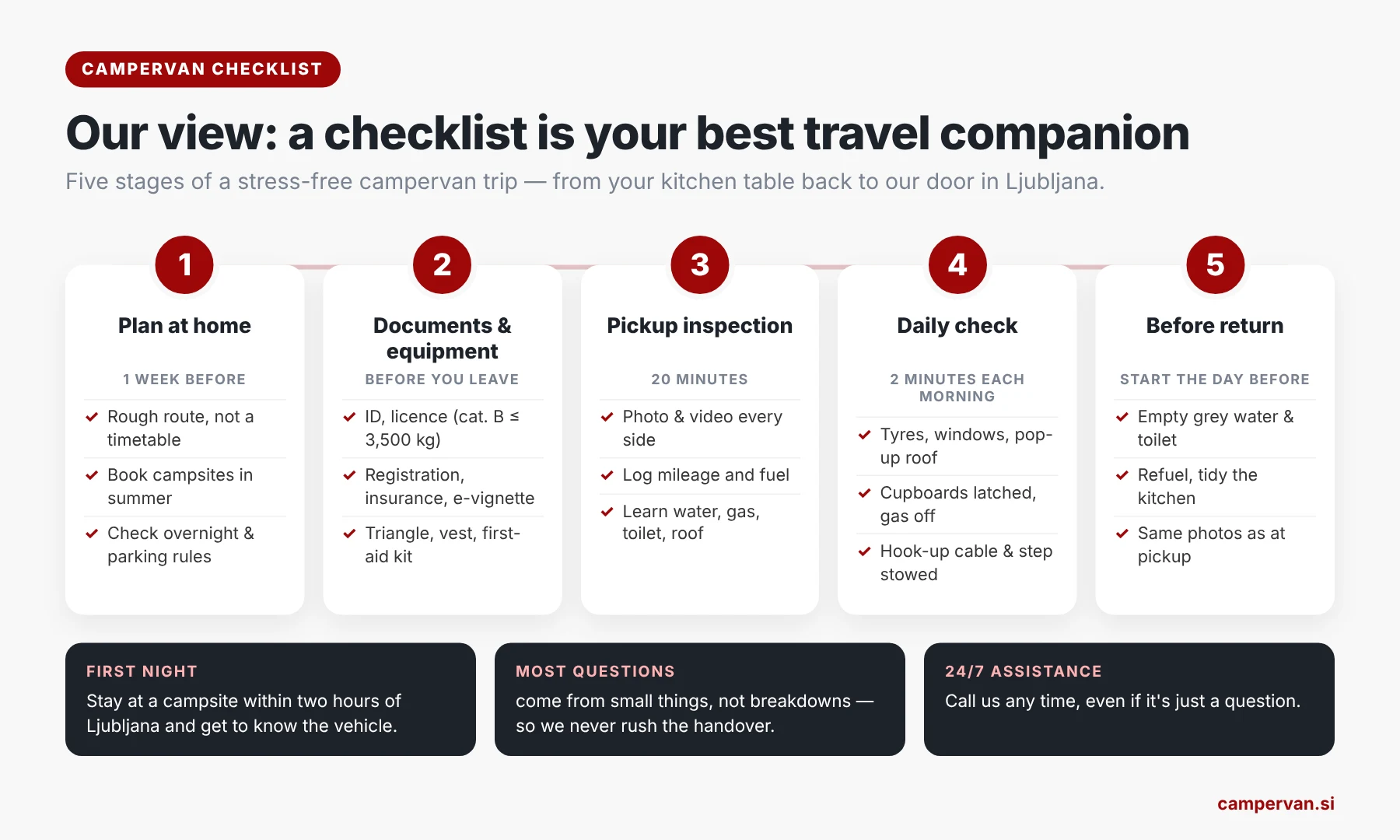
As a family business from Ljubljana, we hand over vehicles to guests from Slovenia and from all around the world. Most questions on the road are not about breakdowns but about small things: how to open the pop-up roof, where the main switch is, where to empty the toilet. That is why we never rush the handover. We would rather take the time to show you everything, so you can then enjoy the lakes, the mountain passes and the scent of the sea without a worry.
Our advice is simple: do not plan to go far on the first night. Stay at a campsite within two hours’ drive of Ljubljana, where you can get to know the vehicle at your own pace and find out what you are still missing. By day two, you will be driving like old friends. And remember that 24-hour assistance is available to you, even when it is just a question.
— Rok
Campervan rental in Ljubljana
If you are putting together a checklist for your first campervan trip, we can help with the vehicle and with tips for touring Slovenia, the Alps and the Balkans. Our fleet includes modern campervans with a kitchen, beds for several people, basic insurance and 24/7 assistance:
- Mercedes V Marco Polo: from €125 per night for daily rental and from €110 per night for weekly rental.
- Ford Nugget Plus: from €125 per night for daily rental and from €110 per night for weekly rental.
Check availability and book your vehicle using our
booking form.
Frequently asked questions
Do I need a special driving licence for a campervan?
For a campervan with a maximum permitted weight of up to 3,500 kg, a category B driving licence is enough. Heavier vehicles require a C1 or C licence. Check the vehicle’s maximum permitted weight in the registration document or ask when booking.
When are winter tyres mandatory in Slovenia?
The winter period runs from 15 November to 15 March. During this time you must have winter tyres on all wheels or, where permitted, summer tyres with at least 3 mm of tread plus snow chains in the vehicle. In the mountains, winter conditions can also occur outside this period.
What should I photograph when picking up a campervan?
Photograph all four sides of the vehicle, the wheels, the windscreen, the interior and the dashboard showing the mileage and fuel level. Any damage should also be written into the handover report. Take the same photos when you return the vehicle.
Do I have to clean the campervan before returning it?
With us, final cleaning is charged as a one-off fee of €80 per rental, so a thorough clean is not necessary. We do ask you to empty the grey water and toilet, take out the rubbish, empty the fridge and refuel as agreed in the rental agreement.
Where can I empty waste water and the toilet?
At motorhome service areas and at campsites with a designated disposal point. Emptying into nature or roadside drains is not allowed. Choose the nearest service area when you plan the last day of your trip.
Sources
CCampervan
Ask about a rental for your trip
Tell us about your travel plans in Slovenia and ask about renting a campervan or motorhome in Ljubljana.