Albania by campervan is one of the most beautiful trips you can start in Ljubljana. Tirana is
about 1,168 km or just over 13 hours’ drive away, and along the way you will see the Croatian coast and the Bay of Kotor, followed by Albania’s mountains, stone Ottoman towns and the Ionian Sea, with beaches you will find hard to forget. For a worry-free trip you need a valid ID, the vehicle registration document with a Green Card, some cash in lek and at least two weeks. Below you will find the route and border crossings, documents, traffic rules, tolls, overnight stays and a suggested itinerary you can drive in a campervan from Ljubljana.
Campervan
Start your Albanian road trip in Ljubljana
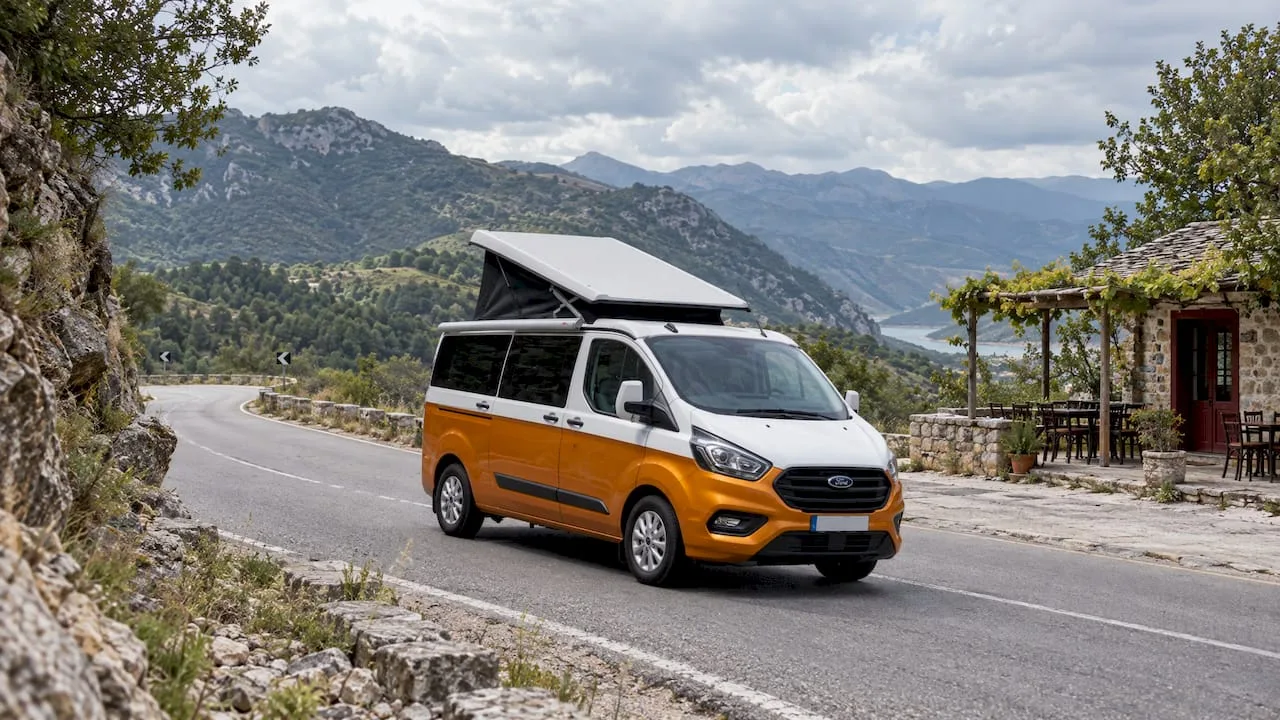
Rent a campervan in Ljubljana for your trip to Albania and choose between the Mercedes V Marco Polo and the Ford Transit Nugget Plus.
Check our campervans
Key takeaways
- The most common route from Slovenia runs through Croatia and Bosnia, or along the coast to Montenegro, and you enter Albania at the Hani i Hotit crossing or from Kosovo at Morinë.
- To enter you need a passport or ID card (for stays of up to 90 days), the vehicle registration document and a Green Card; if you are driving a vehicle that is not yours, you also need the owner’s authorisation.
- The blood alcohol limit is just 0.1 per mille, and stricter penalties for traffic offences have applied since August 2026.
- A campervan that is simply parked in a permitted space is not camping; once you roll out the awning and set up a table and chairs, it is.
- Allow at least 14 days, ideally 16 to 18, for the journey there, touring the country and the return.
Table of contents
The route from Ljubljana to Albania
There are two routes from Ljubljana to the Albanian border, and you can combine them: take one there and the other back. That way you see more and avoid driving the same kilometres twice.
The coastal route through Croatia and Montenegro
This is the route for those who want the journey itself to be part of the holiday. Take the Croatian motorway down towards Dalmatia, continue past Dubrovnik into Montenegro, and along the Bay of Kotor and Budva you reach Podgorica. From there it is only a short drive to the Hani i Hotit crossing and Lake Shkodër. The coastal road is scenic but slower in summer, so expect longer days behind the wheel. After leaving Slovenia, you need an
electronic vignette or toll payment for motorways and expressways in each country, depending on the country.
The inland route through Bosnia
The other option runs through Bosnia and Herzegovina, via Sarajevo or Mostar, and on towards Montenegro.
The most common route from Slovenia goes through Croatia and Bosnia, with entry into Albania at Hani i Hotit from Montenegro or at Morinë from Kosovo. If you want to know what you can see on the Bosnian part of the route, we have gathered stops, campsites and tips in our guide
Bosnia by campervan. For a wider overview of the region, from Croatia to Greece, see our article
the Balkans by campervan.
Border crossings and how to avoid queues
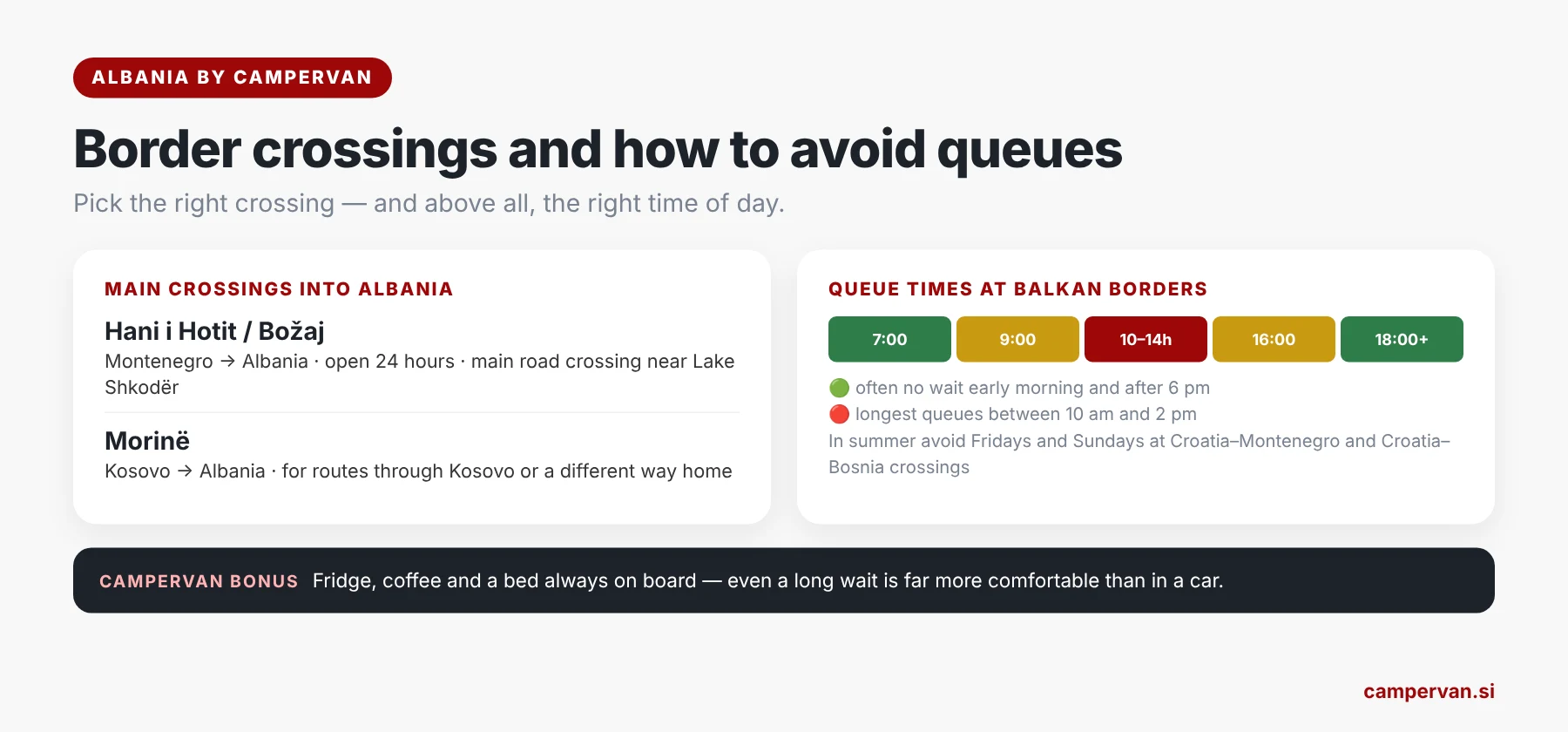
The Hani i Hotit / Božaj crossing is the
main road crossing between Montenegro and Albania and is open 24 hours a day, but queues can be long in summer. Choose the Morinë crossing if your route goes through Kosovo or if you want to return from Albania by a different route.
You save the most time by choosing the right hour. At Balkan borders,
queues are longest between 10 am and 2 pm, while at 7 am or after 6 pm there is often no wait at all. In summer, avoid the Croatia–Montenegro and Croatia–Bosnia crossings on Fridays and Sundays. A campervan gives you an advantage here: you always have your fridge, coffee and bed with you, so even a longer wait is much more pleasant than in a car.
Documents and equipment for the trip
Most border complications come from a forgotten piece of paper, so prepare your documents before you leave and keep them all in one place. According to
AMZS (the Slovenian automobile association) for Albania, you need the following:
| Document |
When you need it |
| Passport or ID card (Slovenian citizens) |
Always; with an ID card you can stay up to 90 days |
| Driving licence |
Always; an International Driving Permit is recommended |
| Vehicle registration document |
Always, for the vehicle you enter with |
| Green Card |
Mandatory for entry with a vehicle |
| Authorisation to drive someone else’s vehicle |
When the vehicle is not yours, for example a rented campervan |
If you are not a Slovenian or EU citizen, check the entry requirements for your nationality before you travel. With a rented vehicle, the authorisation is essential, as you are not the owner of the vehicle. If you are planning Albania, let us know when you book so the vehicle documents are ready for your trip.
Have some cash ready for payments on the road. The currency is the lek (ALL), and cards are
accepted mainly in towns, while in the countryside you will often need cash for fuel, food and tolls. A guide to the
currency in Albania explains which currency to bring and how to exchange it.
Travelling to Albania with a dog or cat
If a four-legged companion is travelling with you, start preparing early. For Albania you need a
rabies antibody titre test carried out before leaving the EU, so that you can re-enter the Union without complications. The test takes time, so talk to your vet a few months before the trip. We have gathered our experience with dogs in a campervan in our article
travelling with a dog in a campervan, and suitable
pet travel accessories, from a portable water bowl to a safety harness, make long driving days more comfortable too.
What to have in the campervan
The Slovenian Ministry of Foreign Affairs advises carrying
essential tools and spare parts, as there are no roadside assistance services in the country. Add to the list:
- a spare wheel or tyre repair kit and checked tyre pressure,
- high-visibility vests, a warning triangle and a first-aid kit,
- a phone charger and maps saved for offline use,
- a supply of drinking water and basic food for days in the mountains,
- cash in lek and euros.
Campervan
Get ready for your trip to Albania
Choose a campervan in Ljubljana for your trip to Albania and other parts of Europe.
Campervan rental | Campervan.si
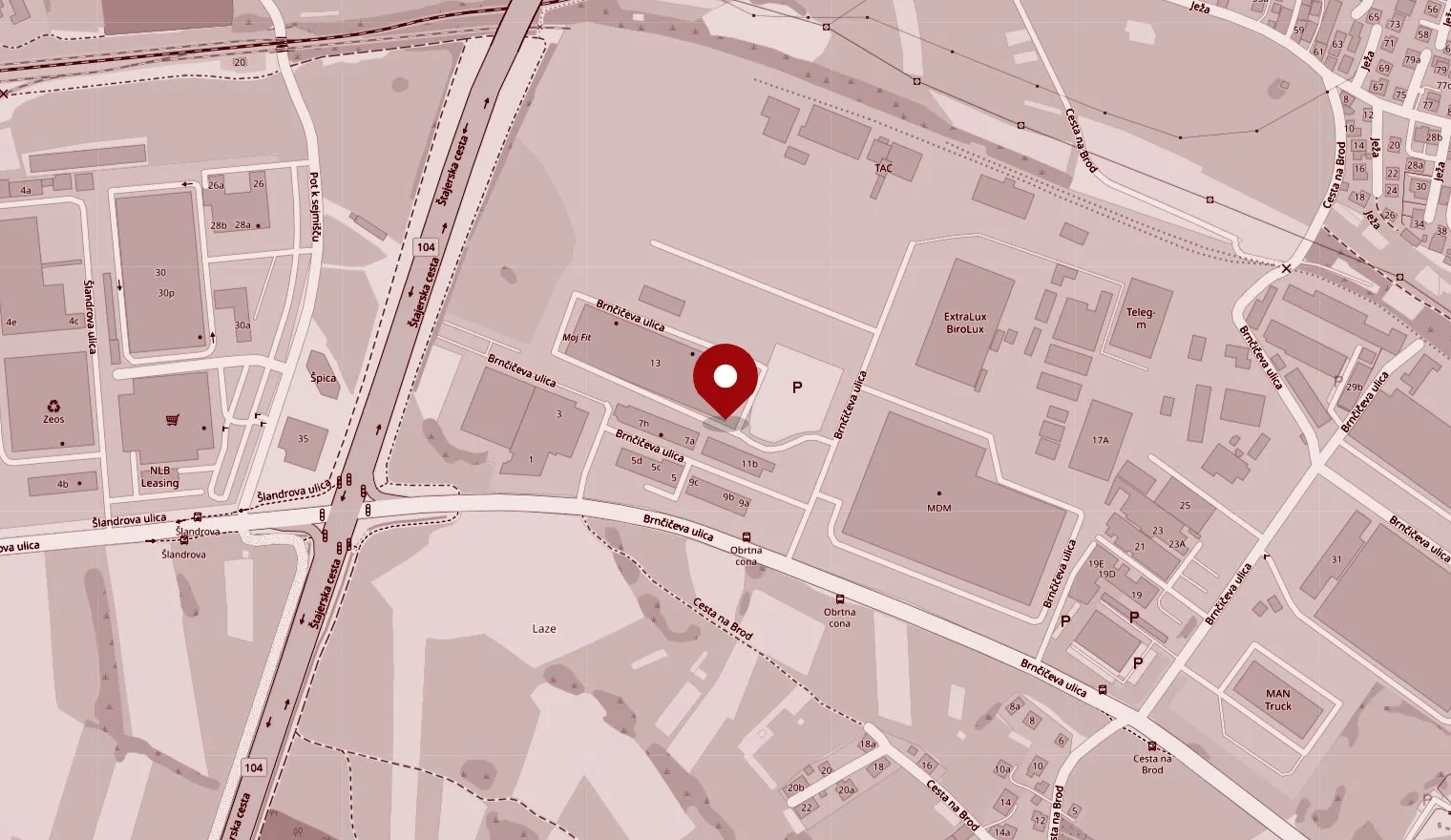
Brnčičeva ulica 13, 1231 Ljubljana, Slovenia
View map
Traffic rules, tolls and fuel
Albanian rules are similar to those elsewhere in Europe, but there are a few important differences. The alcohol limit is
0.1 per mille, which in practice means you get behind the wheel completely sober. In August 2026,
stricter penalties for traffic offences came into force in Albania, including for dangerous driving and using a mobile phone while driving.
Speed limits according to AMZS:
| Road type |
Maximum limit |
Limits for other vehicle categories |
| Motorway |
110 km/h |
80 km/h |
| Expressway |
90 km/h |
70 km/h |
| Other roads |
80 km/h |
70 km/h |
| Built-up areas |
40 km/h |
35 km/h |
Tolls
Most Albanian roads are toll-free. Tolls apply on the
A1 motorway between Morinë and Durrës, and prices are moderate according to
Tolls.eu data for 2026: the Milot–Morinë section costs 660 lek for a car, the Thumanë–Kashar section 250 lek, and the same for the Llogara tunnel on the way south. You can pay in cash or by card. These prices apply to cars; the toll booth will tell you which category your vehicle falls into.
Fuel
Fuel in Albania is more expensive than in Slovenia. At the end of October 2026, a litre of 95 petrol cost
around €2.06 and a litre of diesel €2.31. It is therefore wise to fill up in Montenegro or Kosovo before entering the country, and in Albania to refuel at larger petrol stations along main roads.
Roads and driving a campervan
The main roads between Shkodër, Tirana, Durrës and Vlorë are good, but elsewhere the picture is more varied. The Slovenian Ministry of Foreign Affairs warns that roads
can be in poor condition, especially in rural areas, which applies above all to the mountain roads to Theth and Valbonë and to the narrow streets of old town centres.
The driving style is also different from what you may be used to. Traffic rules and signs are
often not strictly followed, so careful and predictable driving is your best defence. A few practical tips:
- Drive in daylight. Potholes, animals and unlit vehicles are harder to see at night.
- Plan shorter stages. 150 to 200 km a day is quite enough in Albania, as average speeds are lower than at home.
- Check conditions before mountain roads at your campsite or with locals, especially after rain.
- In towns, park on the outskirts and walk or take a taxi into the centre; Berat, Gjirokastër and Krujë have steep, narrow streets.
- Follow the news about protests and road closures, which can affect traffic.
This is where a compact campervan shows its advantage. The Mercedes V Marco Polo and Ford Transit Nugget Plus are built as vans, so they are more nimble on narrow roads and in town car parks than a large integrated motorhome, while inside they have everything you need to live on board.
Overnight stays: campsites, parking and wild camping
Albania’s rules on overnight stays in a campervan are clearer than many people think. According to a
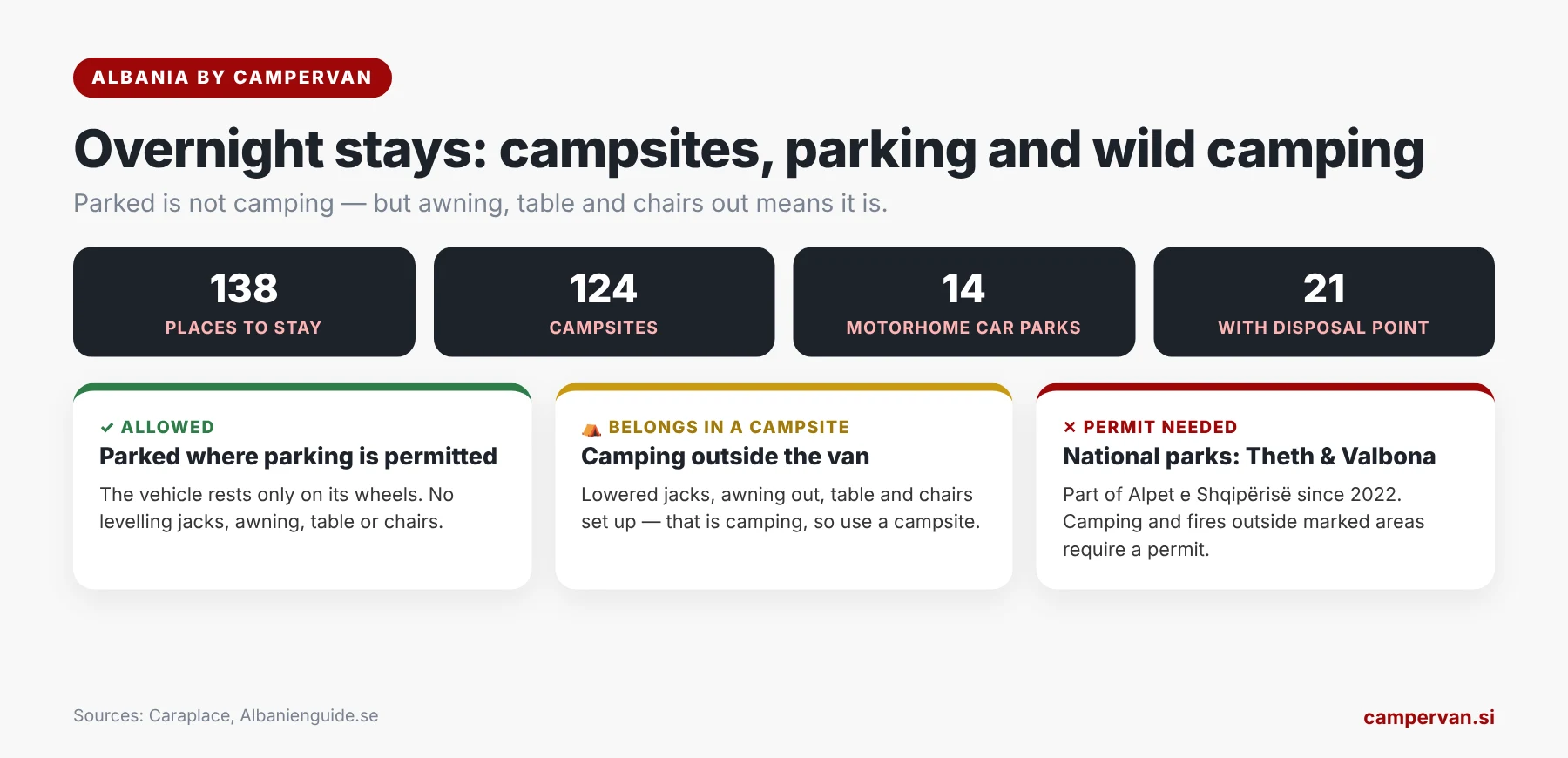
summary of the Albanian highway code, a campervan parked where parking is permitted and resting only on its wheels is not camping. But once you lower the levelling jacks, roll out the awning or set up a table and chairs, it is camping, and that belongs in a campsite. The same source lists 138 places to stay overnight, including 124 campsites and 14 motorhome car parks, 21 of which also have a disposal point.
Stricter rules apply in national parks. Since 2022, Theth and Valbonë have been part of the Albanian Alps National Park (Alpet e Shqipërisë), where camping and lighting fires outside marked areas require a
permit under the protected areas law. In the mountains, therefore, stay at one of the family-run campsites, of which there are more and more in the valleys.
Campsites are also the best choice in practical terms: you can fill up with water, empty the toilet, charge the batteries and get advice from locals about the road for the next day. Along the coast, campsites are spread from Velipojë in the north to Ksamil in the south, while by the lakes and inland they are often small, with home-cooked food served in the garden.
Suggested 16-day itinerary
This itinerary is designed for a first trip: down the coast, through Albania from north to south, and back via Bosnia.
| Day |
Stage |
What to experience |
| 1–2 |
Ljubljana – Dalmatia |
First evening by the sea, Split or Makarska |
| 3 |
Dalmatia – Bay of Kotor |
Dubrovnik from outside, evening in Kotor |
| 4 |
Kotor – Shkodër |
Hani i Hotit crossing early in the morning, Rozafa Castle |
| 5–6 |
Shkodër – Albanian Alps |
Mountain valley, a hike, overnight at a campsite |
| 7 |
Alps – Krujë – Tirana |
The bazaar in Krujë, an evening in the capital |
| 8 |
Tirana – Berat |
The city of a thousand windows |
| 9–10 |
Berat – Gjirokastër |
The stone city and its castle, a slow day |
| 11–12 |
Gjirokastër – Ksamil |
Butrint, swimming in the Ionian Sea |
| 13 |
Ksamil – Llogara Pass – Vlorë |
A spectacular pass above the coast |
| 14 |
Vlorë – Durrës – Podgorica |
Last Albanian breakfast, crossing into Montenegro |
| 15–16 |
Podgorica – Sarajevo or Mostar – Ljubljana |
Return via Bosnia |
If you have less time, skip the mountain days or the south and visit Albania again another time. If you have more time, add a day at Lake Ohrid or on the beaches around Himarë. We have written more about planning stages and daily distances in our
practical route planning guide.
Our view on Albania by campervan
We often recommend Albania to travellers who already know Croatia and Montenegro and want something new. It is a country where in a single week you can walk through a mountain valley in the morning, explore an Ottoman town in the afternoon and dine by the sea with fresh local food in the evening.
In our view, a campervan is the best way to get to know it. You are not tied to hotels and timetables, you always have your own bed and kitchen with you, and you can stay wherever you like it best. Because Albania is part of a longer Balkan journey, Ljubljana is an excellent starting point: the landscape changes day by day, and even the drive to the border is an experience.
As a family business, we talk through the route with every guest before they leave. For Albania, we advise you to allow enough days, not to rush and to drive in daylight. With a comfortable, modern campervan, even a long journey becomes a holiday full of enjoyment.
Rok
Hit the road in our campervan from Ljubljana
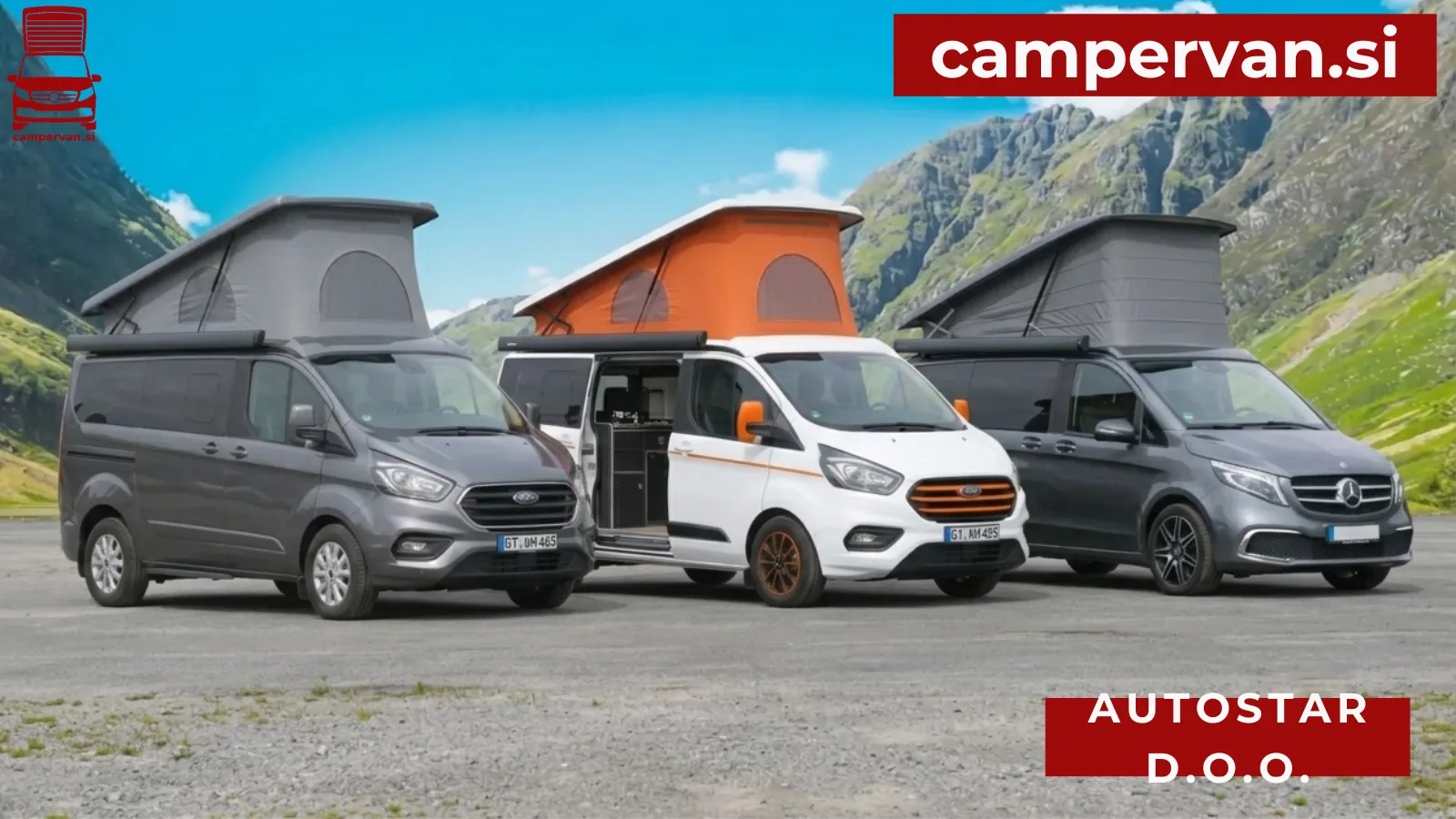
For a trip to Albania, we have two modern campervans in Ljubljana. The
Mercedes V Marco Polo impresses with comfort and elegance, and the
Ford Transit Nugget Plus with its fixed toilet, which you will especially appreciate on a long journey through the Balkans. Both have a kitchen, beds for several people, basic insurance and 24/7 assistance, and we will also help you plan your route.
Daily rental of either vehicle costs from €125 per night, and weekly rental from €110 per night. Final cleaning is €80 per rental. For the 16-day trip in our itinerary, with 15 nights at the weekly rate, that means from €1,650 for the vehicle plus €80 for cleaning. If you cannot decide which vehicle suits you better, read about our
experience with the Mercedes Marco Polo and our
experience with the Ford Nugget Plus, then choose your dates and book.
Frequently asked questions
Can I enter Albania with just an ID card?
Yes. Slovenian citizens can enter Albania with a valid ID card or passport and stay for up to 90 days. For the vehicle you also need the registration document and a Green Card, and with a rented vehicle, an authorisation as well. Citizens of other countries should check the requirements for their nationality.
How many days do I need for Albania by campervan from Slovenia?
The drive to Tirana alone takes just over 13 hours one way, so we recommend at least 14 days. That gives you enough time for the north, the central towns and the south without spending every day behind the wheel. With 16 to 18 days, the trip will be even more relaxed.
Is wild camping allowed in Albania?
Parking a campervan where parking is permitted is not camping, as long as the vehicle rests only on its wheels. Once you roll out the awning or set up a table or chairs, it is camping. In national parks such as Theth and Valbonë, you need a permit to camp outside marked areas, so a campsite is the best choice.
Do I pay tolls in Albania?
Tolls are charged on the A1 motorway between Morinë and Durrës and in the Llogara tunnel; other roads are toll-free. You can pay in cash or by card. On the way through Croatia, Bosnia and Montenegro, each country’s own rules apply.
Sources
CCampervan
Ask about a rental for Albania
Get in touch about your trip to Albania and campervan rental options in Ljubljana.