Air conditioning in a campervan is really two separate devices. The cab air conditioning cools you while driving and runs off the engine, while the living-area air conditioner is a separate roof-mounted or under-bench unit that also cools when the vehicle is parked. The latter uses a lot of electricity, so it usually runs on a 230 V hook-up at a campsite. Below you will find which types exist, how much power they draw, what they cost in Slovenia and how a well-planned route can keep your campervan summer comfortable.
Campervan
Hit the road in a comfortable campervan
Explore Slovenia in a campervan from Ljubljana and plan your summer route exactly the way you want.
Check availability
Key takeaways
- The cab and the living area are separate systems. Cab air conditioning cools while you drive, whereas a roof or under-bench unit runs independently of the engine, even during a long stop.
- Electricity is the key question. Most living-area air conditioners need 230 V mains power, and 12-volt versions can draw more than 50 A from the battery.
- Prices in Slovenia (2026): a living-area unit costs from €1,149.90 without fitting, while a model with installation costs around €2,445.00.
- Inverter technology adjusts output continuously, and modern units also heat and dehumidify the air as well as cooling it.
- Without air conditioning, shade, smart ventilation and a route into higher altitudes, where summer nights are cooler, make all the difference.
Table of contents
Cab air conditioning vs living-area air conditioning: what’s the difference
Most modern vans and motorhomes built on a van chassis have cab air conditioning just like the one you know from a car. It works much like a fridge:
refrigerant circulates through the system and draws heat out of the air (in Slovenian) before the fan blows it into the cab. The compressor is usually driven by the engine, so this type of air conditioning cools mainly while you are driving.
Living-area air conditioning is a different story.
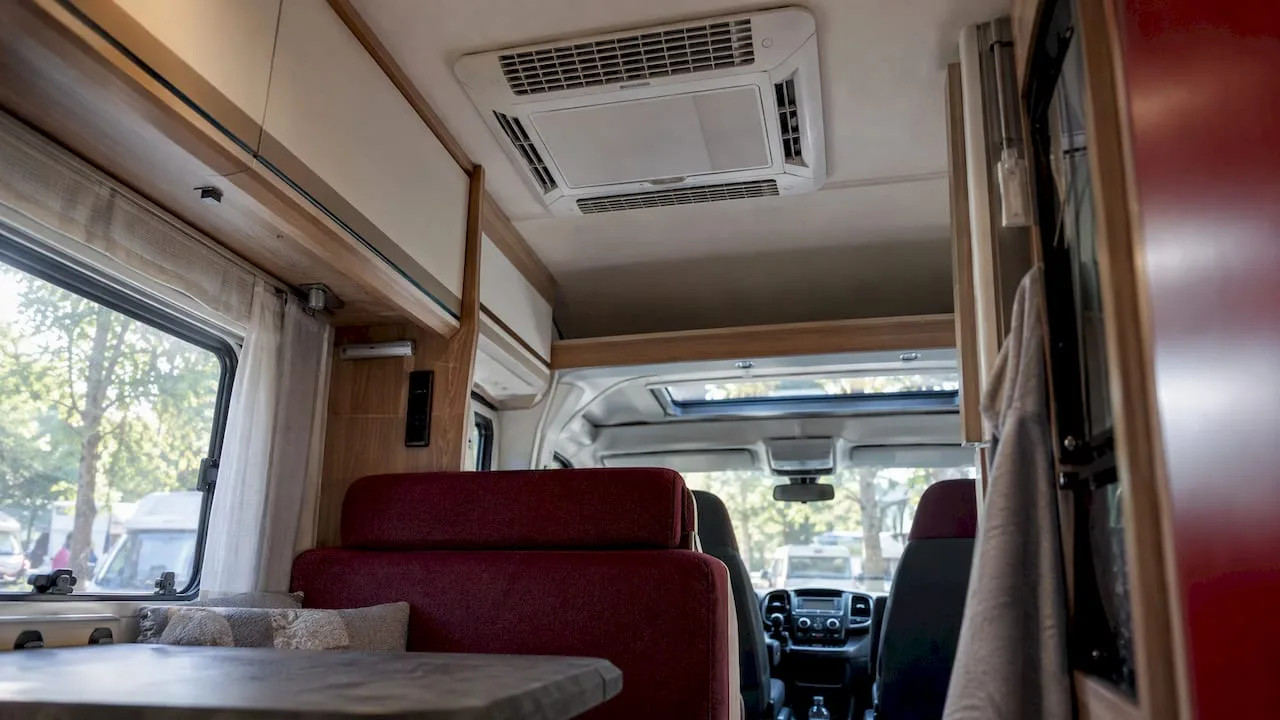
A roof air conditioner for motorhomes and caravans works independently of the engine (in German), so it cools while the vehicle is stationary and is designed precisely for long summer stops: an afternoon by the lake, lunch at the campsite or a night at a hot seaside car park.
The trend is towards electric compressors. A study of automotive air conditioning found that
an electric compressor powered by the battery and charged via the alternator cools independently of engine speed and achieved lower consumption in tests. For travellers this mainly means more even cooling, even when you are crawling along in a traffic queue.
In practice, a simple rule applies:
- while driving, the cab air conditioning keeps you comfortable,
- when parked, you need a living-area unit or well-planned shading and ventilation.
Types of living-area air conditioners
Motorhome air conditioners are classified by two criteria: where they are installed and how they regulate output. By installation, there are
roof-mounted and under-bench air conditioners. A roof unit sits on the roof, usually in the opening of a roof vent, and releases cool air directly into the living space. An under-bench unit is hidden in a storage locker or under a seat and distributes air through ducts to different parts of the vehicle.
| Criterion |
Roof air conditioner |
Under-bench air conditioner |
| Installation |
on the roof, often in a roof vent opening |
under a bench, bed or in a storage locker |
| Fitting |
simpler |
more complex, air ducting required |
| Air distribution |
from a single point in the ceiling |
through ducts to several parts of the vehicle |
| Space |
takes up no interior space |
takes up part of the storage |
| Centre of gravity |
weight on the roof |
weight low in the vehicle |
In larger vehicles it is important that the unit’s capacity is sufficient for every corner of the living area. That is why some owners of longer motorhomes opt for two units or an under-bench version with ducting.
The second criterion is regulation. A fixed-speed unit runs at full power and switches on and off, while an inverter unit adjusts its output continuously to demand. One example is the
Sinclair ASV-25BIS with inverter technology (in Slovenian), which has a cooling capacity of 2.65 kW and a heating capacity of 2.50 kW. Modern units often also use the refrigerant circuit as a heat pump: an
air conditioner buying guide explains how the refrigerant evaporates in the evaporator and draws heat from its surroundings, and some systems also work as heating.
How much electricity does campervan air conditioning use
This is the question that decides everything else. The compressor is the biggest power consumer in a motorhome, so you need to know in advance where it will get its electricity from.
On a 230 V campsite hook-up
Most living-area air conditioners are built for mains power. The Sinclair ASV-25BIS, for example, is
powered via a 220–240 V connection (in Slovenian) and can be controlled via Wi-Fi, a remote control or manually. At a campsite this is the most relaxed solution: plug in the cable, switch on the air conditioning and the vehicle is pleasantly cool within minutes.
Check how much current the pitch’s power post can handle, because the air conditioner shares electricity with the kettle, charger and fridge. We explain how to connect the cable safely and what to watch out for with sockets in our guide to
connecting a campervan to campsite electricity.
On 12 V from the battery
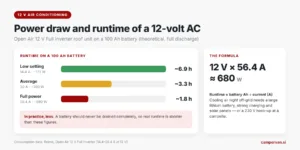
There are also air conditioners that run directly on 12 V. For the Open Air 12 V Full Inverter roof unit, the specification lists
a current draw of 14.4 to 56.4 A at 12 V, depending on the selected power level.
A simple calculation shows what this means. At full power that is roughly 680 W (12 V × 56.4 A). If the unit draws 30 A on average, a 100 Ah battery would theoretically last a little over three hours, and less in practice, because you should never drain a battery completely. To cool all night without a campsite you therefore need a larger lithium battery, a powerful charging system and solar panels.
To learn more about how the power supply works in a vehicle and when you can be self-sufficient, read our article on
electricity in a campervan.
Campervan
Start your summer trip with us
In Ljubljana you can rent a campervan to explore Slovenia and plan a route that also takes you up into cooler, higher altitudes.
Campervan rental | Campervan.si
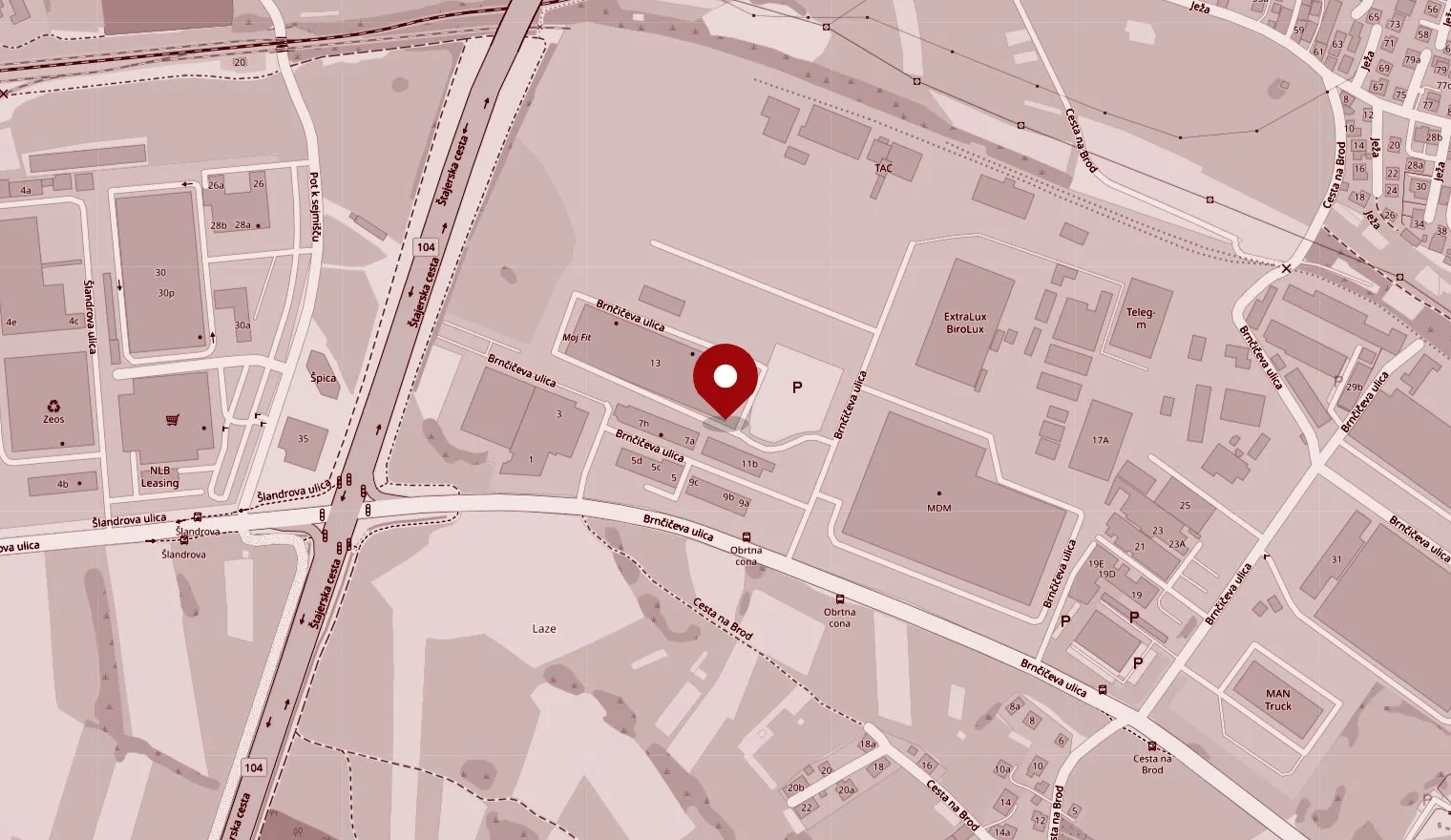
Brnčičeva ulica 13, 1231 Ljubljana, Slovenia
Get directions
How much does campervan air conditioning cost in Slovenia
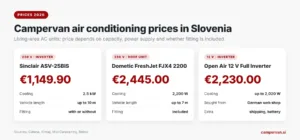
Prices vary depending on capacity, power supply and whether installation is included. For orientation, here are some examples from retailers’ ranges (2026 prices):
| Unit |
Cooling capacity |
Power supply |
Price |
What’s included |
| Sinclair ASV-25BIS |
2.5 kW |
220–240 V |
€1,149.90 |
for vehicles up to 10 m, available with or without fitting |
| Dometic FreshJet FJX4 2200 |
2,200 W |
mains connection |
€2,445.00 |
for vehicles up to 7 m, installation included |
| Open Air 12 V Full Inverter |
up to 2,020 W |
12 V |
€2,230.00 |
online shop in Germany, shipping extra |
For the Dometic, the price includes
installation with pre-existing electrical wiring (in Slovenian), replacing an existing 40 × 40 cm roof vent. The unit also has a heating output of 1,000 W. If you don’t yet have the electrical wiring, expect extra work and a higher bill. The 12-volt version works out more expensive because it also requires a high-capacity battery and charging system.
For an owner who uses their motorhome a few weeks a year, this is a serious expense. That is why more and more travellers choose to rent a modern vehicle for their summer trips, where someone else takes care of the technology and maintenance.
What to look for when choosing and installing
When comparing units, check the following details:
- Capacity relative to vehicle length. Manufacturers state the vehicle length a unit is sufficient for, such as 7 m or 10 m.
- Opening size and roof thickness. The Dometic FJX4 fits into a 40 × 40 cm opening and a roof 25 to 60 mm thick.
- Noise. The Sinclair’s indoor unit sound pressure level is 53/49/42 dB(A) at 1 m (in Slovenian), depending on the fan speed. For sleeping, the lowest value is what matters most.
- Dehumidification. The same unit removes up to 1.0 litre of water from the air per hour, which makes a big difference to how humid seaside nights feel.
- Operating range. A stated range of –5 to 46 °C tells you the unit can handle hot southern destinations as well as cooler mornings.
- Heating. An inverter unit with a heating function also helps in spring and autumn. We cover other options for cold days in our article on heating a campervan.
- Weight on the roof. A roof unit raises the centre of gravity and adds to the vehicle’s weight. Check how much margin you have left to the maximum permitted weight, as described in our guide to campervan weight and payload.
Leave the installation of a 230 V unit to an authorised motorhome workshop or a qualified electrician. It involves mains voltage in a metal vehicle, where correct protection and earthing are essential for safe use.
How to use air conditioning correctly
Even the best air conditioner will treat you better if you use it wisely:
- Don’t overdo the temperature difference. For air conditioning while driving, experts recommend keeping the interior 5 to 7 °C cooler than the outside air (in Slovenian), no more. This helps you avoid catching a cold and a temperature shock when you step out.
- Direct the airflow into the room, not straight at your body.
- Switch off the air conditioning a few minutes before you arrive and leave only the fan running. This stops condensation building up in the system, which causes bacteria and unpleasant smells.
- Close the windows and roof vents while the air conditioning is running, and cover the windows on the sunny side.
- Keep fuel consumption in mind. Air conditioning puts extra load on the engine while driving, so fuel consumption rises slightly. You will find tips for economical driving in our article on how much fuel a campervan uses.
How to cool a campervan without living-area air conditioning
Many travellers spend the summer in a campervan without a roof air conditioner and have a wonderful time. A compact campervan has a smaller space that you can air out quickly, and with a few habits it stays pleasant even on hot days.
- Park in the shade and position the vehicle so the afternoon sun doesn’t shine into the large side windows.
- Shade the windows during the day. Blinds or external covers for the cab windows keep out a lot of heat.
- Ventilate at the right time. When it is warmer outside than inside, close and cover the windows. When it cools down in the evening, open the windows and roof vent to let the heat escape and create a through-draught.
- Use a fan. A small USB or battery fan doesn’t cool the air, but moving air noticeably improves comfort, especially at night.
- Cook outside. A stove inside the vehicle heats up the space, so on hot days prepare meals outdoors.
- Cool yourself down. A wet towel around your neck, a cold shower at the campsite and plenty of water work wonders.
- Choose light bedding. Cotton and linen breathe better than synthetics. More on this in our article on bedding in a campervan.
The most powerful tool, however, is the route itself. Slovenia is small, and within an hour or two you can swap a hot basin for the mountains. A night on the Pokljuka plateau, by Lake Bohinj, in Kranjska Gora or in the Trenta valley is much cooler than in Ljubljana or on the coast. You can end a day at the seaside with an evening drive towards the Vipava Valley and the Karst, and the next morning you are already beneath Triglav.
Our take on summer in a campervan
Here in Ljubljana, every summer we advise travellers who are worried about the heat. Our experience is clear: a good summer break in a campervan is first a matter of planning, and only then of technology.
That’s why we put together a route with you that follows the cool air. An early-morning drive, a midday swim in a lake or river, the shade of the forest in the afternoon, and in the evening a campsite with an electric hook-up or a parking spot at a higher altitude. Slovenia, the Alps and the neighbouring countries offer exactly this: in a few hours you can swap the coast for spectacular mountain passes and cool alpine nights.
As a family business, it matters to us that you set off without worries. Our vehicles are modern, the kitchen and beds are ready to go, and 24/7 assistance is always there for you. Whenever you want to know where to spend the night during a heatwave, just ask us.
Rok
Summer by campervan from Ljubljana
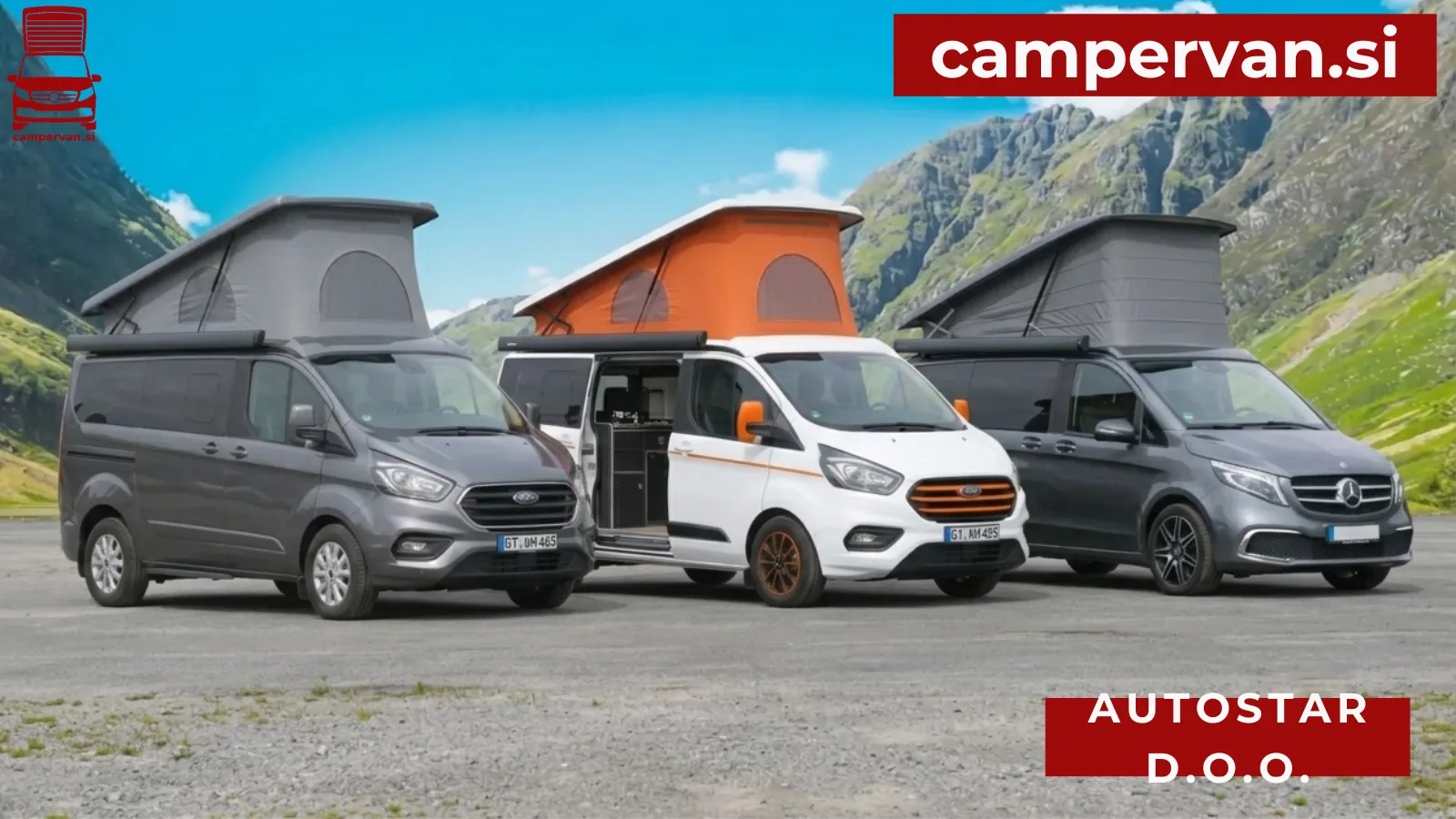
If you are thinking about a summer trip without buying and installing expensive equipment, renting is the simplest way to get a campervan. In Ljubljana we offer two modern campervans: the
Mercedes V Marco Polo and the
Ford Transit Nugget Plus. Both have a kitchen and sleeping space for several people, and basic insurance and 24/7 assistance are included in the rental.
- Daily rental: from €125 per night
- Weekly rental: from €110 per night
- Final cleaning: €80 per rental
When you pick up the vehicle, we are happy to advise you on routes around Slovenia, the Balkans and the Alps, including the coolest spots for hot days.
Frequently asked questions
Does living-area air conditioning work while driving?
A 230 V roof or under-bench air conditioner usually doesn’t work while driving, because the vehicle isn’t connected to mains power. While you drive, the cab air conditioning does the cooling, and you cool the living area when parked, once the vehicle is plugged in at a campsite.
Can air conditioning run all night on the battery?
Not with a standard leisure battery. A 12 V air conditioner can draw more than 50 A, so a standard battery would only last a few hours. For all-night cooling you need a campsite hook-up or a high-capacity lithium system with charging.
How much does it cost to install air conditioning in a campervan?
In Slovenian shops, a living-area unit costs from €1,149.90 without fitting, while a roof air conditioner with installation costs around €2,445.00 (2026 prices). The final amount depends on whether the vehicle already has a roof opening and electrical wiring.
Can you sleep well in a campervan in summer without roof air conditioning?
Yes, if you choose the right place and ventilate properly. During the day keep the vehicle shaded and closed, in the evening open the windows and roof vent, and for the night choose a higher altitude or a campsite by a lake. A small fan and light cotton bedding also help.
CCampervan
Ask us about your summer trip
Write to us about renting a campervan for a trip around Slovenia and find out more about the options for your journey.
Sources