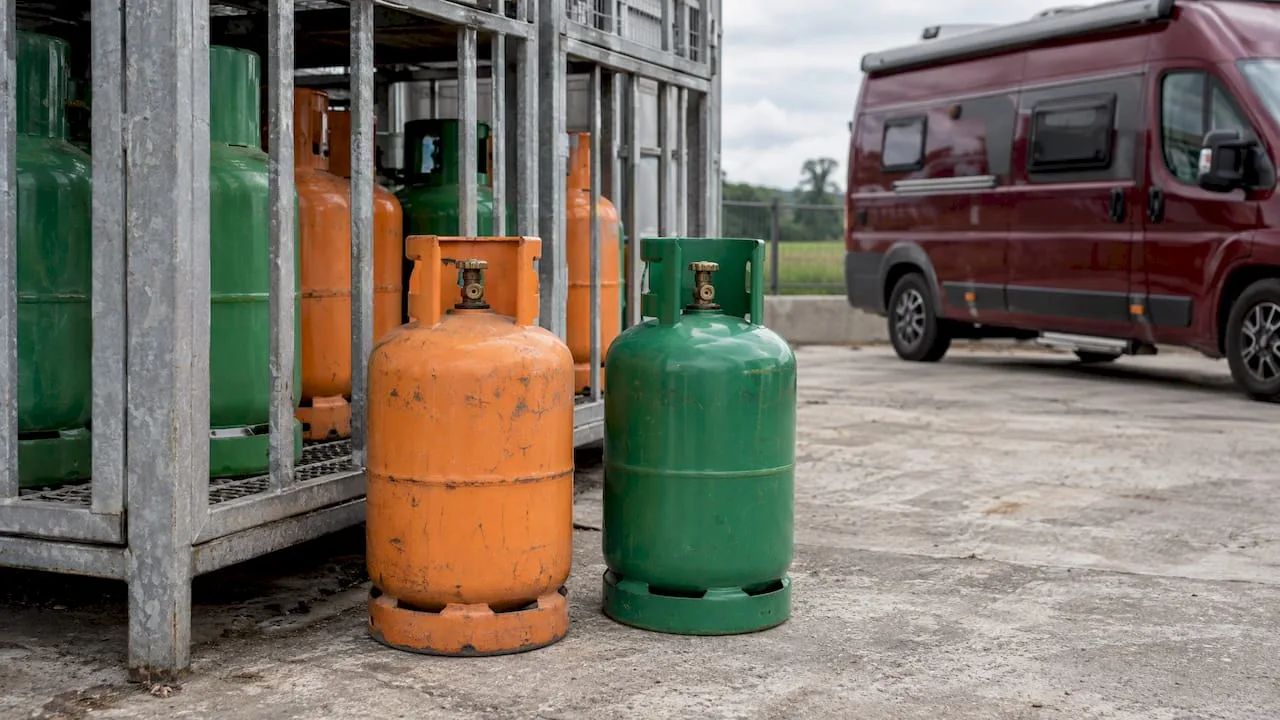
In Slovenia, you exchange a gas cylinder at a petrol station or at an authorised dealer of the gas supplier. You hand in the empty cylinder and get a full one of the same type and size in return. At home or in your campervan, you then connect it in a few minutes: close the valve, replace the seal, screw on the regulator and check with soapy water that no gas is leaking anywhere. You only pay for the gas. You pay a deposit only if you do not have an empty cylinder. Below is everything you need for a worry-free exchange: where to get a cylinder, how much it costs, how to connect and transport it safely, and what to do if you smell gas.
Campervan
Hit the road with a properly set-up gas supply
Campervan rents out the Mercedes V Marco Polo and Ford Transit Nugget Plus campervans for trips around Slovenia.
See our campervans
Key takeaways
- You exchange an empty cylinder for a full one of the same type and size. If you want a different size, contact the gas company directly.
- At Petrol, a 10 kg cylinder of gas costs €34.20 and a 5 kg one €17.10 (prices from 2 April 2026, incl. VAT). If you do not have an empty cylinder, you pay a €10 deposit.
- Fit a new rubber seal with every exchange and always check the connection with soapy water or a leak detection spray.
- Transport the cylinder with the valve closed and the protective cap on, upright and well secured, in a ventilated vehicle, then unload it straight away.
- If you smell gas, put out any flame, close the valve, ventilate the space and call the supplier’s emergency service.
Table of contents
Where to exchange a gas cylinder in Slovenia
Slovenia has a dense network of outlets, so a cylinder will rarely be a problem, whether it is for your kitchen at home, a weekend in the Karst or a campervan trip through Alpine valleys. The only important thing is to know which cylinder you have, as you exchange it at a seller that accepts the same type.
Before you go for gas, it is worth checking the map of outlets on the supplier’s website. That way you will not visit a station that currently has no stock of your type or size, especially at weekends and in smaller towns. If you are travelling by campervan, mark the outlets along your route when planning. Our
campervan route plan for Slovenia, which lists stopovers across the country, will help you with this.
The same-cylinder rule
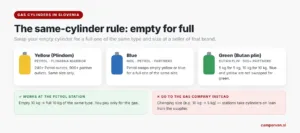
This is the most common reason things do not go smoothly at the till. Outlets work on an “empty for full” basis. When you buy gas, Petrol
exchanges an empty yellow or blue cylinder for a full one of the same size. If you want to swap a 10 kg cylinder for a 5 kg one, Petrol advises contacting the gas company directly. The station receives cylinders on loan, and the gas company can charge it for any cylinder that is not returned.
A similar rule applies at Butan plin. They only exchange cylinders of the same quantity, and they do not exchange blue or yellow cylinders for green ones.
What about an old orange cylinder?
There are still plenty of orange cylinders in cellars and garages. Butan plin states that you can exchange
an old orange 10 kg cylinder for a 10 kg green one by paying the difference up to the full deposit. You can do this on home delivery, at their outlets or at more than 500 outlets across Slovenia. If you have been keeping an old cylinder for a long time, this is the simplest way to get a modern, tested cylinder.
How much does a gas cylinder exchange cost
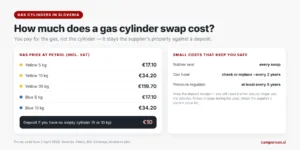
When you exchange a cylinder, you pay for the gas, not the cylinder itself. The cylinder remains the supplier’s property, and you use it against a deposit. Gas prices change during the year, so the amounts below are a guide. Check the supplier’s price list for current prices.
| Cylinder (Petrol, prices from 2 April 2026, incl. VAT) |
Gas price |
| Yellow 5 kg |
€17.10 |
| Yellow 10 kg |
€34.20 |
| Yellow 35 kg |
€119.70 |
| Blue 5 kg |
€17.10 |
| Blue 10 kg |
€34.20 |
When you buy a cylinder for the first time and have no empty one, Petrol charges a €10 deposit for a 5 or 10 kg cylinder. INA also lists
a €10 deposit for household users who do not yet have a blue cylinder, payable at an authorised reseller. Keep the deposit receipt, as it will come in handy when you no longer need the cylinder.
Also allow for small equipment costs: a new rubber seal, and eventually a new hose and regulator. These are small amounts, but the safety of the whole system depends on them.
Exchanging a cylinder step by step
You do not need a technician to exchange a cylinder; care, a spanner and soapy water are enough. The procedure recommended by
GIZ UNP, the Slovenian LPG industry association, is as follows:
- Remove sources of ignition. There must be no open flame, lit cigarette or burner nearby.
- Close the valves of both cylinders, the empty one and the full one.
- Disconnect the regulator from the empty cylinder and immediately screw the protective nut onto it.
- Fit a new seal on the regulator. An old, flattened or cracked seal is the most common cause of leaks.
- Screw the regulator onto the new cylinder with a dedicated size 27 spanner. For safety reasons, the nut has a reverse (left-hand) thread: to loosen it, turn the spanner to the left, not to the right.
- Open the cylinder valve.
- Check the connection with soapy water or a leak detection spray. If no bubbles appear, the cylinder is correctly and safely connected.
Never check for leaks with a lighter or match. With
every gas cylinder exchange, Plinarna Maribor replaces the regulator’s rubber seal and checks the seal with a special spray or soapy water. We recommend the same care to you.
When to replace the seal, hose and regulator
You get a tested cylinder every time, but the rest of the system is your responsibility. Istrabenz plini recommends
replacing the rubber seal with every exchange, checking or replacing the hose about every 2 years, and replacing the regulator at least every 8 years.
| Part |
When to replace it |
| Rubber seal |
with every cylinder exchange |
| Gas hose |
check or replace about every 2 years |
| Pressure regulator |
at least every 8 years |
The year of manufacture is usually printed on the hose, so you can quickly see whether it is time for a new one. A cracked, hard or crushed hose does not belong in the system, even if it is less than two years old.
Campervan
Start your campervan trip in Ljubljana
Visit Campervan.si and see our campervans for trips around Slovenia and beyond.
Does the cylinder match your regulator and appliance
Before you connect a new cylinder, check three things: the type of gas, the pressure and the valve.
- Type of gas. GIZ UNP states that household appliances must be designed for a propane-butane mixture.
- Pressure. Appliances must operate at 30 or 35 mbar. This is written on the rating plate of the cooker, heater or grill and on the regulator.
- Regulator. Never connect a cylinder without a pressure regulator. It must be between the cylinder and the appliance, and appliances used indoors must have a flame failure device that shuts off the gas if the flame goes out.
- Valve and label. A cylinder from an authorised seller is properly filled, tested, clean and safe. A household cylinder must have the prescribed label, a suitable valve and a protective nut.
Gas cylinders in a campervan and when travelling
With campervans, caravans and camping stoves, you often come across smaller camping cylinders. Butan plin offers
camping cylinders of 2, 2.5 and 3 kg and points out that the campervan season does not end in summer. For winter, they recommend a propane cylinder, as propane works more reliably than butane at low temperatures. We have written more about why propane is the right choice for cold mornings in the mountains in our guide to
cooking safely with gas in a campervan.
If you travel across borders or have a regulator from another country in your vehicle, the thread will not always fit a Slovenian cylinder. For such cases there are adapters, such as the brass
SLO-GER adapter, designed for camping cylinders and cylinders for campervans and caravans. An adapter is a connection aid, not a substitute for a regulator: even with an adapter, there must be a suitable pressure regulator between the cylinder and the appliance.
When packing for your trip, add a size 27 spanner, spare seals and a small spray bottle of soapy water to the list. You will find all of these in our
campervan packing list too.
How to transport a cylinder safely by car
Most exchanges end with a drive home, so transport is just as important as connection. The guidelines for
safe transport of gases are clear:
- before driving, close the valve and fit the protective cap or nut,
- disconnect the regulator and hose,
- secure the cylinder firmly, preferably upright,
- ventilate the vehicle while driving, for example with a window slightly open,
- drive directly to your destination without long stops,
- do not leave the cylinder in the boot or any other unventilated space, and unload it as soon as you arrive.
Slovenian law also requires a safely loaded load. Under
Article 74 of Slovenia’s Road Traffic Rules Act, a load must be secured so that it does not endanger other road users, does not reduce the vehicle’s stability or visibility, and cannot fall. A cylinder rolling around in the boot is dangerous even when braking, so wedge it in with a bag or tie it down with a strap.
What to do if you smell gas
If you smell gas after an exchange, or bubbles appear when you test with soapy water, act calmly and in order. Plinarna Maribor advises the following:
- Put out all flames.
- Close the cylinder valve.
- Open windows and doors and ventilate the space thoroughly.
- Fit the protective nut on the valve.
- Take the cylinder outside, away from living spaces.
- Call the supplier’s emergency service. For Plindom, this is the free number 080 1248.
If bubbles appear, Petrol adds: in the room,
do not smoke, do not use lighters, and do not switch electrical switches on or off. Do not make phone calls or ring doorbells until the space has been ventilated, as a spark from a switch or doorbell can ignite the gas. Do not transport a leaking cylinder to the outlet yourself; that is what the emergency service is for.
If the smell appears again after reconnecting with a new seal, the problem is most likely in the regulator or hose. In that case, contact a gas appliance technician before using it again.
Our view
Bottled gas is one of the most practical sources of energy on the road. With it you can make your morning coffee by a lake, cook dinner on a mountain pass and not depend on restaurants or an electric hook-up. The key to worry-free use is not complicated procedures but a few simple habits: always a new seal, always a soapy water test, and always a closed valve while driving.
As a family business from Ljubljana, we see every day how much it helps travellers when they can focus on the journey rather than technical worries. That is why our modern campervans, the Mercedes V Marco Polo and the Ford Transit Nugget Plus, come with a kitchen, beds and basic insurance, and the Nugget Plus also has a fixed toilet. Our 24/7 assistance is available throughout your rental. If anything bothers you on the road, call us, whatever the time.
We are also happy to advise on routes around Slovenia, the Balkans, the Alps and neighbouring countries. With a good plan, you know where to stock up, where to sleep and where the best views are waiting.
Rok
Hit the road in a campervan from Ljubljana
If all this reading has you itching to set off, renting a campervan is the quickest way to try life on wheels. In Ljubljana we offer two proven models. The
Mercedes V Marco Polo costs from €125 per night for daily rental and from €110 per night for weekly rental. The same applies to the
Ford Nugget Plus: from €125 per night for daily rental and from €110 per night for weekly rental. Final cleaning costs €80 per rental.
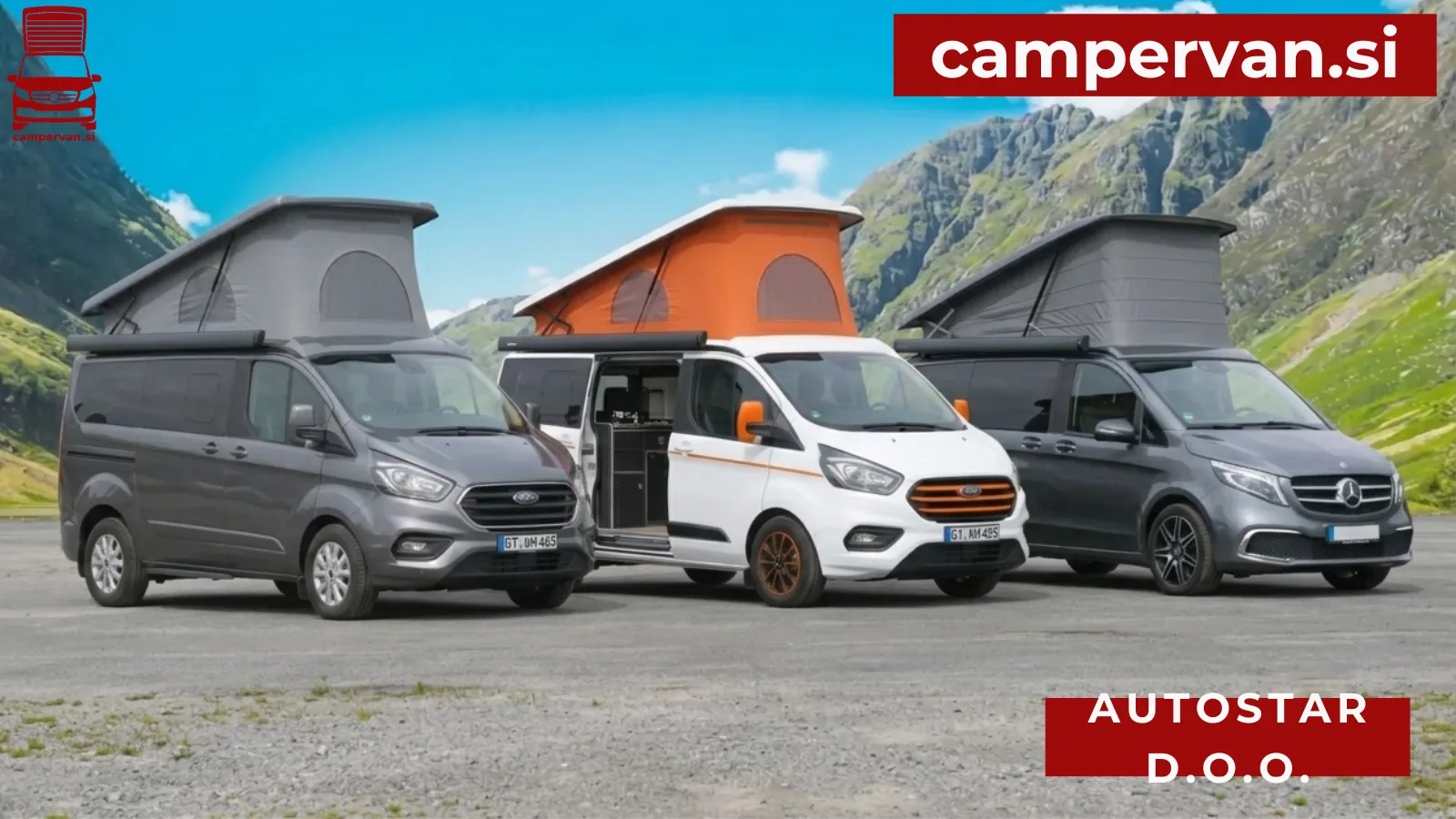
Both models have a kitchen, beds for several people, basic insurance and 24/7 assistance, and you choose your own pickup time. Take a look at
Mercedes V Marco Polo campervan rental or
Ford Nugget Plus campervan rental and book your dates. To find out where you can legally stay overnight with a campervan, read our guide to
overnight stays with a campervan in Slovenia.
Frequently asked questions
Can I exchange a 10 kg cylinder for a 5 kg one?
Usually not at a petrol station, as outlets exchange cylinders of the same size. Petrol advises contacting the gas company directly for such an exchange. The same rule applies at Butan plin: 5 kg for 5 kg and 10 kg for 10 kg.
Can I exchange a yellow cylinder for a blue or green one?
Petrol accepts an empty yellow or blue cylinder and gives you a full one of the same size. Butan plin does not exchange blue or yellow cylinders for green ones, but it does exchange an old orange 10 kg cylinder for a green one if you pay the difference up to the full deposit.
What do I need to exchange a cylinder at home?
You need a size 27 spanner, a new rubber seal and soapy water or a leak detection spray. Once the regulator is screwed on and the valve is open, brush soapy water over the connection. If no bubbles appear, the cylinder is correctly connected.
Can I carry a cylinder inside the car?
Transport the cylinder with the valve closed, the protective cap on and the regulator disconnected, upright and firmly secured, and ventilate the vehicle while driving. Drive straight to your destination and do not leave the cylinder in a closed vehicle or boot. The law requires a load to be secured so that it cannot fall and does not endanger other road users.
CCampervan
Ask us about gas on the road
Get in touch if you are planning a trip around Slovenia and are interested in renting a Mercedes V Marco Polo or Ford Transit Nugget Plus campervan.
Sources