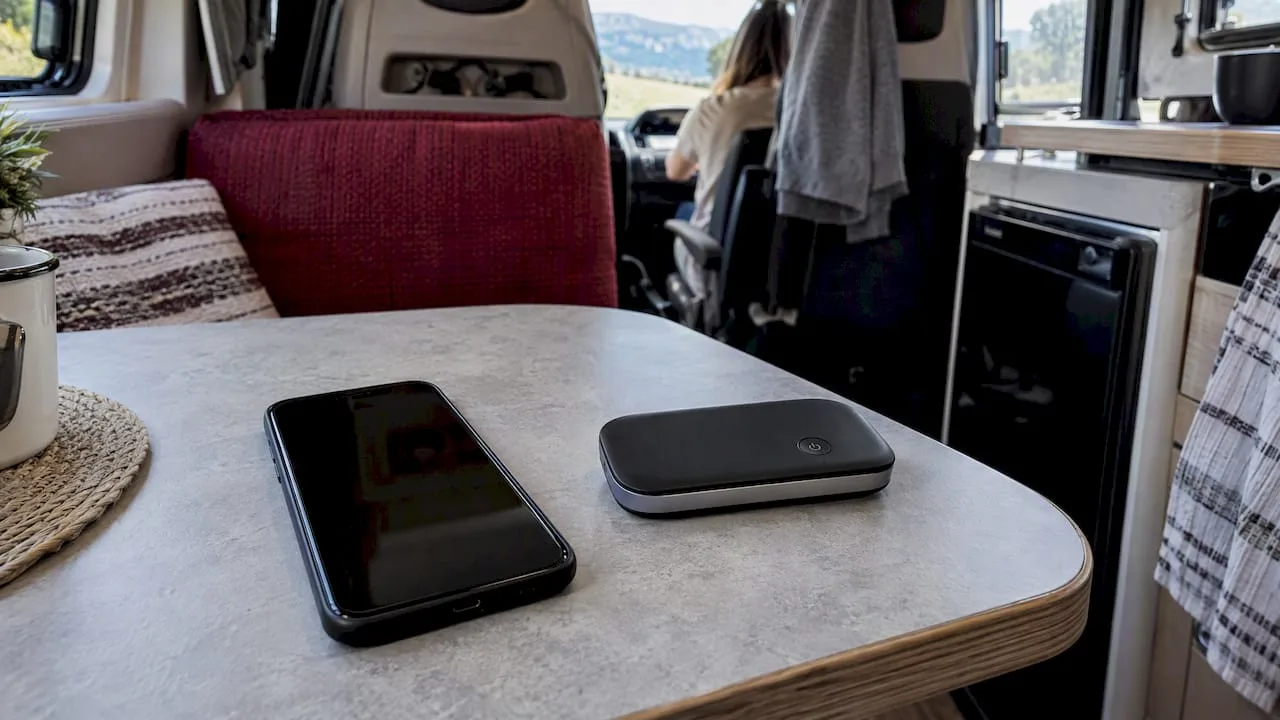
If you are travelling alone or as a couple and mainly use the internet to check maps, the weather and messages, a hotspot on your phone will be perfectly sufficient. But when several devices are running at once in a motorhome or campervan for days on end, when someone is working remotely or the children are watching cartoons on a tablet, a mobile router with its own SIM card is the more reliable, calmer and more practical choice. Below we explain how they differ, what mobile coverage in Slovenia means for you, and what to watch out for in data plans so you are not caught out on the road by a flat battery or a warning from your operator.
Campervan
Stay connected on the road
Choose a campervan for your trip around Slovenia and plan how you will connect your devices on the road.
Check available dates
Key takeaways
- A hotspot is a phone feature, while a mobile router is a standalone device with its own battery and SIM card slot, designed solely to broadcast a Wi-Fi signal.
- For short, occasional use with one or two devices, a phone is enough; for longer trips, several devices and working on the road, a router is more convenient.
- Slovenia has very good 4G coverage, while 5G is still concentrated mainly in cities.
- Before putting a SIM card in a router, read the terms of your plan: some operators restrict tethering or charge extra for it.
- In EU countries, roaming works at domestic prices as long as you spend most of your time at home.
Table of contents
What is a phone hotspot and what is a mobile router
A
hotspot is a smartphone feature that broadcasts your mobile data connection as a wireless network for other devices. This is also how
Telekom Slovenije describes it in its explanation of hotspots. In this case the phone does two jobs: it is still your phone, and at the same time it becomes a small router.
The broader term is
tethering. According to the
Android help pages, a phone can share its connection with another device via Wi-Fi, Bluetooth or a USB cable. A hotspot is therefore just one form of tethering, and the one most travellers use.
A
mobile router (often also called a 4G or 5G router, Mi-Fi or pocket Wi-Fi) is a standalone device with its own battery and SIM card slot, designed specifically to broadcast a Wi-Fi signal.
TechTarget describes it as a device that does the same job as a home router, only in a smaller, portable form. There are also versions without a battery, powered via USB or a 12-volt socket and designed for permanent installation in a vehicle.
The key difference is simple: a phone can share its connection as an extra feature, while a router does nothing else.
Comparison at a glance
| Criterion |
Phone hotspot |
Mobile router |
| Extra device |
Not needed |
Yes, it needs to be bought |
| SIM card |
Your existing one |
Its own, can be a separate data plan |
| Battery |
Drains the phone battery |
Own battery or power from the vehicle |
| Number of devices |
Usually fewer simultaneous connections |
Usually more simultaneous connections |
| Wi-Fi bands |
Depends on the phone |
Often 2.4 and 5 GHz |
| Calls while sharing |
Phone is under load and may heat up |
Phone stays free |
| Placement |
Wherever the phone is |
Where the signal is best, e.g. by a window |
| Best suited for |
Short trips, 1–2 devices |
Longer trips, families, remote work |
Speed and reliability: where the differences lie
With the same network and the same SIM card, the speed will often be similar, as both draw from the same mobile network. The difference lies elsewhere: in how stably the device holds the signal for hours and days on end.
A phone is designed as an all-round device. When it shares the connection while charging and running navigation, it heats up, and the system may switch off the hotspot after a few minutes of inactivity to save power. A router has no such dilemma: its only job is to keep the network available all the time.
The network itself also affects reliability.
In its 2025 awards, Opensignal named A1 Slovenija among the winners for 5G network reliability. Whatever the operator, a simple rule applies: where the signal is weak, it helps to place the device higher and closer to a window. You can leave a router by the windscreen or under the skylight, but you would not want to leave your phone there all evening.
How many devices can connect
This is where the difference is most noticeable. In its
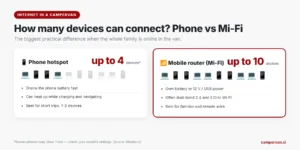
review of wireless and mobile connectivity, Monitor magazine stated that phones support up to four connected devices, while Mi-Fi routers often support up to ten, the newer ones on both 2.4 and 5 GHz networks. Modern phones have improved in this respect, so check the limits in your model’s settings. For a family of four with phones, a tablet and a laptop, however, a router is still the more relaxed choice.
Battery, data and practicality on the road
Battery. A hotspot drains your phone battery quickly, which is its biggest drawback on the road. Your phone is your map, camera, ticket and emergency contact; if tethering has drained it by evening, you lose all of them at once. A router uses its own battery, and your phone stays ready for what you really need.
Data. Both solutions use data from your mobile plan, so keep an eye on usage with either. System updates, photo syncing to the cloud and streaming high-definition video can use several gigabytes in a single evening. On laptops and tablets connected to a hotspot, set the network as “metered” so that large updates do not download automatically.
Practicality. You always have your phone with you, and setting up a hotspot takes seconds. A router is one more device to charge and keep at hand, but in return it creates a proper “home” network in the vehicle: all devices connect automatically when you get in, regardless of who has gone for a walk with their phone.
Security. With both solutions, set your own strong password. For the iPhone hotspot,
Apple explains that connected devices have no direct access to data stored on the phone. With a router, change the default admin password and network name the first time you use it.
When a phone is enough and when a router pays off
A phone hotspot is enough when:
- you are travelling for a few days at most and only browse, check your route and send messages online,
- you connect one or two devices, for example a laptop for a quick campsite booking,
- your plan has enough data and your operator does not restrict tethering,
- you can plug into electricity in the evening and charge your phone without worry.
A mobile router pays off when:
- you are travelling for a week or more and the internet is part of everyday life,
- several people and devices connect at the same time,
- you work remotely and need stable video calls,
- you want to separate work or family data traffic from your phone,
- you often park in places with a weaker signal and want to put the device where reception is best.
A practical example: a couple spending three days touring between Bled, Bohinj and Kranjska Gora will be perfectly happy with a phone. A family travelling for ten days around Slovenia and on towards the Alps or the Balkans, with one parent joining a video meeting twice a day, will save themselves a lot of stress with a router.
Campervan
Start a connected road trip
With us you can choose a campervan to explore Slovenia and organise your trip to suit your plans.
Mobile signal coverage in Slovenia
Good news for anyone travelling around Slovenia: according to
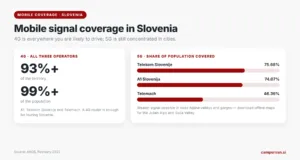
data from AKOS, the Slovenian communications regulator, for February 2025, all three major operators, A1, Telekom Slovenije and Telemach, cover more than 93% of the territory and more than 99% of the population with a 4G signal.
The picture for 5G is different. The network is still being rolled out and is concentrated mainly in larger cities. According to the same data, Telekom Slovenije covered 75.68% of the population with 5G, A1 74.07% and Telemach 46.36%. For a router, this means a 4G model is perfectly sufficient for travelling around Slovenia, while 5G is mainly useful in cities and along main roads.
Where can the signal weaken? In deep Alpine valleys, in gorges, at the foot of high rock faces and on some remote mountain pastures. If you are planning a
campervan round trip of Slovenia, download maps for the Julian Alps and Soča Valley sections in advance for offline use. The same goes for choosing where to stay: before deciding on a stopover, also check the rules we describe in our guide to
overnight stays with a campervan in Slovenia.
If you are curious how we got to today’s coverage, you can visit the
Museum of Post and Telecommunications in Polhov Gradec on your way out of Ljubljana. Telephone exchanges, telegraphs and old devices are a nice reminder that a call from the valley was once a real achievement, while today you can easily send a report or post your travel photos from your laptop in the same place.
Data plans, SIM cards and operator rules
This is where most of the pitfalls lie, so take a few minutes to read the small print.
Tethering restrictions. According to
Google’s Android help, some mobile operators restrict tethering or charge extra for it. It matters even more with a router: operators can use fair use policies to restrict the use of SIM cards in such devices. Telemach, for example, states in its
special terms valid from 1 August 2025 that using the card predominantly as a mobile hotspot may constitute a breach of the rules. For a router, therefore, choose a plan intended for data use.
Prepaid plans. For occasional trips, a prepaid SIM card with no contract is practical. For its
Mobi prepaid plans, Telekom Slovenije lists speeds of up to 1 Gbit/s, no monthly bills and an eSIM option; in 2026 the cheapest plan was available for €4.99 per month. Data allowances and prices change, so check the current offer with the operator.
Roaming in the EU. If you continue from Ljubljana to Austria, Italy or Croatia, the “roam like at home” principle applies. According to the
Your Europe portal, you are considered to be roaming abroad as long as you spend more time at home than abroad or use your phone more at home. The data allowance when roaming may be smaller than at home, and different prices apply when travelling to non-EU Balkan countries such as Bosnia and Herzegovina or Montenegro. Check them before you leave.
Visitors to Slovenia. If you are coming from further afield, a Slovenian prepaid SIM card in your router or phone can save you a lot of money compared with roaming on your home operator from outside the EU.
Quick checklist before you leave
- Check how much data your plan includes at home and when roaming.
- Read whether your operator allows tethering and using the card in a router.
- Unlock the router for all networks if you bought it as part of a plan.
- Turn on metered connection and switch off automatic syncing on your laptops.
- Download maps for offline use.
- Bring a USB car charger or a cable for charging from the vehicle.
Power and charging in a campervan
Whichever source of internet you choose, it needs electricity. You can charge your phone and router from the vehicle’s sockets while driving, and plug into electricity at the campsite. We have gathered how to do this safely and what you need in our guide to
campervan hook-ups at campsites. If you stay overnight without a hook-up, get a power bank for the router; smaller models use little power and last longer with one.
Our view on internet in a campervan
When renting, travellers often ask us how they will stay connected on the road. Our answer is always the same: first imagine how you will travel, and only then choose the device.
For a couple setting off to explore Slovenia for a few days, a phone is perfectly enough. But anyone who rents a campervan from us for a week or more, perhaps with children or a laptop for work, will quickly appreciate having their own network in the vehicle. The compact design of a campervan means that one well-placed router covers the whole living space, from the kitchen to the beds.
As a family business from Ljubljana, we know Slovenian roads, passes and the corners where the signal weakens. Before you leave, we are happy to advise you on routes and destinations in Slovenia, the Alps and the Balkans, so you know where you will be connected and where you can switch off completely with a clear conscience.
Rok
Hit the road in our campervan
Whether you share the internet from your phone or bring your own router, two well-equipped campervans are waiting for you in Ljubljana. The Mercedes V Marco Polo is available from €125 per night for daily rental and from €110 per night for weekly rental, and the same applies to the Ford Nugget Plus. Final cleaning costs €80 per rental.
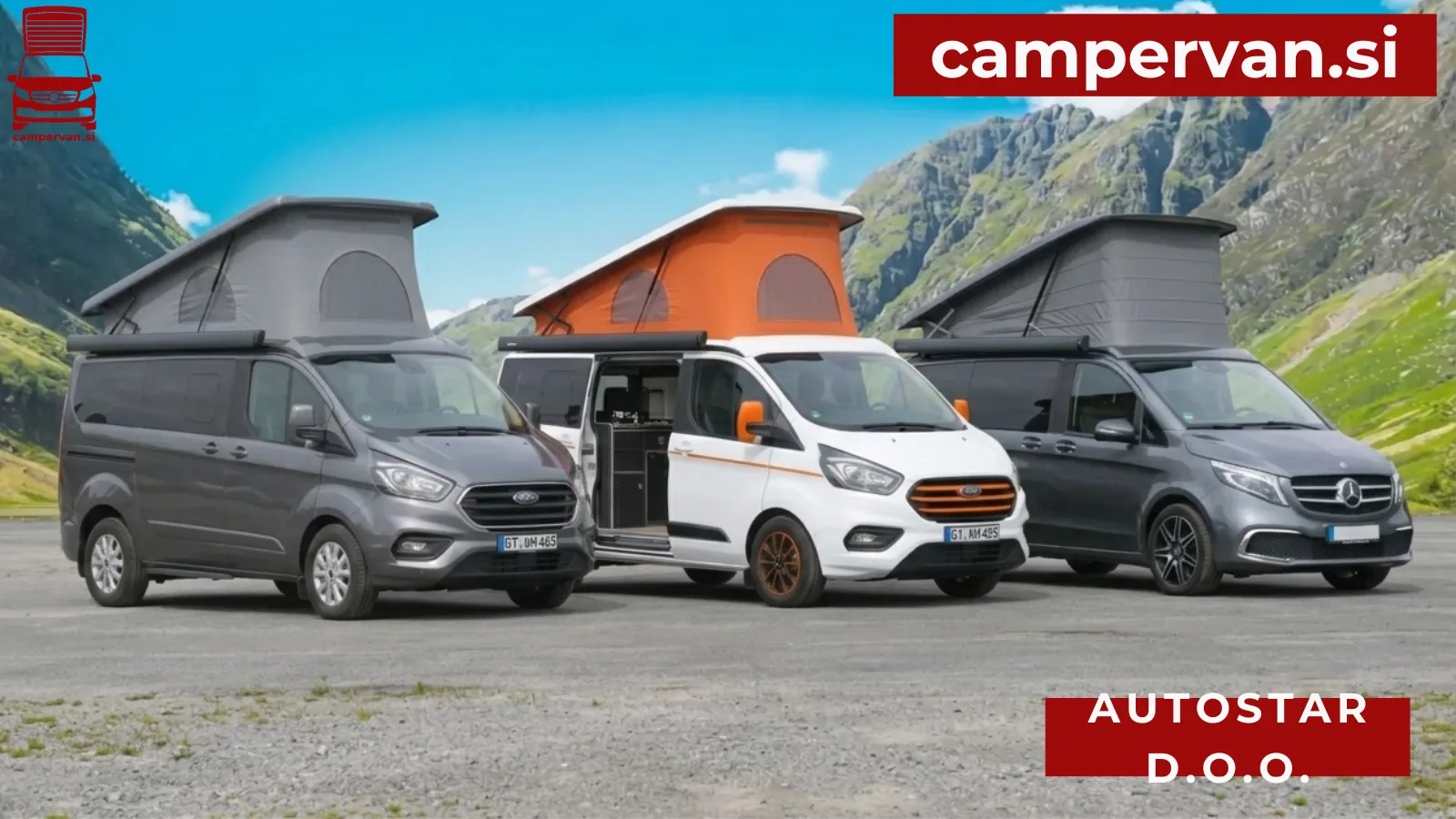
Both models have a kitchen and beds for several people, and the rental includes basic insurance and 24/7 assistance. Take a look at
Mercedes V Marco Polo rental or
Ford Nugget Plus rental and choose your dates.
Frequently asked questions
Is a mobile router faster than a phone hotspot?
Not necessarily, as both use the same mobile network. A router, however, usually holds the signal more stably, can be placed where reception is best and handles more simultaneous devices better. With prolonged use, the experience is therefore often better.
Can I put my phone SIM card in a router?
Technically yes, usually, if the router is unlocked. But check your plan’s terms, as an operator may consider using the card mainly as a hotspot a breach of its fair use policy. It is safer to choose a separate data or prepaid plan.
Does USB tethering use less battery?
With USB tethering, the phone charges at the same time, so it is a good choice when you are working on a laptop. A Bluetooth connection is slower but power-efficient, while a Wi-Fi hotspot is the most convenient for several devices.
Will I have a signal at all stopovers in Slovenia?
4G covers more than 93% of the territory, so you will be connected almost everywhere. The signal can weaken in deep Alpine valleys and gorges, so download maps for these sections in advance.
Sources
CCampervan
Ask us about travelling by campervan
Get in touch if you are planning a trip around Slovenia and would like to know more about renting a campervan or motorhome in Ljubljana.