Switzerland by campervan is one of the most beautiful trips you can start in Ljubljana: lakes, glaciers and Alpine passes are just a few days’ drive away, and every evening you choose your own view. It works best from April to October, with 1 to 3 hours of driving a day, a CHF 40 vignette for vehicles up to 3.5 t and overnight stays at campsites that you book in advance in high season. Below you will find two tried-and-tested routes, approximate costs, the rules of the road and tips that will save you plenty of surprises.
Start your Swiss road trip in Ljubljana
Rent a campervan in Ljubljana and plan your own exploration of Swiss lakes, mountain passes and Alpine roads at your own pace.
See our campervans
Key takeaways
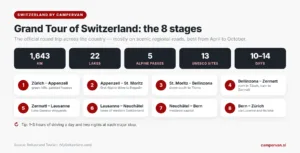
- The official Grand Tour of Switzerland round trip is 1,643 km long, links 22 lakes, 5 Alpine passes and 13 UNESCO sites, and is divided into 8 stages.
- Travellers take 10 to 14 days for the full loop, while a shortened version can be driven in one week.
- For Swiss motorways you need a CHF 40 vignette (vehicles up to 3.5 t), and some tunnels and car trains are paid separately, for example the Furka car train at CHF 33.
- You cannot drive a campervan into Zermatt: leave the vehicle in Täsch and continue by train.
- Overnight stays outside campsites are restricted in many places, so choose campsites and stopovers in advance.
Table of contents
When is the best time for Switzerland by campervan
Switzerland Tourism
recommends April to October for driving the Grand Tour. Each part of the season has its own charm:
- April and May: quieter roads, valleys in bloom and pleasant stops in cities such as Lucerne, Bern or Lausanne. High passes may still be closed at this time.
- Summer: the main season for the Grand Tour. The passes are open, the lakes invite you to swim and hiking trails are accessible high above the valleys. Campsites are at their busiest, so booking is essential.
- September and October: autumn colours, clear views and fewer crowds. Autumn is perfect for those seeking peace by the lakes and relaxation in thermal baths.
Weather in the Alps changes quickly, and passes can close even outside winter. Check road conditions before every climb and expect more traffic on Fridays, Sundays and at the start and end of school holidays, as a
Switzerland road trip guide advises.
How to plan your route: the Grand Tour and shorter versions
The easiest starting point for planning is the
official Grand Tour of Switzerland, a round trip across the whole country. Its eight stages run as follows:
- Zürich–Appenzell
- Appenzell–St. Moritz
- St. Moritz–Bellinzona
- Bellinzona–Zermatt
- Zermatt–Lausanne
- Lausanne–Neuchâtel
- Neuchâtel–Bern
- Bern–Zürich
The route
mostly avoids motorways, taking you along scenic regional roads, through villages and past lakes. For a campervan this means a slower but far more beautiful pace. The
official Grand Tour app helps you plan, letting you choose ready-made sections or build your own route and see driving times, distances and sights along the way.
How many days do you need
Most travellers
take 10 to 14 days for the full loop, while a shortened route can be driven in seven days. From Ljubljana, add a day’s drive to the Swiss border and a day to get back. For a relaxed trip, a simple rule applies: no more than 1 to 3 hours of driving a day and two activities, no more. We describe how to realistically estimate daily distances by campervan in more detail in our guide on
driving pace and daily distances, which applies to the Alps too.
One-week route: eastern Switzerland and Ticino
This version is ideal for a first trip, as eastern Switzerland and Italian-speaking Ticino can be reached relatively quickly from Slovenia, and you can return via Italy.
| Day |
Section |
What to experience |
| 1 |
Ljubljana – eastern Switzerland |
Travel day, first campsite near the border or in Appenzell |
| 2 |
Appenzell and surroundings |
Green hills, traditional villages, a short hike |
| 3 |
Appenzell – St. Moritz |
First Alpine drive towards the Engadin |
| 4 |
St. Moritz |
Engadin lakes, a cable car to a viewpoint |
| 5 |
St. Moritz – Bellinzona |
Descent to the south, the mighty castles of Bellinzona |
| 6 |
Ticino |
Lake Lugano, a relaxed day by the water |
| 7 |
Ticino – Ljubljana |
Return via Italy |
10- to 14-day route: the big loop
If you have two weeks, you can drive most of the Grand Tour. After Ticino, continue towards Valais and Zermatt, then along Lake Geneva to Lausanne, via Neuchâtel to Bern and on towards Lucerne and Zürich. For each major stage, allow two nights in the same place: that way you drive one day and on the next you hike, take a boat or ride a cable car above the valley. Lonely Planet advises
combining driving with mountain railways and cable cars, as only from above do you truly feel the scale of the Swiss landscape.
Sights you should not miss
The choice is of course a personal one, but these places prove themselves time and again on a campervan trip through Switzerland:
- Appenzell: a fairy-tale landscape of green hills and painted houses, ideal for a gentle start.
- St. Moritz and the Engadin: high-mountain lakes, fresh air and wonderful views.
- Bellinzona and Lugano: a Mediterranean vibe, palm trees by the lake and Italian cuisine.
- Zermatt and the Matterhorn: Zermatt is a car-free village, so you park your campervan in Täsch and take the train to the village and back.
- Lake Geneva and Lausanne: terraced vineyards above the water and city walks.
- Interlaken and the Jungfrau: a base for trips between Lakes Thun and Brienz and into the Jungfrau region.
- Lucerne: the old bridge, the lake and mountains within reach by boat.
- Bern: the capital with a medieval old town, perfect for an unhurried stroll.
Campervan
Choose a campervan for Switzerland
Choose a campervan in Ljubljana that lets you explore Switzerland according to your own plan.
Campervan rental | Campervan.si
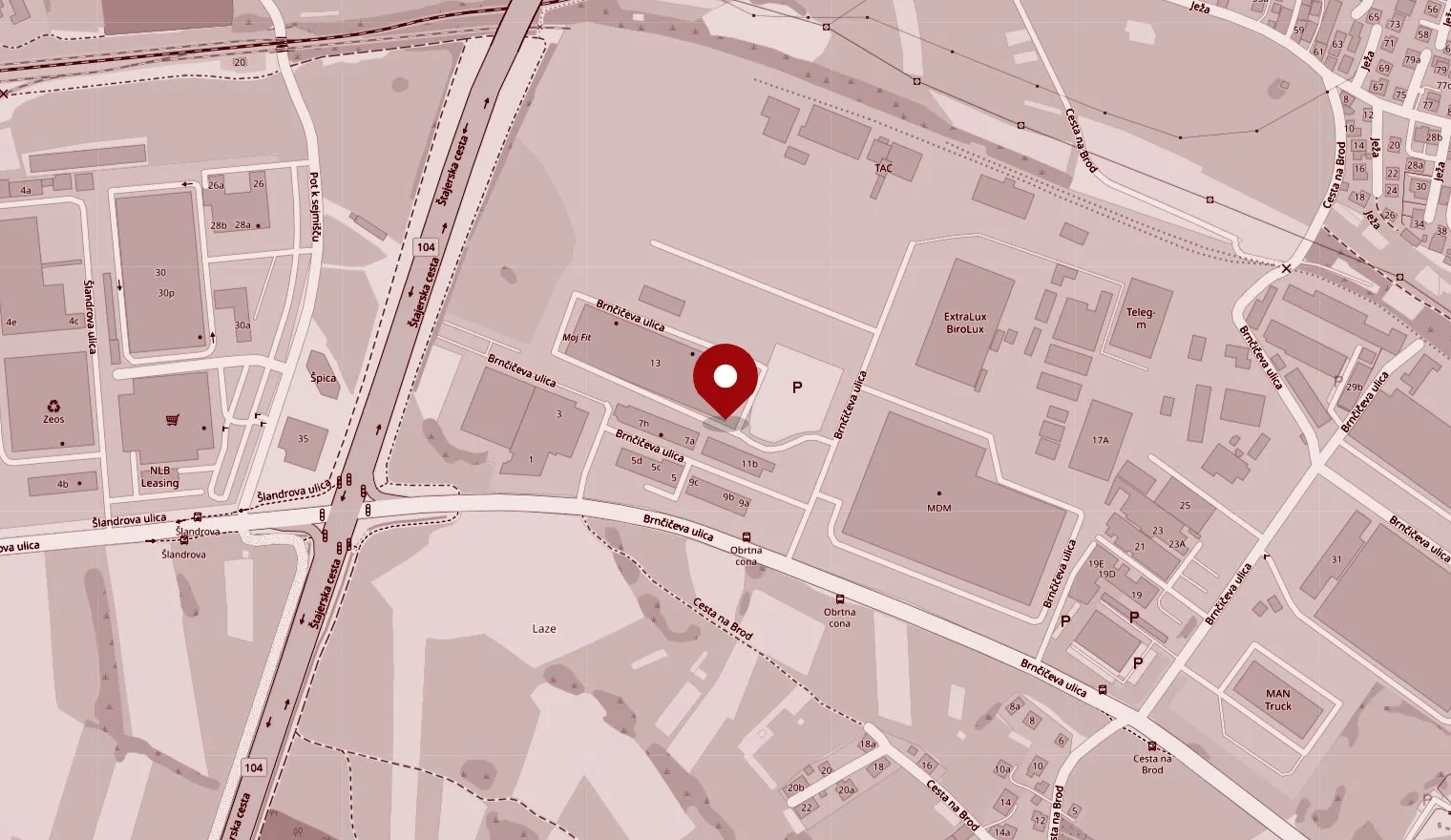
Brnčičeva ulica 13, 1231 Ljubljana, Slovenia
Get directions
How much does Switzerland by campervan cost
Switzerland is known as an expensive country, but with a campervan much of the cost is in your hands: you cook for yourself, you do not pay for hotels, and you adapt the route to your budget. The main items are:
| Item |
What to consider |
Approximate amount |
| Vignette (up to 3.5 t) |
Mandatory for motorways |
CHF 40 |
| Flat-rate heavy vehicle charge (over 3.5 t) |
Applies instead of the vignette |
Charged per day |
| Furka car train |
Vehicle up to 3.5 t or motorhome up to 5 t |
CHF 33 |
| Lötschberg car train |
Car up to 3.5 t or motorhome up to 5 t |
CHF 28 |
| Alpine passes |
No toll |
CHF 0 |
| Campsites |
Depends on region and season |
Check the campsite guide |
| Mountain railways and cable cars |
Paid separately per line |
Check with the operator |
The prices of the Furka and Lötschberg car trains are listed by
AMZS (the Slovenian automobile association) in its overview for Switzerland. The passes are
toll-free, but some tunnels are paid separately, for example Munt la Schera and the Great St Bernard, as are the Vereina, Furka and Lötschberg car trains, which save you a long detour over the mountain.
On the way from Slovenia you also cross Austria or Italy, so include their tolls in your budget as well. It pays to fill up before the border and keep an eye on fuel prices along the way.
Driving rules in Switzerland
Swiss rules are clear. The most important points for drivers coming from Slovenia are:
- Vignette: on motorways, motor vehicles up to 3.5 t need a CHF 40 vignette, valid from 1 December of the previous year to 31 January of the following year. The vignette does not apply to motorhomes with a maximum permitted weight over 3.5 t; for these, a flat-rate heavy vehicle charge (PSVA) is payable. Check your vehicle’s weight in the registration document.
- Speed: 120 km/h on motorways, 100 km/h on expressways, 80 km/h outside built-up areas and 50 km/h in built-up areas, unless signed otherwise.
- Lights: daytime running lights are mandatory, and the fine for driving without them is CHF 40.
- Alcohol: the general limit is 0.5 per mille, and 0.1 per mille for drivers who have held their licence for less than three years.
- Winter equipment: winter tyres are mandatory in wintry driving conditions, and snow chains may also be required on higher passes.
Speed limits and the rules on lights, alcohol and winter equipment are summarised by
AMZS for Switzerland; check it for any changes before you leave.
Driving over Alpine passes
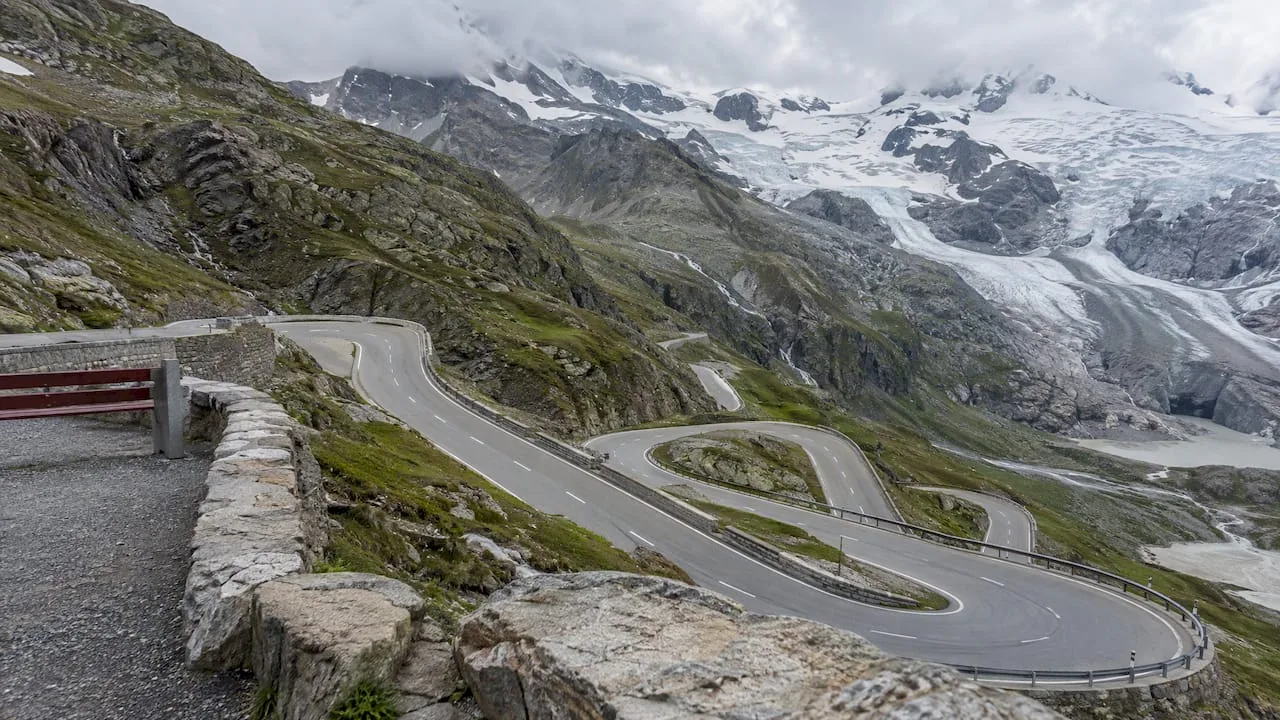
The passes are the highlight of any Swiss road trip: hairpin bends, glaciers beside the road and viewpoints where you stop for coffee. Drive downhill in a lower gear and use engine braking, and give the vehicle plenty of room on tight bends. You can practise all this at home first, so take a look at our tips for
driving on mountain roads in Slovenia before you tackle the Swiss passes.
Where to stay overnight with a campervan
The most reliable choice is official campsites, of which Switzerland has many, from Alpine valleys to lakeshores. The
Campingführer Schweiz 2026 guide helps you search, listing campsites by region along with the months they are open. This is particularly useful in spring and autumn, when many higher-altitude campsites are not yet or no longer open.
Overnight stays outside campsites are restricted or prohibited in many places in Switzerland, and the rules vary from place to place. Respect the signs at car parks and choose a campsite or an official motorhome stopover for the night. In larger cities there are few parking spaces for bigger vehicles, so Park & Ride car parks on the outskirts often come in handy, from where you can take public transport into the centre.
If you are planning a night in a hotel, ask about the garage height and space for a van when you book. This guide to
parking a van at a hotel nicely sums up what to check.
Choosing a campervan for Switzerland
A compact campervan proves its worth in Switzerland: it is easier to park in cities, it handles narrow mountain roads with confidence, and it still offers everything you need for a comfortable stay. When choosing, think about the number of passengers, the beds you need and whether you want a toilet on board. Before you leave, also read our list for
smart campervan packing: in the Alps, do not forget warm clothes for the evenings, even in the middle of summer.
Checklist before you leave
Once your route is chosen, this short list helps make sure you are not left without anything important at the border or below a pass:
- Check the vehicle’s weight in the registration document and decide between the vignette and the flat-rate charge.
- Buy the vignette for the current year before you drive onto the first Swiss motorway.
- Book campsites for summer weekends and popular places such as Interlaken, Lucerne or the area around Zermatt.
- Check that passes are open on the day of driving, especially in spring and late autumn.
- Have a backup plan with a car train or tunnel if a pass is closed due to snow.
- Bring warm clothes and good shoes for hikes and evenings at altitude.
- Save the assistance number and keep the vehicle documents within reach.
- Plan two rest days without driving, to spend at a lake, on a cable car or walking around a city.
With good preparation, you will have more time for what you set out for: morning coffee with a view of a glacier and evenings by the lake.
Our view
Switzerland is one of those destinations we recommend to our guests again and again, because it is quick to reach from Ljubljana yet offers a completely different world: high passes, turquoise lakes and an orderliness that makes travelling worry-free.
As a family business, we see that the best experiences come from a simple plan: fewer kilometres, more stops. We advise guests not to try to conquer all of Switzerland, but to choose two or three regions and stay at least two nights in each. That leaves time for a cable car, a swim in a lake or an evening cooking in front of the campervan.
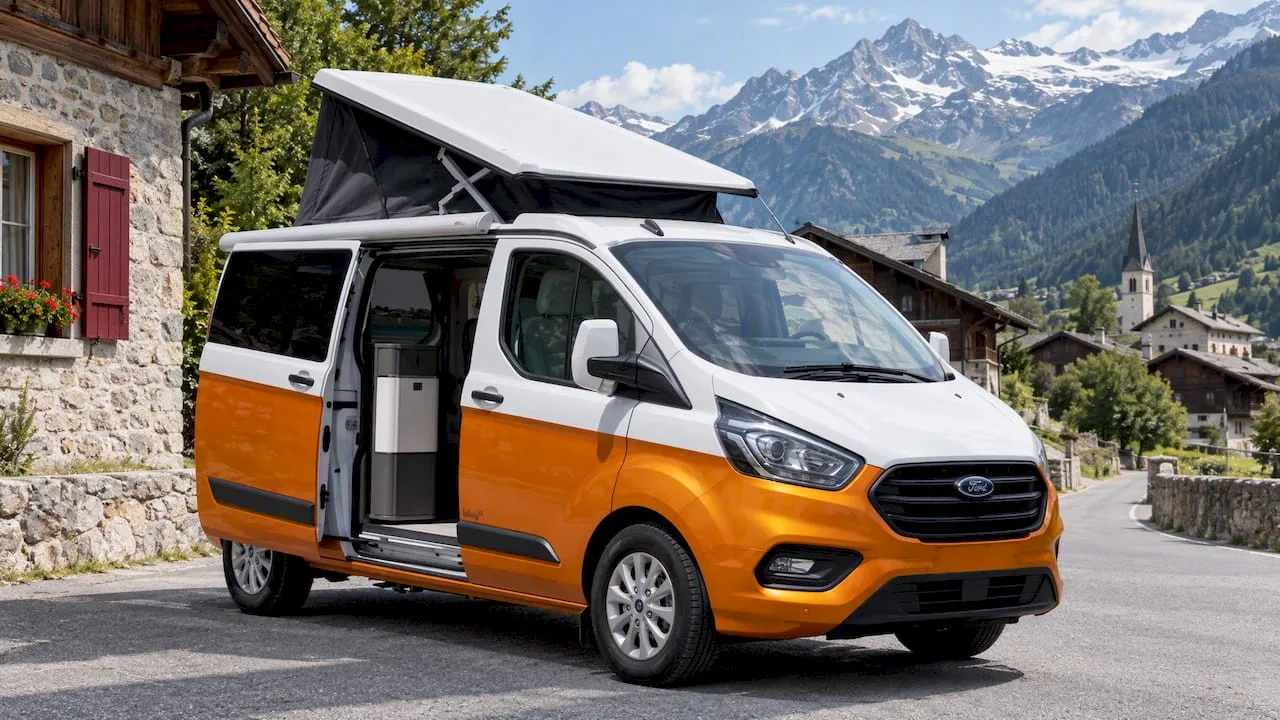
That is exactly why we prefer to send compact campervans such as the Mercedes V Marco Polo and Ford Transit Nugget Plus to Switzerland. Modern, carefully maintained and fully equipped for living on board, they are nimble in the mountains and cause no parking headaches in cities. Before you leave, we are happy to help plan your route through the Alps and neighbouring countries.
Rok
Campervan rental in Ljubljana for a trip to Switzerland
Your Swiss trip can start right in Ljubljana. Our fleet includes the
Mercedes V Marco Polo and the
Ford Nugget Plus, equipped with a kitchen, beds for several people, basic insurance and 24/7 assistance. Daily rental starts at €125 per night, and weekly rental at €110 per night. Final cleaning is €80 per rental.
For a week in eastern Switzerland and Ticino or two weeks on the Grand Tour, choose your dates and book the
Mercedes V Marco Polo or the
Ford Nugget Plus. If you are still deciding, read about our
experience with the Mercedes Marco Polo and our
experience with the Ford Nugget Plus.
Frequently asked questions
Do I need a Swiss vignette for a campervan?
Yes, if you will be driving on Swiss motorways and the vehicle has a maximum permitted weight of up to 3.5 t. The vignette costs CHF 40 and is valid from 1 December of the previous year to 31 January of the following year. For vehicles over 3.5 t, a flat-rate heavy vehicle charge is payable instead of the vignette.
Can I stay overnight anywhere in Switzerland with a campervan?
No. Overnight stays outside campsites are restricted or prohibited in many places, so respect the signs and local rules. The most reliable option is to stay at campsites or official stopovers, which you book in advance in high season.
How many days do I need for Switzerland by campervan?
For a first visit, one week is enough to see two or three regions, for example Appenzell, the Engadin and Ticino. For the full Grand Tour, allow 10 to 14 days, plus a day to get there from Slovenia and a day to get back.
How do I get to Zermatt with a campervan?
Not by campervan, as Zermatt is a car-free village. Park the vehicle in Täsch and take the train to Zermatt and back.
Sources
CCampervan
Ask about a rental for Switzerland
Get in touch if you would like to know more about renting a campervan in Ljubljana for your trip around Switzerland.