20% off rentals until the end of March 2027 with code SNOW20•20% off rentals until the end of March 2027 with code SNOW20•20% off rentals until the end of March 2027 with code SNOW20•20% off rentals until the end of March 2027 with code SNOW20•
20% off rentals until the end of March 2027 with code SNOW20•20% off rentals until the end of March 2027 with code SNOW20•20% off rentals until the end of March 2027 with code SNOW20•20% off rentals until the end of March 2027 with code SNOW20•
Service stations for campervans in Slovenia: where, how, and at what cost
October 26, 2026
A motorhome service point is a place where you can refill your fresh water tank, empty your grey and black water tanks and chemical toilet, and often connect to electricity. In Slovenia, these facilities are mainly found at motorhome stopovers (PZA) and campsites. The network includes more than 150 designated locations, ranging from simple parking areas to fully equipped service points. In this guide, you will learn how to identify a service point, how much it costs, and how to carry out your vehicle’s servicing quickly, hygienically and in accordance with local rules. This guide has been prepared by Campervan, a family-run campervan rental company based in Ljubljana. We help our guests plan routes through Slovenia, the Alps and the Balkans every day.
Campervan
campervan.si
Hit the road in a fully equipped campervan
Choose a campervan for your Slovenian road trip and plan service stops along your route.
Not every motorhome stopover has service facilities. In Slovenia, you will find basic parking areas without services, stopovers with partial facilities, and fully equipped motorhome service areas.
A fully equipped stopover provides electricity, fresh water, separate waste collection, a chemical toilet disposal point and a grey water drain.
Prices are generally reasonable. In Maribor, for example, a 24-hour stay for one motorhome and two people costs €19.60. Payment is often automated and may involve tokens, a card or cash.
Dispose of wastewater only at designated disposal points. Discharging it into nature, a ditch or a road drain is not permitted.
Before setting off, check the motorway vignette requirements and local parking regulations, as rules vary between municipalities.
What is a motorhome service point and what does it offer?
In everyday campervan terminology, a service point is a place where you can service your vehicle: fill the fresh water tank and empty the waste you do not want to carry with you. In Slovenia, the term most commonly used is postajališče za avtodome, meaning a motorhome stopover. According to the Slovenian government’s SPOT business portal, it is a designated area intended for parking leisure vehicles so that occupants can rest. It must have a barrier, a reception area if check-in is not automated, house rules, surfaced and marked spaces, electrical connections for all designated pitches, access to water, separate waste collection containers, and facilities for emptying chemical toilets and discharging wastewater.
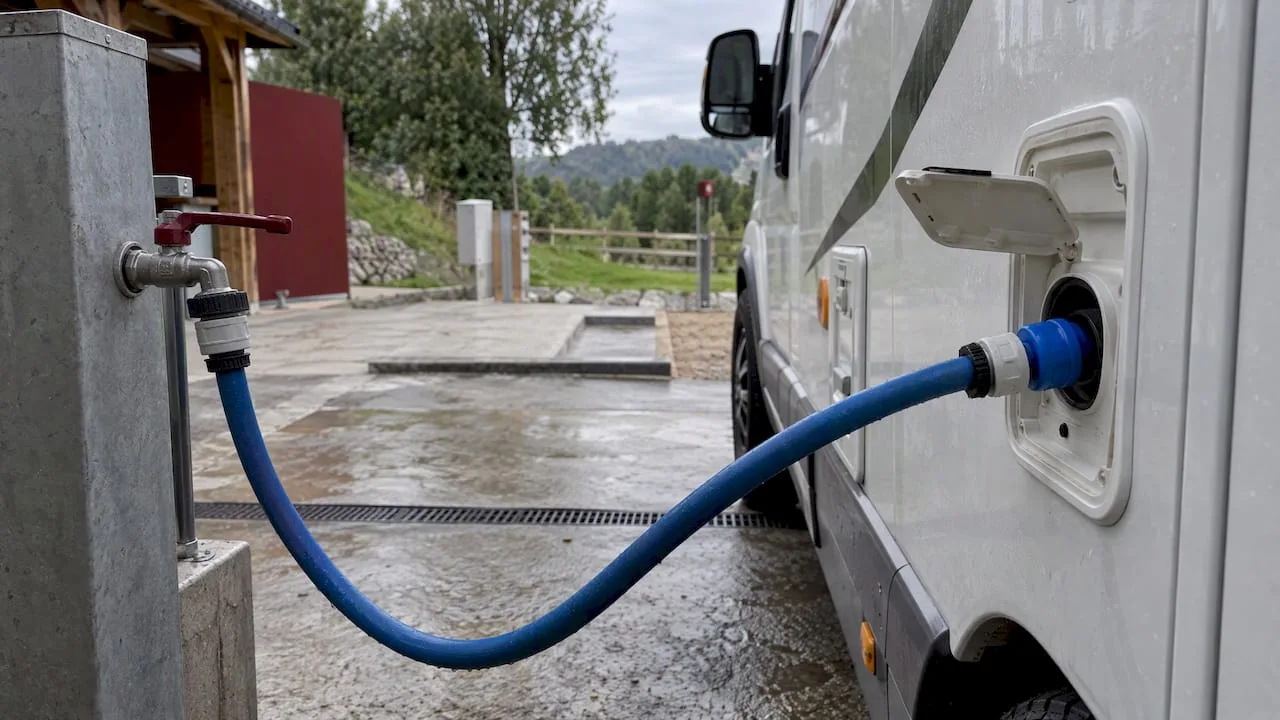
In practice, a service point usually includes:
A tap supplying drinking water for filling the fresh water tank.
A ground-level drain or drainage channel for grey water from the kitchen sink and shower.
A chemical toilet disposal point for black water, often with a separate tap for rinsing the cassette.
An electrical hookup post beside a parking space or on a shared service island.
Separate waste collection containers, and sometimes toilets and showers.
Modern motorhome stopover projects increasingly use a separate service and sanitation area. Professional planning guidance for motorhome stopovers notes that electrical hookup posts positioned directly beside parking spaces have proved less practical because of limited space and unpleasant odours. For you, this means that at newer sites you will often drive to a shared service area, complete the necessary tasks and then park in your allocated space.
Service points, motorhome stopovers, campsites and parking areas: what’s the difference?
These terms are often used interchangeably in conversation, but the facilities and rules can differ considerably. According to SPOT, a campsite is a fenced and secured area for tents, motorhomes, caravans and holiday homes. A motorhome stopover is primarily intended for parking and resting in a leisure vehicle, rather than camping in the full sense of the word. This usually means you cannot put out an awning, table or chairs unless the site’s rules specifically allow it.
Type of location
What it offers
Best suited for
Standalone service point
Water, grey and black water disposal, and sometimes electricity for a short period
When you only need a quick service stop during your journey
Motorhome stopover with partial facilities
A parking space and selected services, such as water or toilets
An overnight stay when you have enough water and your waste tanks are not full
Fully equipped motorhome stopover
Electricity, water, wastewater disposal, waste collection, and often internet and toilets
Spending several nights in one place or preparing for a longer journey
Campsite
A full range of services, security, sanitary facilities and often a restaurant and shop
A longer break, travelling with children or staying during bad weather
Regular parking area
Parking only, subject to local regulations
Visiting a town during the day, without staying overnight where overnight parking is not permitted
When planning your trip, it is also useful to know that professional recommendations specify a parking space measuring 4 × 8 metres for one motorhome, together with a sign displaying the rules, essential information and contact details. This sign should be your first point of reference: it tells you how long you can stay, how much it costs and where to find the service point. We explain the differences in more detail in our article about motorhome stopovers and how they differ from traditional campsites.
Where to find motorhome service points in Slovenia
The Slovenian Tourist Board divides motorhome locations into three categories: temporary parking areas without services, stopovers with partial facilities, and stopovers with extensive infrastructure, such as drinking water, electricity, internet and sanitary facilities. The same page includes a map of motorhome stopovers, which is a useful starting point when planning your trip. Check which category each location belongs to: a stopover without service facilities will not help when your grey water tank is full.
Here are a few examples that illustrate the range of facilities available:
Maribor:PZA Kekec offers electricity, water and sanitary facilities. There is also a parking area near the railway station, but it is intended for parking only and does not provide motorhome servicing.
Gorenjska region, Šenčur:PZA Cubis has 14 pitches with electricity, water and free internet and is open all year round. Its proximity to Kranj and the airport makes it convenient for the first or last night of a trip.
Slovenian wine-growing countryside, Jakobski Dol:Vinogradništvo Mulec offers a motorhome stopover with full facilities, and you can also order breakfast. It is a good example of combining practical vehicle servicing with an experience in Slovenia’s wine-growing countryside.
Kranjska Gora and Planica: According to the Smučarija website, the motorhome parking area below the Vitranc 1 chairlift does not offer service facilities but does have toilets. The spacious stopover in Planica is popular with cross-country skiers, hikers and ski tourers.
These examples illustrate a simple rule: plan your servicing separately from your overnight stop. If you intend to spend the night at a stopover without service facilities, visit a location with fresh water and wastewater disposal beforehand. For regional recommendations, see our profiles of popular motorhome stopovers and campsites.
Campervan
Start your journey in Ljubljana
Rent a campervan from Campervan in Ljubljana and explore Slovenia while planning service stops along your route.
How much does motorhome servicing cost and how do you pay?
Compared with many Alpine destinations abroad, prices in Slovenia are generally reasonable, although they vary considerably between locations. Some municipalities offer servicing free of charge or for a nominal fee because they know motorhome travellers may stay longer and spend money locally. A professional analysis of motorhome stopover planning specifically notes that well-maintained, free facilities encourage visitors to extend their stay, indirectly increasing revenue for the local community.
Examples of local prices and services include:
Payment methods vary. Unstaffed stopovers often use automated payment machines that accept tokens, payment cards or cash. Carry a few coins and a payment card, as not every machine accepts all payment methods. At some sites, you pay at the entrance barrier; at others, you pay at the reception of a nearby restaurant or through a mobile app specified on the information board. Prices can change from one season to the next, so check the official website before arriving. You can also find an overview in our article about the facilities offered at motorhome stopovers and how much they cost.
How to service your campervan step by step
Your first service stop can feel a little unfamiliar, but after the second one it usually becomes a routine that takes around ten to fifteen minutes. Here’s how to do it cleanly and efficiently, without holding up other travellers.
Before you arrive
Check your tank levels. Use the vehicle’s control panel to check the fresh water and grey water levels, as well as the fill level of the chemical toilet cassette.
Prepare your equipment. Bring disposable gloves, a hose suitable for drinking water with the appropriate connectors and, if needed, an attachment for draining grey water.
Read the information board. Check whether you need to pay before servicing the vehicle and where the various connections are located.
At the service point
Position your vehicle so that the drain outlet is above the drainage channel. Ground drains are usually sloped towards a central channel, so try to park as straight as possible.
Empty the grey water first. Open the drain valve and wait until the tank has emptied completely. If necessary, rinse the drainage area afterwards with a cleaning hose, not the drinking water hose.
Empty the chemical toilet next. Remove the cassette and carry it to the designated disposal point. Empty it and rinse it using the marked tap. Use only toilet chemicals suitable for disposal at service points.
Refill fresh water last. Use only a tap clearly marked for drinking water and your own clean hose. The tap used to rinse the toilet cassette must never be used to fill your fresh water tank.
Leave the area clean. Close the valves, put away your hoses and make sure there is no residue left on the ground.
Doing the dirty jobs before the clean ones is not only a matter of hygiene; it is also considerate to the people waiting behind you. If there is a queue, move your vehicle to a parking space once servicing is complete and organise the inside of your campervan there.
Electricity
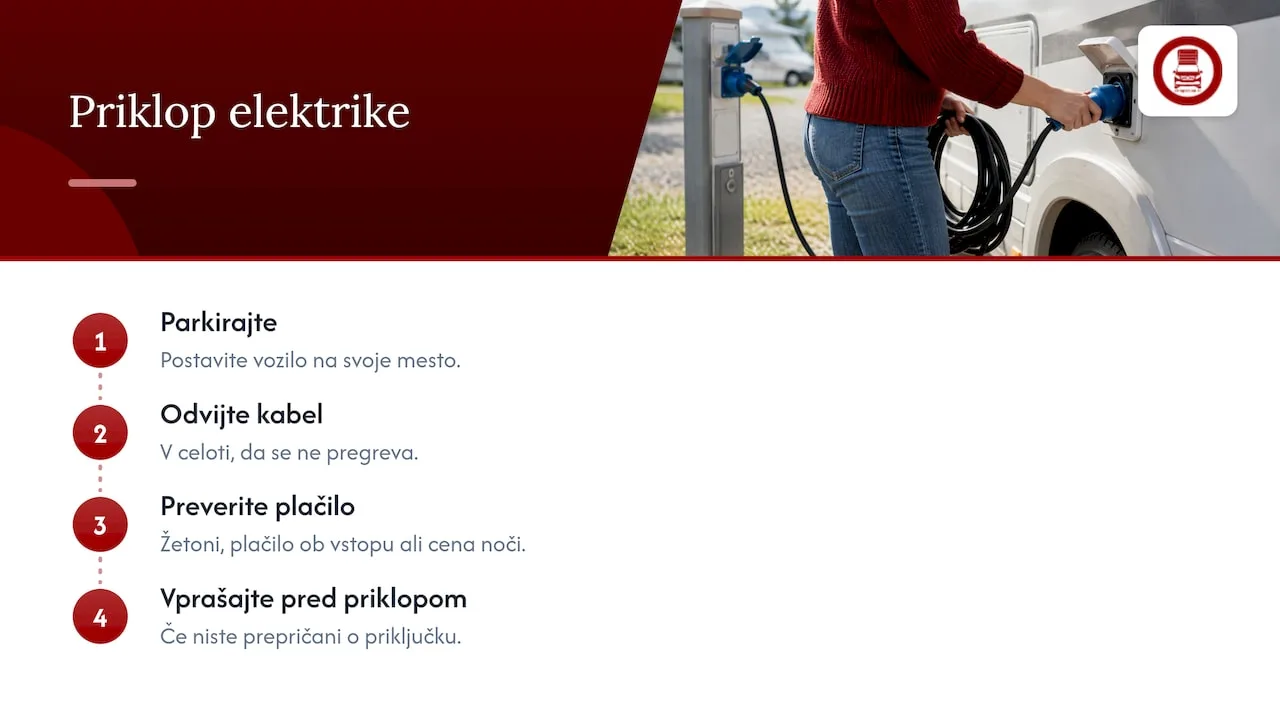
If the stopover offers electrical hookups, connect your vehicle only after parking in your designated space. Fully unwind the cable to prevent overheating, and check whether the electrical post operates with tokens, requires payment at the entrance or is included in the overnight fee. If you are unsure which connector your vehicle uses, ask your rental company or the site manager before plugging anything in.
Rules for parking, overnight stays and wastewater disposal
Slovenia is generally welcoming to motorhome travellers, but parking rules are set by individual municipalities and therefore vary from place to place. Some towns have local regulations specifying where motorhomes may park and directing them to designated areas. In the Karst and Brkini regions, you must display your arrival time on the windscreen using a parking disc or a note at designated public parking areas with time limits.
Wastewater disposal is not a grey area. Waste management in Slovenia is governed by environmental protection legislation, which sets strict rules to prevent pollution. Grey and black water must be discharged only into designated disposal points at service areas or campsites, never into a stream, ditch, field or road drain. This is particularly important in Slovenia’s karst landscapes, where water can quickly seep underground.
Keep this short checklist in mind at every stop:
Stay overnight only where it is explicitly permitted, such as a designated motorhome stopover, campsite or authorised parking area.
Respect the maximum permitted stay displayed on the information board.
Do not put out an awning, table or chairs at a stopover unless the site rules allow it.
Separate your rubbish and use the waste containers provided at the site.
Planning your trip: motorway vignettes, vehicle weight and seasonal availability
Slovenia is a small country, so you can travel across it from one end to the other in just a few days. This makes it practical to plan a service stop every two to three days, depending on your tank capacity and water consumption.
Before entering a motorway, make sure you understand the toll requirements:
Vehicles weighing up to 3.5 tonnes require an electronic motorway vignette. Buy it before entering the motorway through the official DARS website or an authorised seller. The fine for driving without a valid vignette ranges from €300 to €800.
Vehicles weighing more than 3.5 tonnes must use the DarsGo toll system, which calculates tolls according to the distance travelled.
Seasonal availability is another factor to consider. Some motorhome stopovers, such as PZA Cubis in Šenčur, are open all year round, while others shut off their water supply in winter to prevent freezing. When travelling in the mountains during winter, check whether the service point is operating and fill your fresh water tank while you are still at a lower altitude. Experienced winter motorhome travellers advise that you do not necessarily need to restrict yourself to campsites in Slovenia, except during extremely low temperatures. Read our guide on choosing the right stopover and preparing your motorhome before departure for more information.
Our perspective: make servicing part of the journey, not a chore
Whenever we hand over a vehicle to guests in Ljubljana, we show them the drain valves, toilet cassette and water connection before they set off. Experience has taught us that the first service stop can determine whether the rest of the trip feels relaxed. Once someone has completed the process with us guiding them, they can usually do it independently next time, without any stress.
Our advice is simple: build servicing into your daily itinerary. If you are leaving the Gorenjska region in the morning and heading towards the Karst, stop at a fully equipped service point before turning onto rural roads, where facilities may be less frequent. If you plan to spend the night at a remote stopover without services, arrive with a full fresh water tank and empty waste tanks. That way, you can enjoy a peaceful evening and wake up to the view rather than worrying about your next service stop.
Guests often ask us how much water they will actually use. The answer depends on their habits, so when you collect your campervan, we show you how to monitor the tank levels on the control panel and help you identify service points along your route. This personal approach is something we value as a family-run business, and one of the reasons our guests enjoy returning to us.
— Rok
Start your journey in a campervan from Ljubljana
If you would like to experience motorhome service points first-hand, we offer two modern campervans with kitchens and sleeping arrangements for several people, basic insurance and 24/7 roadside assistance. The Ford Nugget Plus, with its fixed toilet, is ideal for travellers who want greater independence between service stops. The Mercedes V Marco Polo impresses with its compact design and comfortable driving experience. Daily rental rates for both vehicles start at €125 per night, while weekly rates start at €110 per night. Final cleaning costs €80 per rental. When you collect your vehicle, we will be happy to advise you on routes through Slovenia, the Alps and the Balkans. Check availability using our booking form.
Frequently asked questions
Can I use a motorhome service point without staying overnight?
Many locations allow this, sometimes for a separate service fee, but the rules are set by the site operator. Read the information board at the entrance or call the contact number displayed there. At campsites, service facilities are generally intended for registered guests.
How often do I need to visit a motorhome service point?
This depends on tank capacity, the number of people travelling and whether you shower inside the vehicle. Most groups travelling in a compact campervan service their vehicle every two to three days. Monitor the levels on the control panel and plan your next stop before a tank becomes full.
Can I discharge grey water into nature if it only comes from washing dishes?
No. Grey water still contains detergents and food residue, so it must be discharged at a designated service point or campsite. Releasing it into nature or a road drain is contrary to environmental regulations and may result in a fine.
Are motorhome service points open in winter?
Some remain open all year round, while others turn off their water supply in winter to prevent freezing. Before a winter trip, check the website of the individual stopover and fill your fresh water tank at a lower altitude.