20% off rentals until the end of March 2027 with code SNOW20•20% off rentals until the end of March 2027 with code SNOW20•20% off rentals until the end of March 2027 with code SNOW20•20% off rentals until the end of March 2027 with code SNOW20•
20% off rentals until the end of March 2027 with code SNOW20•20% off rentals until the end of March 2027 with code SNOW20•20% off rentals until the end of March 2027 with code SNOW20•20% off rentals until the end of March 2027 with code SNOW20•
Camping Rules in Slovenia: Where You Can Spend the Night in a Motorhome
October 23, 2026
“`htmlIn Slovenia, you can legally spend the night in a motorhome or campervan at a registered campsite, a designated motorhome stopover (PZA), or on private land with the owner’s permission. Wild camping and overnight stays in random car parks are prohibited, and fines can be substantial, especially in Triglav National Park. Below, we have gathered the rules you are likely to encounter on your trip: what the law defines as a campsite, what motorhome stopovers offer, where parking becomes camping, what fines you may face, and what the house rules at most campsites require. We have also added practical advice that we share with our guests every day when they collect their campervan from us in Ljubljana.
Campervan
Explore Slovenia without worries
Choose a campervan for exploring Slovenia and check availability before setting off.
Overnight stays in a motorhome are permitted at campsites, designated motorhome stopovers (PZA), and on private land with the owner’s permission. Wild camping is prohibited.
Fines for unauthorised camping range from €40 to €500, with the strictest enforcement in Triglav National Park and Bohinj.
A short rest in a parked vehicle for safety reasons is not the same as camping. Once you open an awning, set up chairs, or use levelling ramps, enforcement officers may consider you to be camping.
Campsites in Slovenia must be classified from one to five stars. The classification determines requirements such as pitch sizes and the proportion of pitches with electrical hookups.
Keep an identity document with you, as the police may issue a fine if you cannot establish your identity.
Slovenia is a small but diverse country, offering lakes, mountains, karst plateaus and the coast within relatively short distances. Its network of designated overnight facilities for motorhomes is therefore well developed, and the rules are clear. The UK Foreign Office’s travel advice for Slovenia warns that wild camping is prohibited and that fines for unauthorised camping range from €40 to €500.
Location
Can you stay overnight?
What applies
Registered campsite
Yes
The campsite’s house rules apply; register on arrival and pay for your pitch.
Motorhome stopover (PZA)
Yes
A designated area with electricity, water and wastewater disposal facilities.
Private land (e.g. a tourist farm)
Yes, with the owner’s permission
Agree with the owner and observe local restrictions.
Public car park
Only for a short rest, where permitted
No awning, chairs, table or levelling ramps.
Natural areas, forests and lakeshores
No
Camping is prohibited and fines may apply.
This table is a simplified overview. Individual municipalities and parks may have their own regulations, so always read the signs at the entrance to a car park and at the start of a valley.
What Slovenian regulations define as a campsite
A campsite is not just any meadow with a sign. According to the description provided by the national SPOT business information portal, motorhome campsites fall under hospitality accommodation activities. A campsite is a clearly defined, enclosed and protected area with facilities for pitching tents and parking caravans and motorhomes. This means it has an operator, reception and house rules for which the operator is responsible.
Stars tell you what to expect
Registered campsites in Slovenia, except tourist farms, are required to be classified from one to five stars. The classification is not just a quality label; it also determines minimum requirements:
Category
Average pitch size
Share of pitches with electricity
1 star
At least 55 m²
At least 40%
5 stars
At least 90 m²
Significantly higher proportion
For a campervan such as the Mercedes V Marco Polo or Ford Nugget Plus, even a smaller pitch is perfectly adequate. For a larger motorhome with a trailer or extended awning, however, the larger pitches at higher-rated campsites are noticeably more comfortable. Some campsites also carry a sustainable tourism label, as highlighted in the Slovenian Tourist Board’s publication on campsites and nature.
Campsite house rules: what you will find almost everywhere
Every campsite has its own house rules, which you can obtain at reception or find on its website. The details vary, but most rules are similar:
Check-in on arrival. Reception usually requires an identity document for every guest, so keep them handy.
Quiet hours. Campsites set a time after which music, loud conversations and driving around the site are discouraged. Check the house rules for the exact hours.
Driving around the campsite. Drive slowly, and be aware that the entrance is often closed by a barrier at night.
Your pitch. Keep your motorhome within the marked pitch and do not occupy neighbouring areas.
Waste. Waste separation is standard practice in Slovenia. Empty chemical toilets and grey water only at designated disposal points.
Fires and barbecues. Open fires are generally allowed only in designated fire pits. Check with reception about barbecue rules.
Pets. Many campsites accept pets but require them to be kept on a lead and their waste to be collected.
PZAs in Slovenia are designated facilities, but they are not classified in the same way as campsites. According to the official standards cited by the Slovenian Tourist Board, a stopover should have an entrance barrier, level and marked parking spaces, an electrical connection at every space, access to fresh water, and facilities for waste separation and the disposal of chemical toilet waste and grey water.
Who is a PZA best suited for? Travellers with a clear destination who want to get going again quickly in the morning: one night beneath the Alps, then on towards the Karst region or the coast. Stopovers are often closer to town centres and attractions than campsites, but they do not offer the toilets, swimming pools and reception facilities you may be used to at a campsite. A campervan with its own kitchen and water supply is ideal for this type of stay.
Some rules that apply at most PZAs:
Stays are generally limited to a short period, often one or a few nights.
Payment is made at a barrier-side machine, through an app or at a nearby reception desk.
Outdoor tables and chairs are permitted only if the operator explicitly allows them.
Fill up with drinking water only at designated points, and never pour wastewater into drains or into nature.
Parking or camping: where is the line?
This is the question our guests ask most often. The answer is simpler than it might seem. As explained in this article about overnight stays in vehicles in Slovenia, parking and resting in a vehicle for safety reasons are not the same as camping. A parked vehicle may be considered a campsite once you extend an awning, set up chairs outside or level the vehicle using ramps. In other words, sleeping alone does not necessarily constitute the offence; setting up a living space around the vehicle does.
In practice, this means:
If you are tired, stop in a permitted place and rest in the vehicle. Road safety comes first.
Do not extend the awning, set up a table or cook outside the vehicle.
Do not stay for several consecutive nights in the same car park.
Observe the signs: restrictions on overnight motorhome parking are common around lakes and in tourist valleys.
There can be grey areas. If you are on holiday rather than stopping for an emergency rest, a campsite or PZA will save you stress and money. We explain what is allowed and where you can still enjoy a sense of wilderness in our article about wild camping in Slovenia.
Campervan
Start your trip with the right choice
When guests collect their campervan in Ljubljana, we share practical tips for travelling around Slovenia.
The Julian Alps are one of the main reasons many people travel around Slovenia by motorhome, and the rules are strictest there. According to Promet Bohinj’s page on campsites and stopovers, overnight stays, camping, pitching tents, bivouacking and resting in motorhomes in the Julian Alps and Triglav National Park are permitted only in designated areas, campsites and overnight motorhome parking areas.
There is no room for improvisation here. Car parks around Lake Bohinj, in the Trenta Valley and along the road towards Vršič are often monitored by enforcement officers. According to the UK travel advice, fines in such areas can reach €500. Our advice: during the summer season, book your campsite near Bohinj or in the Soča Valley in advance, as spaces fill up quickly.
Nature has its own rules
Slovenia prides itself on being one of the world’s most sustainable destinations, but maintaining that reputation depends on visitors. The Slovenian Tourist Board publication emphasises the importance of respecting local rules, including:
restrictions on flying drones in parks,
lighting fires only in designated fire pits,
driving only on designated roads, never across meadows or along forest tracks where driving is not permitted.
We would add a few simple principles: take your rubbish with you, do not discharge grey water beside the road, and stay on marked trails in the mountains. That way, the mountains, lakes and views will remain as beautiful for future visitors as they are today.
Fines and documents to carry
Fines in Slovenia can be substantial enough that it is worth knowing in advance what you could face:
Offence
Possible fine
Unauthorised camping or overnight stay
€40–€500
Failure to establish your identity during a police check
€50–€200
Both figures are provided by GOV.UK’s travel advice for Slovenia, which advises foreign visitors to carry at least a copy of their passport at all times. For Slovenian travellers, this means carrying an identity card or passport, as well as your driving licence and the vehicle registration document. When renting a vehicle, the vehicle documents will be inside it; your personal identification documents are your responsibility.
Safety at campsites and rest areas
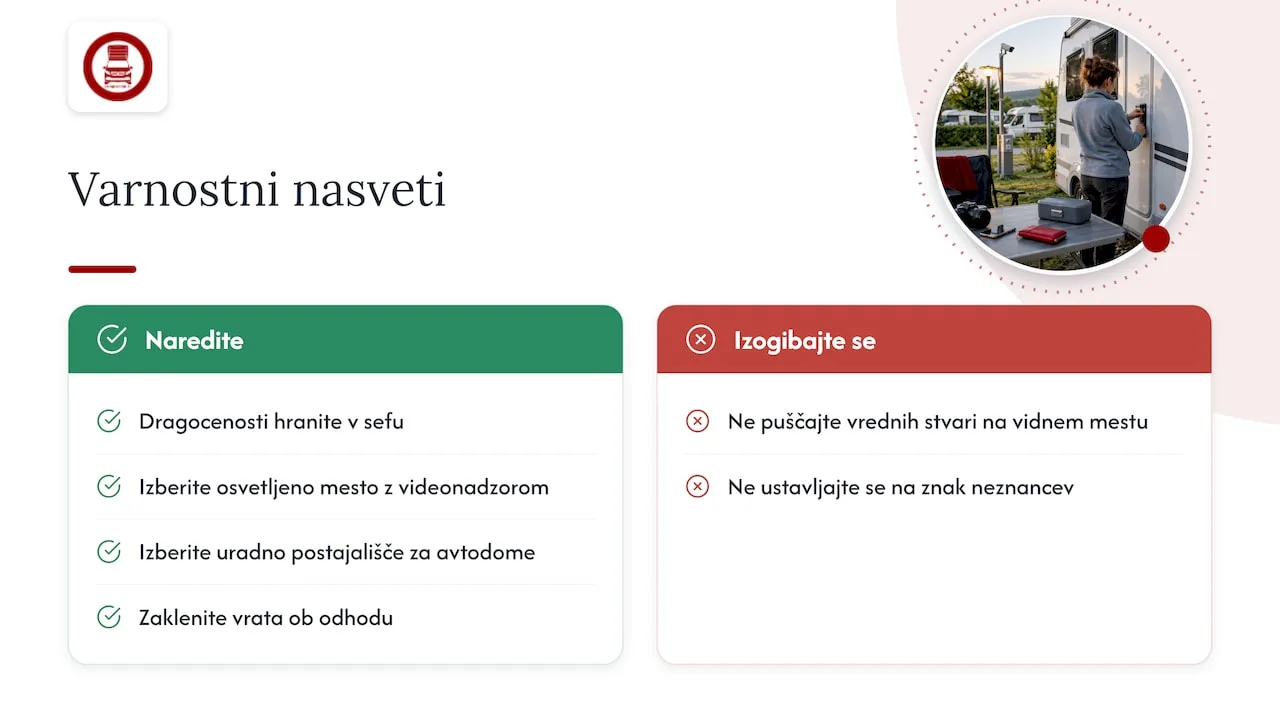
Slovenia is among the safest countries in Europe, but the police warn that crime more often targets property than people, and that a tent or motorhome is not as secure as a home. They advise against leaving valuables in plain sight and recommend keeping documents and valuables in a campsite or hotel safe. They also warn drivers not to stop on the motorway if strangers signal them to do so.
Motorway rest areas deserve particular attention. The police page on thefts at motorway rest areas reports an increase in thefts and robberies in recent years, involving everything from tyres to items taken from vehicles. If you need to stop because you are tired, choose a well-lit part of the rest area with CCTV or an official motorhome stopover. Lock the doors even if you are only stepping away for a few metres.
Before you go: vehicle, driving licence and route
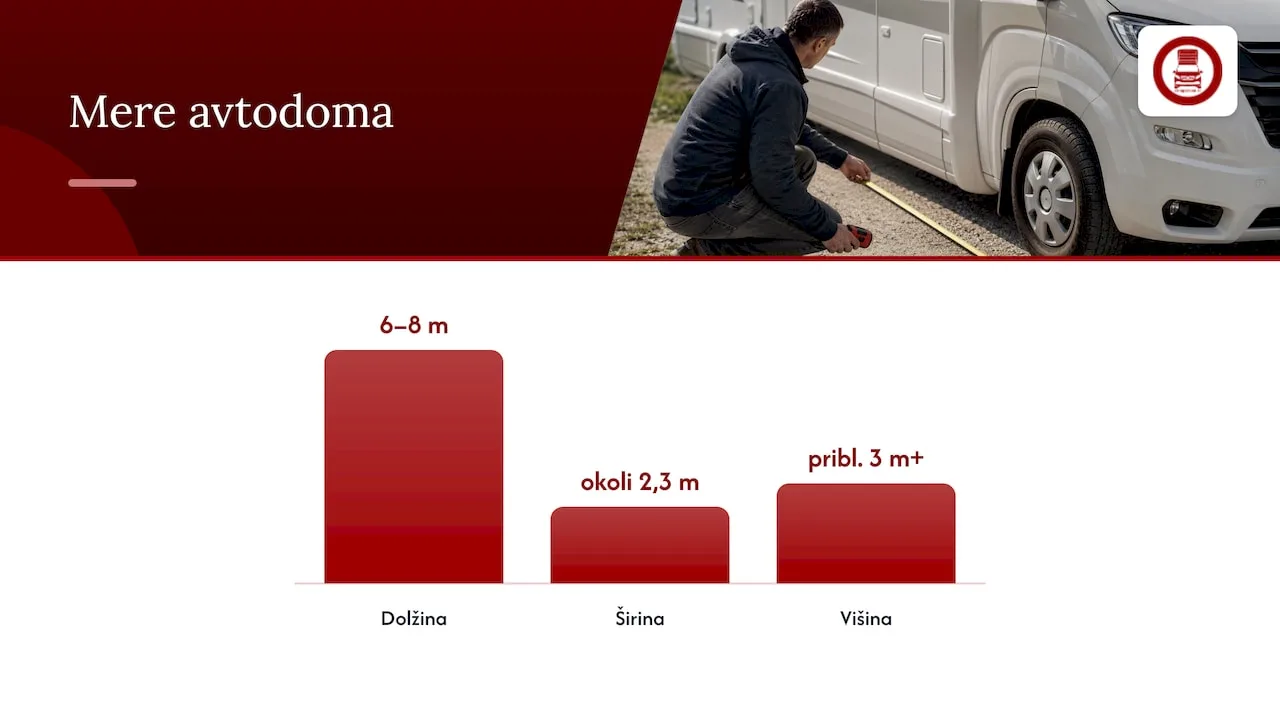
Campsite rules are only one part of the picture. The other is the journey itself. The Slovenian Traffic Safety Agency points out that a typical motorhome is six to eight metres long, around 2.3 metres wide and approximately three metres high or more. As a result, braking distances are longer and the vehicle is more sensitive to crosswinds. The agency identifies fatigue and incorrectly loaded vehicles as major risks, so start your journey well rested.
Check your driving licence category too: category B is sufficient for vehicles with a maximum authorised mass of up to 3,500 kg; heavier vehicles require category C1 or C. You can find the vehicle’s mass in its registration document. The same source advises against relying blindly on car navigation systems: check height restrictions under bridges and at petrol station canopies yourself, as well as weight restrictions on older roads. Write down the vehicle’s dimensions and keep them on a card by the dashboard. The police also highlight the question of how safe motorhomes are in a crash, so always secure luggage and equipment properly while driving.
We have prepared a short checklist for every journey in our guide to motorhome road safety.
Our view: rules are your holiday friend
As a family-run business based in Ljubljana, we hand over the keys to guests from Slovenia and across Europe every week. Almost everyone asks us the same question: can I spend the night beside a lake? The answer is no, but behind the question is a desire for peace, a beautiful view and a morning without crowds. You can enjoy all of that perfectly legally.
In our experience, the best trips are planned just enough to leave room for spontaneity. Choose a campsite or PZA for each day of your journey, and book in advance during the high season around Bohinj, in the Soča Valley and on the coast. Once your overnight stay is sorted, the day feels more relaxed: coffee beside a river, a walk through a gorge, lunch at a tourist farm. Compact campervans such as the Marco Polo and Nugget Plus are a great advantage, as they can take you to places where a large motorhome might struggle.
When guests collect their vehicles, we are always happy to advise them on routes and overnight stops in Slovenia, the Alps and the Balkans. By respecting the rules, we help keep campsites welcoming and nature beautiful for everyone who comes after us.
— Rok
Campervan rental in Ljubljana
If you are just starting to plan your trip around Slovenia, you can rent a Mercedes V Marco Polo or a Ford Nugget Plus from us in Ljubljana. Both have a kitchen and sleeping space for several people, and the rental includes basic insurance and 24/7 assistance.
Can I sleep in a motorhome in a car park in Slovenia?
A short rest in a parked vehicle for safety reasons is not prohibited where signs do not forbid it. However, if you extend an awning, set up chairs or level the vehicle using ramps, this is considered camping, which is prohibited outside campsites and PZAs. For a planned overnight stay, choose a campsite or motorhome stopover.
How much is the fine for wild camping in Slovenia?
Fines for unauthorised camping range from €40 to €500. The highest fines apply in sensitive areas such as Triglav National Park and Bohinj, where enforcement is also most frequent.
What is the difference between a campsite and a PZA?
A campsite is an enclosed and protected accommodation facility with reception, sanitary facilities and a one-to-five-star classification. A PZA is a designated stopover with a barrier, electricity, water and wastewater disposal facilities, but without a formal star classification and usually without additional amenities.
Can I stay overnight at a tourist farm?
Yes, overnight stays on private land are permitted with the owner’s permission. Many tourist farms welcome motorhome travellers, but always arrange this in advance and observe any local restrictions, for example in a national park.
Which document do I need to check in at a campsite?
Reception usually requires an identity document for every guest. Keep your identity card or passport with you at other times too, as the police may issue a fine of €50 to €200 if you cannot establish your identity.