In brief:
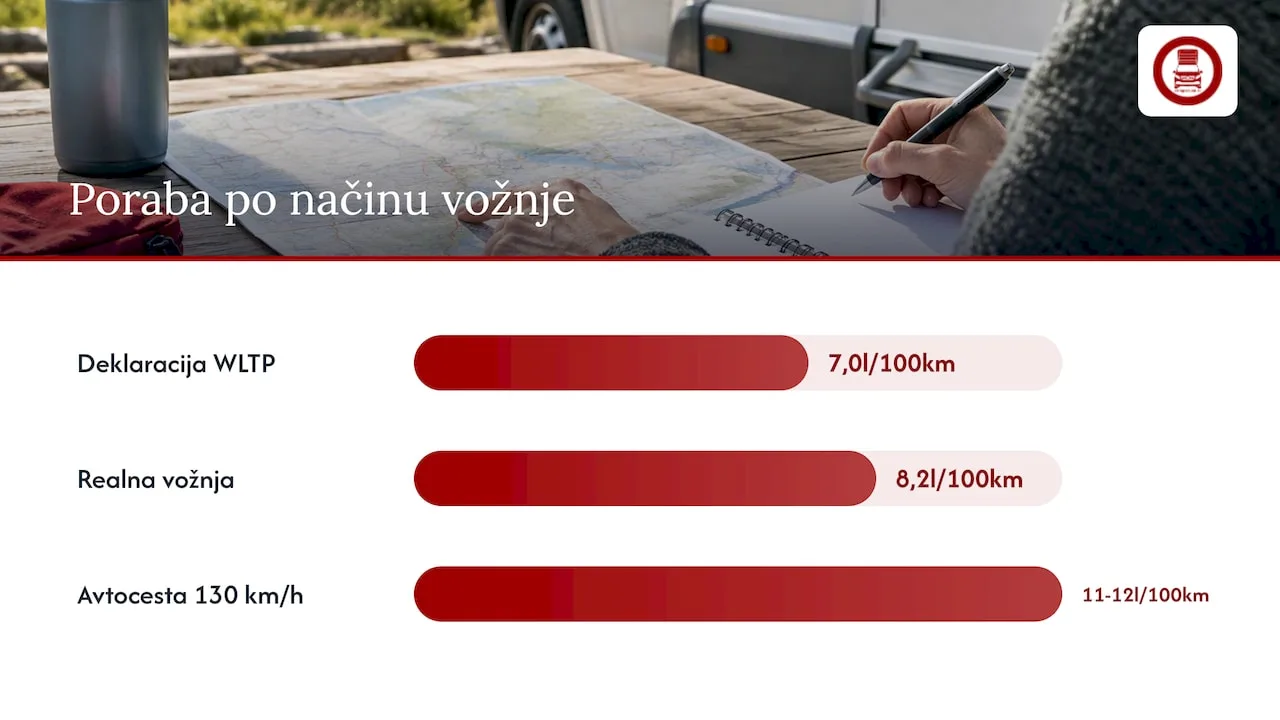
- A European report states that real-world fuel consumption exceeds the official WLTP figure by an average of 1 to 1.5 litres per 100 km.
- At a moderate driving speed and a consumption rate of 8.2 litres per 100 km, a 700 km weekly trip requires approximately 57.4 litres, excluding any additional reserve.
- A full water tank, gas cylinders, luggage and hilly roads increase fuel consumption, particularly on climbs and during acceleration. Remove unnecessary equipment and avoid carrying water you will not need.
- Driving at around 100 km/h instead of 130 km/h can save several litres per 100 km, especially on long motorway stretches.
Table of contents
- What affects motorhome fuel consumption
- How to estimate fuel consumption for your trip: steps and adjustments to WLTP figures
- Practical tips for reducing fuel consumption when driving a motorhome
- Fuel calculation examples: how much fuel you need for typical trips in Slovenia
- The author’s perspective: how we advise customers about fuel consumption
- Frequently asked questions
- Sources
What affects motorhome fuel consumption
Fuel consumption in a motorhome is not a fixed figure. It is the result of several factors working together. Understanding these factors helps you make a realistic estimate for your trip and identify what you can adjust yourself. Speed is the single biggest factor. Because a motorhome has a tall, relatively flat front, aerodynamic drag increases more rapidly at higher speeds than it does in a passenger car. As a result, consumption can rise by more than 25 to 30 per cent between 80 and 130 km/h. Vehicle weight also matters: a full water tank, two full gas cylinders, luggage and additional equipment all increase the vehicle’s weight, affecting fuel consumption on climbs and during acceleration. Terrain is another important factor. Mountain roads with successive climbs and bends use considerably more fuel than driving at a steady speed on flat roads, regardless of how carefully you drive. Tyres, tyre pressure and regular engine maintenance also affect consumption, although generally less dramatically than speed or terrain. Factors to consider when planning your route:- speed and road profile (motorways versus hilly regional roads)
- the total weight of the vehicle, including equipment, water and passengers
- ambient temperature and the use of air conditioning or heating
- tyre condition and correct tyre pressure
- driving style and the use of assistance systems such as Eco mode
How to estimate fuel consumption for your trip: steps and adjustments to WLTP figures
The starting point for any estimate is the vehicle’s official fuel-consumption figure, which you can find in the vehicle documentation or obtain from the rental company. This figure is based on the standardised WLTP test, but real-world fuel consumption often differs from the test result. Follow these steps to make a realistic estimate:- Find the official WLTP fuel-consumption figure for your motorhome model.
- Add a correction factor to account for the difference between test conditions and real-world driving.
- Adjust the figure according to the expected average speed on your route.
- Allow for the additional load from luggage, water and passengers.
- Multiply the final adjusted figure by the distance and divide by 100 to calculate the litres required.
Practical tips for reducing fuel consumption when driving a motorhome
A few simple driving habits can noticeably reduce fuel consumption, particularly over long distances where the savings add up. The biggest difference comes from maintaining a moderate, steady speed: according to ADAC figures, driving at 100 km/h instead of 130 km/h can save several litres per 100 km. Where available, Eco mode adjusts gear changes and engine revs. It is most effective during calm, steady driving on regional roads. On motorways at high speeds, the savings are less noticeable, as illustrated by long-term tests of modern vehicles with similar systems, such as this long-term test of a van with an Eco function. Packing and weight distribution matter too: unnecessary equipment, full water tanks you will not use, or heavy bicycles mounted on the rear of the vehicle can increase consumption more than most travellers realise. Practical steps to reduce fuel consumption:- drive smoothly, avoiding sudden acceleration and braking
- check tyre pressure regularly, as underinflation increases rolling resistance
- remove unnecessary equipment and luggage before setting off
- plan a route with fewer motorway sections where practical
- keep up with scheduled servicing, as a poorly maintained engine can use more fuel
Fuel calculation examples: how much fuel you need for typical trips in Slovenia
Practical examples make it easier to plan your fuel supply and travel budget. Let us use the adjusted estimate of 8.2 l/100 km at a moderate speed calculated above for three typical journeys in Slovenia.- Weekend trip, 200 km: at 8.2 l/100 km, you will need approximately 16.4 litres of fuel.
- Week-long trip, 700 km: the same consumption rate means around 57.4 litres for the entire journey.
- Longer transfer, 1,200 km, for example towards the coast or the Alps: fuel consumption will be approximately 98.4 litres.
| Speed | Fuel consumption (l/100 km) |
|---|---|
| 80 km/h | 6.3 to 7.5 |
| 100 km/h | 8.1 to 9.2 |
| 130 km/h | 11 to 14 |
The author’s perspective: how we advise customers about fuel consumption
When customers make a reservation, we prefer to give them a realistic estimate of fuel consumption rather than an optimistic figure from a brochure. For our fleet, which includes the Mercedes V Marco Polo and Ford Nugget Plus, we advise customers on expected consumption based on known test figures and our experience driving on Slovenian roads, from flat motorways to mountain passes. The difference between relaxed and fast driving quickly becomes apparent in the number of fuel stops you need to make. If you are planning a trip and would like a more precise estimate for your chosen vehicle, get in touch with us when making your reservation.— Rok