Sustainable campervan travel in Slovenia means reducing energy and water consumption while managing waste responsibly. You can achieve this with a few practical measures: install solar panels or choose a campervan that already has them, use LED lighting, save water and separate waste while travelling. Choose campsites and campervan parking areas that use resources responsibly rather than simply choosing the lowest price. Campervan rental guides can also make planning a more sustainable trip easier.
In short:
- Solar panels, LED lighting and responsible water use can reduce your environmental footprint while travelling around Slovenia.
- When choosing campsites and campervan parking areas, check whether they follow recognised sustainable practices and separate waste inside your campervan.
- Choosing a lighter, regularly maintained campervan with suitable equipment, such as a solar system, can support a more sustainable and efficient travel experience.
- Energy management includes charging batteries with solar power during the day and switching off unused devices, helping reduce unnecessary fuel consumption and emissions.
- Avoid informal wild camping and use designated campsites and campervan parking areas to ensure responsible waste management and protect the natural environment.
Explore Slovenia with more freedom
Choose a campervan from Ljubljana and enjoy a more flexible way to explore different destinations across Slovenia.
Check campervans
Table of Contents
Key Measures on the Road: Energy, Water and Waste
Your campervan uses energy and water and generates waste throughout your trip, even when it is parked. Three areas have the biggest impact on your environmental footprint when travelling around Slovenia: electricity, water and waste management.
Small changes can make a significant difference to electricity consumption. Installing solar panels on the roof, using LED lighting and charging phones or laptops during the day can reduce your dependence on external energy sources and reduce the load on the engine when charging the leisure battery, as explained by
Elektro Stumpfl.
The following steps can help with water and waste management:
- Use biodegradable cleaning products for washing dishes and personal hygiene, as they break down more easily and reduce the potential impact on soil and water sources.
- Where permitted, collect rainwater for washing dishes or cleaning equipment.
- Separate waste inside your campervan, making it easier to dispose of it correctly at campsites and parking areas.
- Shop at local markets and farms to reduce packaging and support the region you are travelling through.
Expert tip: Take two or three small containers with you for separating waste before you leave. Searching for a single bin for all types of waste at a small parking area when your campervan is full can create unnecessary stress.
Choosing a Campervan and Equipment for the Season and Sustainability
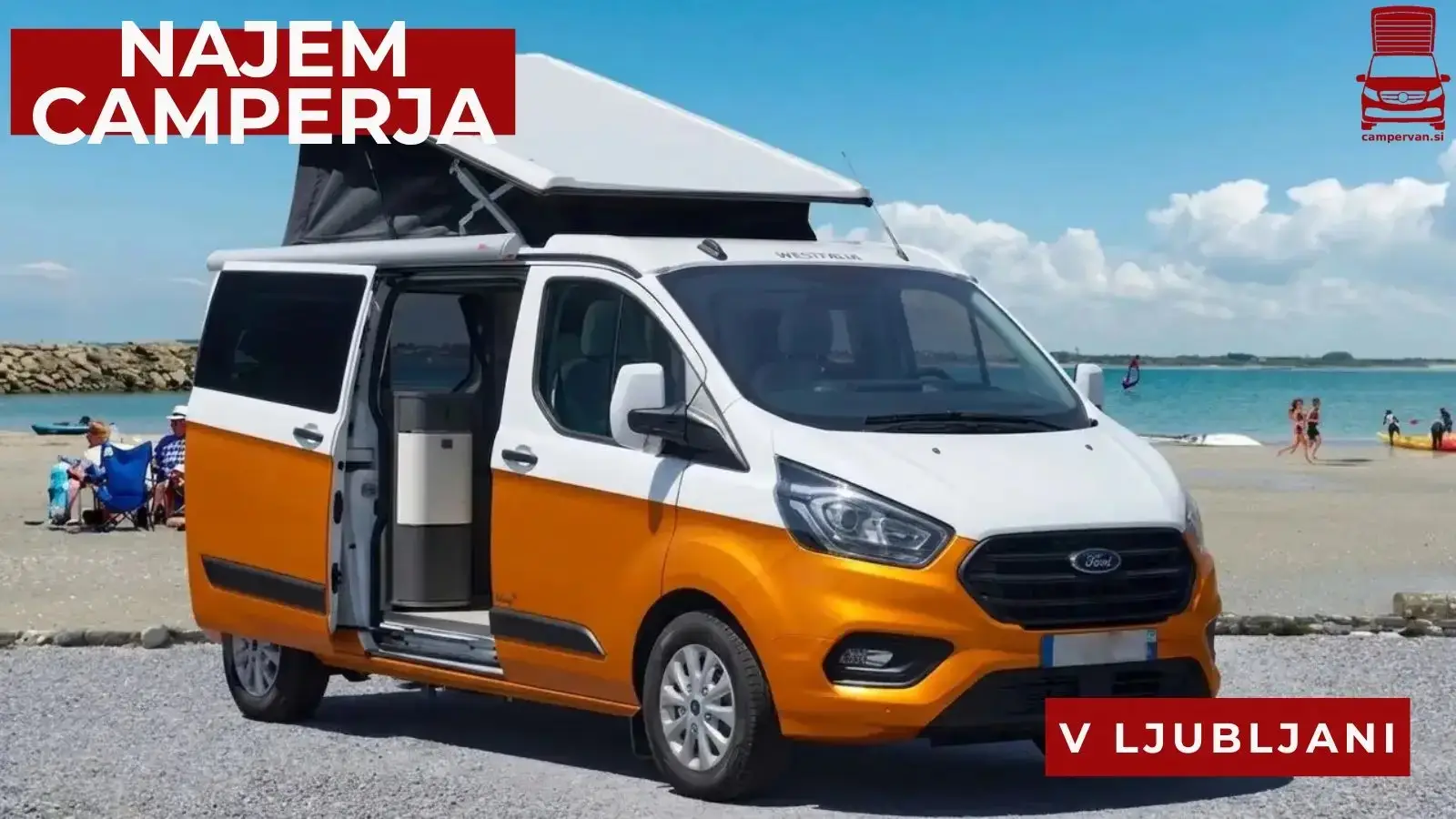
The vehicle you choose determines your fuel and energy consumption before you even start your journey. A newer, lighter and regularly maintained campervan generally uses less fuel and is less likely to require unnecessary service trips.
When choosing equipment, pay attention to:
- solar panel readiness or an already installed solar system,
- LED lighting throughout the living area,
- an energy-efficient refrigerator that places less demand on the leisure battery,
- lightweight interior materials that reduce the overall weight of the vehicle.
If you are renting a campervan, ask the provider directly whether the vehicle has a solar system, how large the leisure battery is and how much energy the refrigerator consumes. More details about recommended equipment for travelling in Slovenia can be found in our
campervan camping equipment guide.
Energy on the Road: Solar Panels, Batteries and Energy Management
Lighting, refrigeration and charging two or three devices each day create a relatively small but continuous energy demand in a compact campervan. A roof-mounted solar panel can help cover part of this demand without relying on the engine.
Charge batteries during the day when sunlight is available rather than waiting until the evening, when lighting and other consumption are typically higher. LED lighting combined with solar panels can reduce energy consumption inside the campervan and reduce the need to use the engine for additional battery charging, as explained by Elektro Stumpfl.
A practical approach to energy management includes:
- charging phones, cameras and power banks during the day rather than waiting until the evening,
- combining solar charging with driving, as the vehicle’s alternator can provide additional battery charging during longer journeys,
- switching off lights and devices that are not being used, even when you have a solar system.
Energy consumption in a compact campervan continues even when the vehicle is parked, so spreading charging throughout the day can be more important than simply having a larger system. Fully electric campervans are still relatively uncommon in Slovenia, partly because charging infrastructure suitable for larger vehicles remains limited. However, hybrid approaches combining solar power with an efficient leisure battery can already reduce the need to run the engine simply to provide additional electrical power.
Water and Sanitation: How to Save Water and Dispose of Wastewater Properly
Water is a limited resource in a campervan and can be used surprisingly quickly if you are not careful. Shorter showers, turning off the tap while brushing your teeth and washing dishes in a container rather than under running water can save several litres per day.
For cassette toilets, choose biodegradable products that are less harmful to wastewater treatment systems and the environment. Traditional formaldehyde-based chemical products can have a greater environmental impact and are not recommended at some campsites.
Dispose of grey water and black water only at designated disposal facilities, which are available at larger campsites and campervan parking areas throughout Slovenia. Never release wastewater into nature, near a stream or onto a meadow, as this can directly affect soil and water sources. A list of designated parking areas with suitable facilities can be found in our
campervan parking area guide.
Choosing Campsites and Campervan Parking Areas: What to Look for in Sustainable Providers
A campsite sustainability certificate is more than just a label at the entrance. It can indicate that the operator has established processes for managing resources responsibly. Slovenia Green emphasises that sustainability is primarily about processes and values rather than simply carrying a label, including at accommodation providers that help guests use resources responsibly, as
Slovenia Green explains.
When choosing a campsite in Slovenia, check the following:
- Does the campsite separate waste and clearly mark the different waste categories?
- Does it provide electricity connections and possibly charging points for electric vehicles?
- Does it offer bicycle rental for exploring the surrounding area without the campervan?
- Does it cooperate with local farmers or shops to provide fresh produce?
- Does it have a designated disposal point for wastewater and cassette toilets?
Campsites carrying the Slovenia Green label can be a useful starting point when looking for more sustainable accommodation. Campsites near protected natural areas may also follow additional environmental requirements.
Driving and Maintenance: Tyre Pressure, Load and Fuel-Efficient Driving
Correct tyre pressure, adjusted to the actual load of the vehicle, can reduce fuel consumption and tyre wear and therefore also reduce tyre particle emissions, as reported by
Svet24. A fully loaded campervan with equipment, water and passengers weighs considerably more than an empty vehicle, so check the recommended pressure according to the vehicle manufacturer’s load specifications.
Driving habits can further reduce fuel consumption. Maintaining a steady speed without unnecessary acceleration and braking, shifting appropriately and avoiding unnecessary weight in storage compartments can reduce fuel consumption over longer journeys.
Regular servicing, clean air filters and timely oil changes help keep the engine operating efficiently throughout the season.
Expert tip: Check tyre pressure in the morning while the tyres are still cold, as driving heats the tyres and temporarily increases the pressure reading.
Local Examples and Practical Itineraries: How Campervan.si Makes Travel More Sustainable
Practical steps such as staying longer in one location and exploring the surrounding area by bicycle instead of moving the campervan can significantly reduce the environmental footprint of a trip, as also highlighted by
ECOCAMPS. The same approach can be applied when planning campervan itineraries.
A one-week trip through Slovenia can easily be adapted to involve less driving and more local experiences:
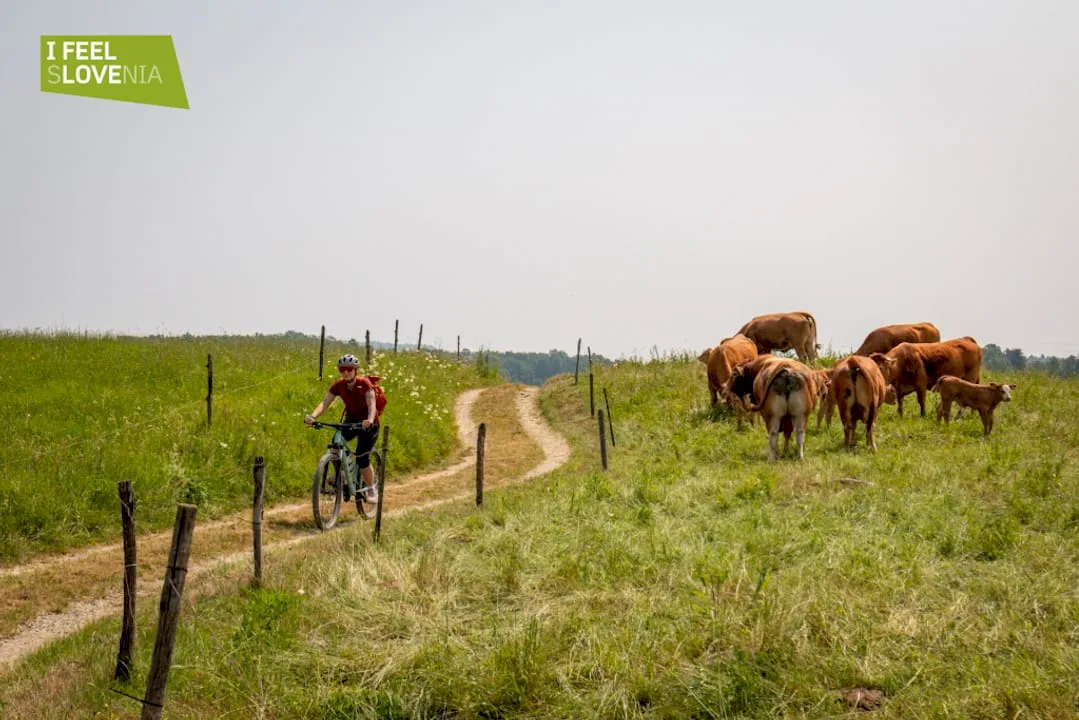
- Instead of changing locations every day, stay for two or three days in one area, such as the Soča Valley or the Karst region.
- Bring a bicycle with you or rent one at the campsite for shorter trips around the area.
- Plan your route to avoid unnecessary backtracking between destinations.
More detailed guidance for planning your route, including winter campervan rental, can be found in our
campervan trip planning guide. These adjustments are not only environmentally sensible but can also make the journey more relaxed.
Alternative Fuels and Electric Campervans for Lower Emissions
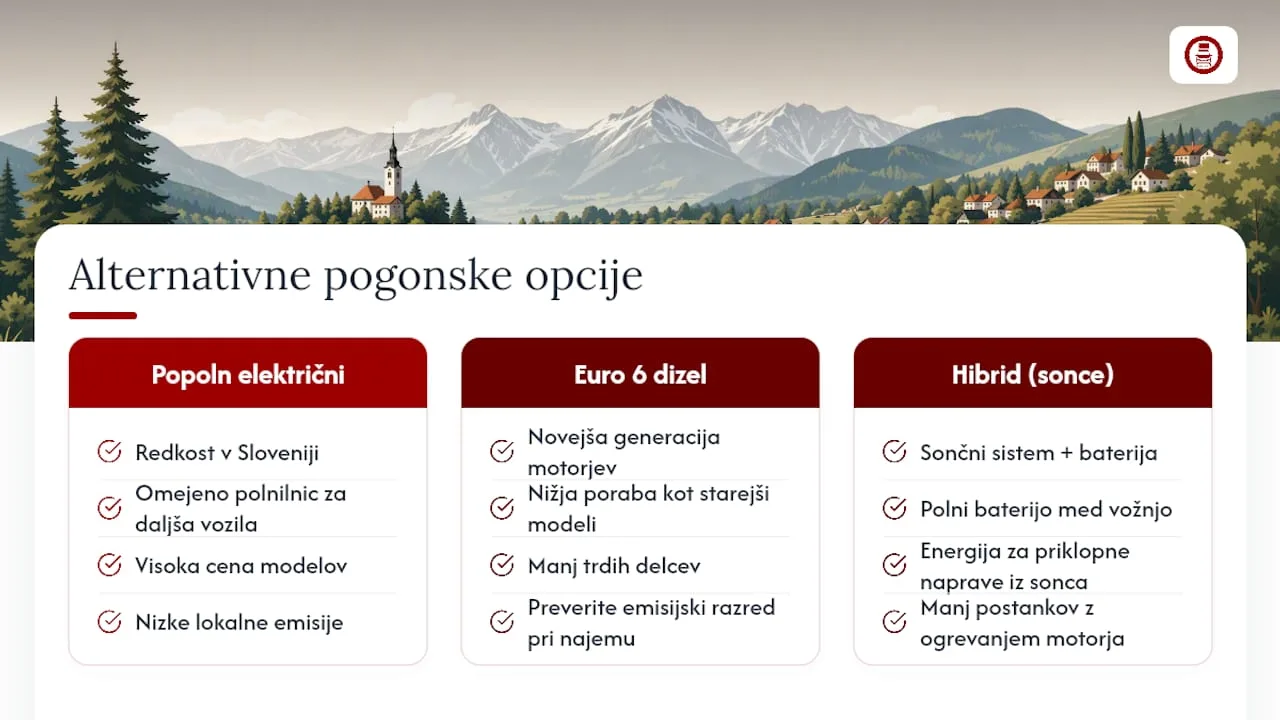
Fully electric campervans are still relatively uncommon in Slovenia, mainly because of the limited number of charging points suitable for larger vehicles and the cost of such models. Nevertheless, there are several ways to reduce emissions without replacing the entire vehicle.
Newer-generation diesel campervans with Euro 6 engines generally use less fuel and produce fewer particulate emissions than older vehicles. If you are renting a vehicle, ask which engine and emissions standard it uses, as the difference between older and newer engine generations can be significant.
Hybrid approaches that combine a solar system and an efficient leisure battery with a smaller, modern engine are currently a practical way to reduce unnecessary energy use for many travellers. While driving, the engine can charge the battery, while at a campsite or parking area the solar system can provide energy for lighting and refrigeration without needing to keep the engine running.
Avoiding unnecessary engine idling for heating the cabin or charging batteries also reduces fuel consumption. If you are travelling through cities with low-emission or restricted-emission zones, check the vehicle’s emissions standard before your journey, as the rules vary between countries and cities.
When choosing a rental vehicle, therefore, you do not necessarily need to look for a fully electric campervan. It can be more useful to ask how the vehicle is equipped to reduce energy consumption while parked, and this is a worthwhile question to ask whenever you rent a campervan.
Where Is Campervan Parking and Overnight Camping Allowed in Slovenia?
Informal wild camping in nature, meaning overnight stays outside designated campsites, campervan parking areas and other authorised locations, is restricted in many parts of Slovenia. The rules can vary depending on the municipality and type of land, so it is important to check local regulations before stopping for the night.
Designated campervan parking areas (PZA) are therefore one of the most reliable options. They are often equipped with wastewater disposal points, electricity and sometimes sanitary facilities. For a detailed overview of where overnight stays with a campervan are permitted, see our
guide to overnight stays with a campervan in Slovenia.
Irresponsible waste disposal at these locations, such as leaving rubbish outside designated collection points, can contribute to access restrictions or even the closure of individual parking areas for all travellers. Every campervan traveller who leaves a site untidy can therefore make it more difficult for future visitors to use the same location.
In cities such as Ljubljana, special rules can apply to parking larger vehicles, which may differ from the rules for ordinary passenger-car parking. Before travelling into the city centre, check which parking areas actually accept campervans and under what conditions. More details can be found in our
guide to campervan parking in Ljubljana.
Following these rules is not simply a formality. It helps ensure that designated parking areas and quiet locations near natural parks remain available to future travellers as well.
Author’s Perspective: Why Sustainability Matters When Travelling by Campervan
Sustainability when travelling by campervan is often seen as a list of restrictions, but it can actually mean greater freedom. Every litre of water you save and every amount of fuel you avoid using while idling gives you more flexibility to stay on the road without worrying about running out of essential resources in the Karst region or the Alps.
Slovenia is a small country with sensitive natural areas where the consequences of irresponsible camping can become visible quickly, from closed parking areas to polluted streams. Respect the nature and local communities you travel through, and look for detailed advice for specific regions from local sources such as
Slovenia.info.
— Rok
How Campervan.si Supports Sustainable Campervan Travel
Campervan rental can be an alternative to private ownership for travelling around Slovenia: instead of purchasing a vehicle that may remain unused for much of the year, you rent a campervan only for the days you actually need it. Shared use can make better use of a vehicle’s capacity and avoid some of the resources associated with owning an additional vehicle.
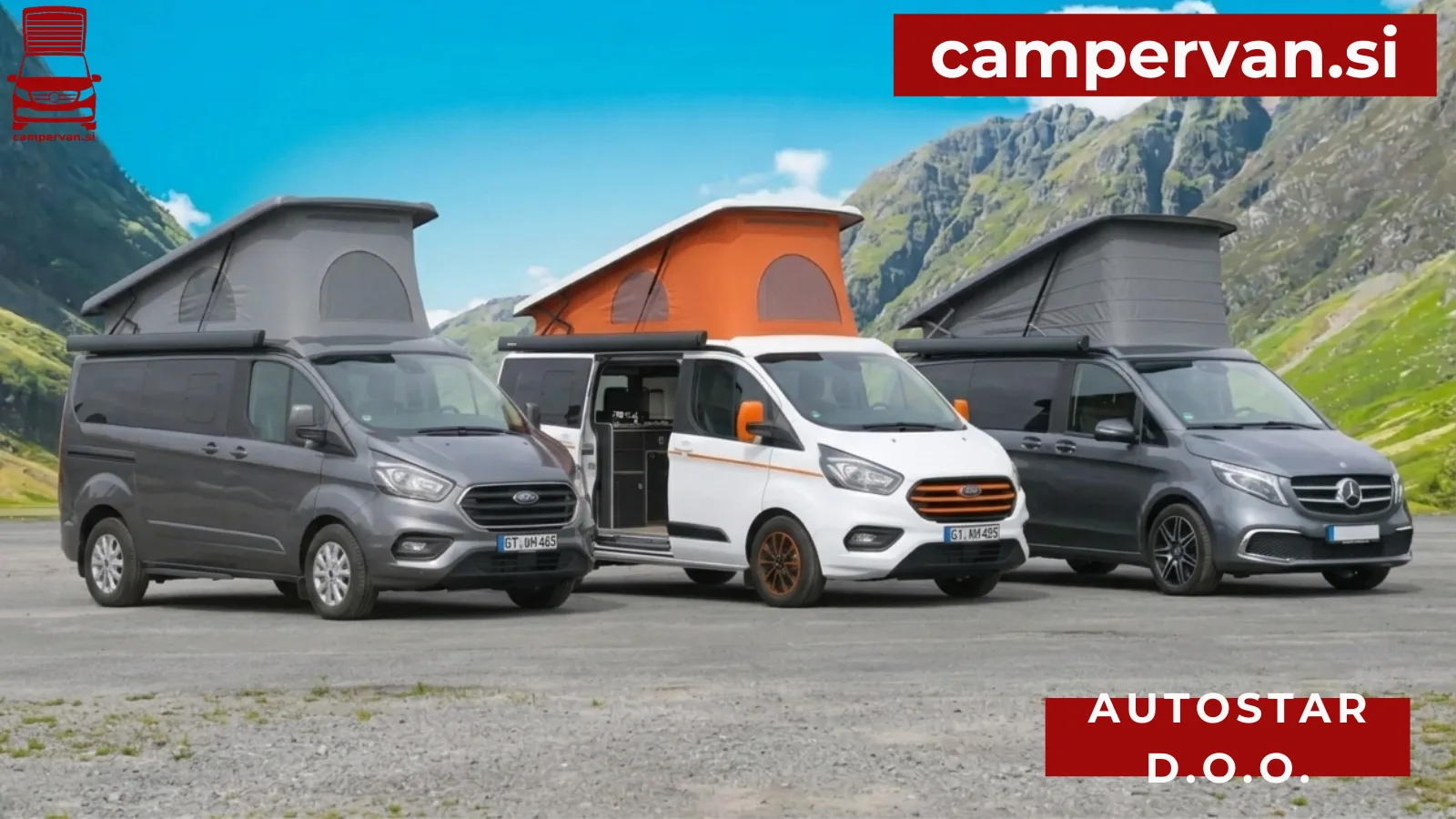
Campervan rental providers can also help with route planning, reducing unnecessary kilometres and suggesting practical stops around Slovenia, the Balkans and the Alps. Check vehicle availability and ask about sustainable equipment, such as solar panels and LED lighting, when booking through our
campervan rental page in Ljubljana. For advice on suitable equipment before departure, also see our camping equipment guide.
Sources
For further information, we recommend Elektro Stumpfl for technical advice on campervan electrical installations, Slovenia Green for understanding sustainability as a broader value,
Hobby Slovenija for basic information on eco-friendly camping, and ECOCAMPS for practical advice on sustainable campervan travel.
Frequently Asked Questions
What Does Sustainable Campervan Travel Mean?
It means reducing energy, water and waste consumption while travelling, for example by using solar panels, LED lighting, biodegradable cleaning products and campsites with genuine sustainable practices.
Is Campervan Rental More Sustainable Than Buying?
Rental can support shared use of a vehicle, allowing the same campervan to be used by multiple travellers rather than being owned by a single person and potentially remaining unused for long periods.
Where Can I Legally Stay Overnight in a Campervan in Slovenia?
Informal wild camping is restricted in many areas, while designated overnight locations include organised campervan parking areas (PZA), campsites and other authorised locations. For details, see our guide to overnight stays with a campervan in Slovenia.
How Does Correct Tyre Pressure Support Sustainable Travel?
Correct tyre pressure, adjusted to the vehicle’s actual load and manufacturer’s recommendations, can reduce fuel consumption and tyre wear, which can also help reduce tyre particle emissions.
Does Campervan.si Offer Campervans with Solar Panels?
When making a reservation, you can ask about vehicles with solar systems and LED equipment, as this type of equipment can reduce the need for additional electrical power from the engine while travelling.
CCampervan
Ask us about your campervan trip
Tell us about your plans for travelling around Slovenia and check your campervan rental options in Ljubljana.