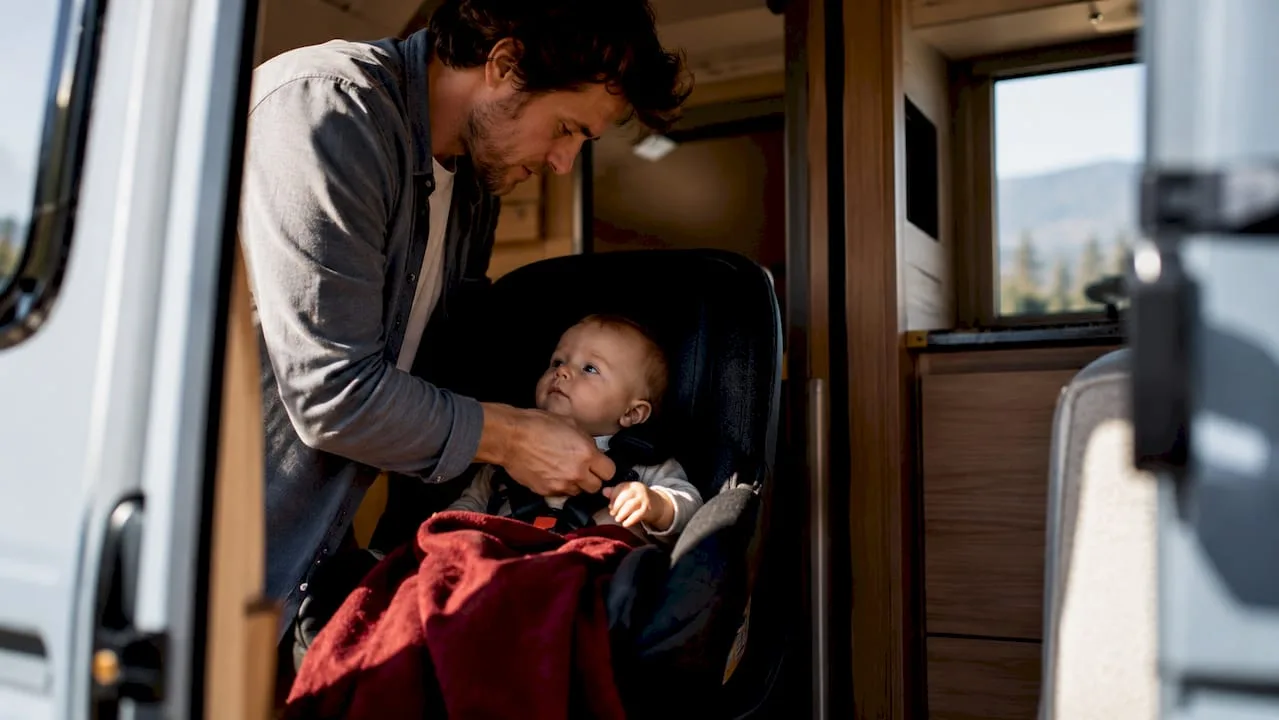
Yes, travelling with a baby in a campervan is absolutely possible and, based on the experience of many families, can even be more relaxing than a traditional holiday by car and hotel. The key is to focus on three things: a properly secured child car seat, a slower travel pace with frequent breaks, and essential baby equipment such as a portable baby nest and enough food for the first few days. For vehicle pickup and practical route advice, Slovenian families can also contact a local campervan rental provider such as Campervan.si.
In brief:
- A properly secured child car seat with an ISOFIX system is essential for your baby’s safety while travelling. Other areas of the campervan should not be used as seating positions while the vehicle is moving.
- When planning your route, it is recommended to limit daily driving to around three to four hours, as frequent breaks are generally more comfortable for a baby.
- Slovenia has a good selection of organised campsites and campervan overnight stops, so wild camping should be avoided and key overnight stays should be booked in advance during busy periods.
- For easier organisation, pack items into separate transparent bags and clearly label storage compartments. Remember to regularly empty the chemical toilet and refill the fresh-water tank.
- When travelling across time zones, gradually adjust your baby’s schedule, as babies can find large changes in their usual routine more difficult to handle.
Table of Contents
Benefits of a campervan for families with a baby and realistic expectations
Babies often sleep better when they are surrounded by familiar things and routines. A campervan makes this easier because the same baby nest, blanket and familiar sounds travel with you, whereas a hotel holiday means a different room, new smells and a different environment every evening. The same applies to feeding: you can prepare baby food or formula whenever you need to, without depending on restaurant opening hours or a hotel schedule.
You also need less day-to-day luggage organisation because you are not constantly moving between the car and a hotel room. On the other hand, travelling by campervan requires more organisation than a traditional holiday:
- regularly emptying the chemical toilet and refilling the fresh-water tank
- finding a suitable campsite or campervan overnight stop every few days
- limited indoor space for playing during bad weather
- adjusting your driving schedule around your baby’s sleep and rest periods
Families who have tried both types of holidays often say that a campervan can be less stressful for shorter distances, while longer trips require more thoughtful route planning and a slower pace.
Safety while driving and preparing the campervan before departure
A properly installed child car seat is the only appropriate solution for travelling with a baby, regardless of how comfortable the living area of the campervan may look. The seat must be approved for the child’s age and weight and installed exactly according to the manufacturer’s instructions, preferably using an ISOFIX system where available. Allowing a baby to lie in a bed or on a sofa while the campervan is moving is not safe and creates a serious risk of injury in the event of sudden braking.
Before every departure, check the following:
- Lock all drawers and cupboards so they cannot open while driving.
- Secure loose objects such as cups, toys and dishes.
- Check that all windows and the roof vent are properly closed.
- Make sure there are no sharp edges or accessible gaps that could pose a risk to your baby when the vehicle is parked.
- Save the contact details of nearby paediatricians and emergency medical centres along your route, together with a copy of your child’s health insurance card.
Expert tip: Take a photo of your child’s health insurance card and vaccination record and save it on your phone before departure. If the original documents remain inside the campervan, you will still have the essential information available.
Practical packing list for a baby in a campervan
Packing by category saves time and reduces the chance of forgetting something important on the road. Your basic supplies should include enough nappies for at least a week, spare clothes for two extra days and plenty of cleaning cloths or muslin squares.
For sleeping, bring a portable baby nest or travel cot, a lightweight blanket and perhaps a familiar toy for comfort. For feeding, pack bottles, a thermos or insulated flask for liquids and several days’ supply of food your baby already knows. The hygiene kit should include small containers of shampoo, nappy rash cream and waste bags.
Practical tips that work well on the road:
- Pack clothes and supplies by day in transparent bags or packing cubes so you can quickly find what you need.
- Keep dirty laundry in a separate breathable bag rather than mixing it with clean clothes and equipment.
- Clearly label boxes and storage compartments, as space inside a campervan is limited and searching through everything takes valuable time.
- For a baby under six months, bring enough food for an additional three to four days. For an older baby already eating solid food, you may need slightly less because additional supplies can usually be purchased along the route.
How to maintain sleep and a daily routine in a campervan
A baby’s routine does not have to disappear just because you are travelling. Place the portable baby nest in the same dedicated location each day so your child quickly associates that space with sleeping. When parking, choose a shaded location and ensure there is adequate ventilation, as the interior of a campervan can heat up quickly during summer.
Part of your driving time can coincide with your baby’s daytime nap, which can be a practical solution for many families. However, your baby must always remain properly secured in an approved child car seat while the vehicle is moving. A baby nest or travel cot is not a safe alternative during driving.
For a calmer evening, it helps to have:
- a short, predictable bedtime routine such as bathing, reading a story and turning off the lights
- blackout blinds or suitable window coverings near the baby’s sleeping area
- an agreement between the parents about who handles night-time wake-ups, as every sound in a small campervan can easily wake both parents
A small campervan refrigerator is usually sufficient for storing milk and baby food for one or two days, so plan to restock as you travel. For warming bottles, a portable bottle warmer that operates from a 12-volt connection can be particularly practical, while a gas burner is not an appropriate solution while the vehicle is moving.
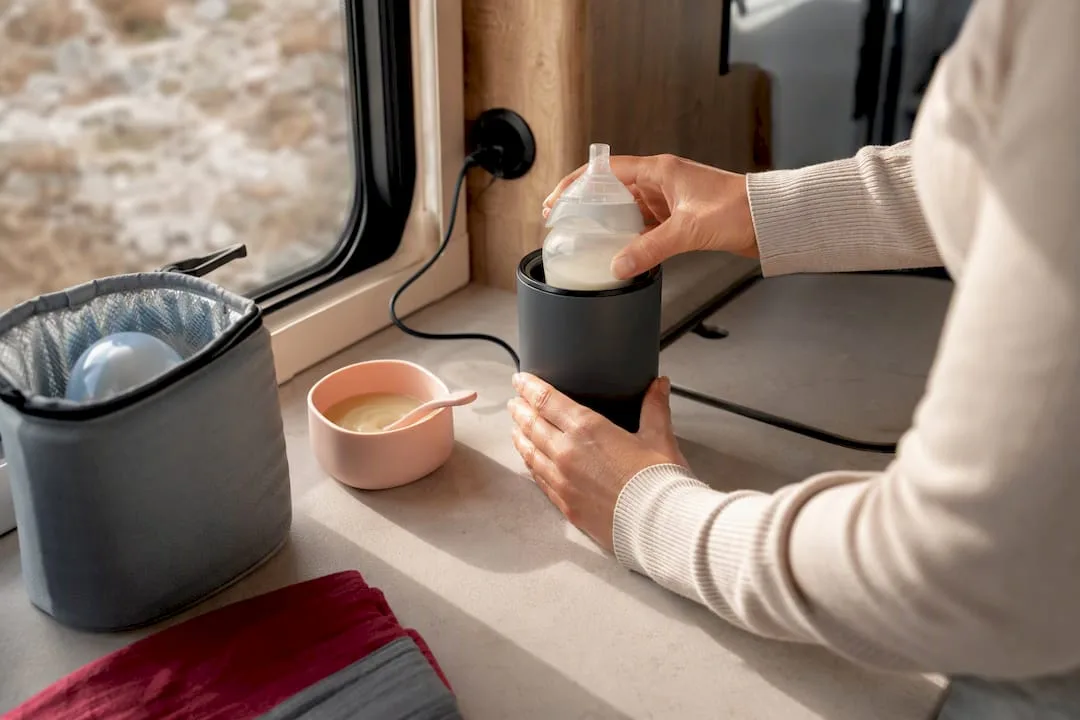
Label containers of prepared food with the preparation date so you know which items are still suitable for use. Because familiar baby food products may not always be readily available at your destination, bring a basic supply of products your baby already knows. An insulated flask, resealable food containers and a portable changing mat are small items that can save a surprising amount of time during a campervan trip.
Planning your route and driving pace: how far can you really travel in a day?
When travelling with a baby, forget about planning your journey around kilometres in the same way you might without children. Families’ experiences show that a
two-hour drive can easily stretch to three or four hours because of frequent stops, and that is completely normal.
When planning your route, keep the following in mind:
- Enter the actual dimensions of your campervan into your navigation app so that you are not directed onto unsuitable roads.
- Use apps for finding campsites and campervan overnight stops, such as Park4Night, to see the real experiences of other travellers.
- Book accommodation for the first few days in advance, as you may not yet know how your baby will react to travelling and a change of environment.
- Follow the principle of fewer kilometres and more time at each destination. A day without driving can mean a much more relaxed day for your baby.
For a detailed overview of routes through Slovenia and neighbouring countries, see our
campervan road trip planning guide.
Where to stay overnight and how to manage sanitation and water in Slovenia
Wild camping in Slovenia is
prohibited or heavily restricted, so it is sensible to choose organised campsites or official campervan overnight stops (PZA) in advance. For a family travelling with a baby, this is not necessarily a disadvantage. Organised campsites provide something that informal overnight parking cannot reliably offer: running water, sanitary facilities and often laundry facilities.
It is a good idea to spend every third or fourth night at a campsite, allowing you to empty the chemical toilet, refill your fresh-water tank and wash your baby in a more comfortable environment. When choosing a campsite, pay attention to:
- child-friendly sanitary facilities or at least spacious changing areas
- shaded pitches suitable for parking your campervan
- access to laundry facilities, as families with babies tend to accumulate dirty clothes much faster than expected
For an overview of suitable places in Slovenia, see our guide to
campervan overnight stays in Slovenia.
Quick solutions for common problems on the road
Heat, stomach discomfort or a sudden change in mood can happen at any time, so it is useful to have a simple plan. If your baby becomes unwell, first check their temperature and look for signs of illness. If necessary, contact your paediatrician or the nearest emergency medical centre, whose location is worth noting before departure.
For minor problems, three simple steps can help:
- Check your supply of any basic medicines recommended or prescribed by your paediatrician and replenish them before departure.
- If the chemical toilet is full, find the nearest campsite or campervan service point for emptying it rather than waiting until the last moment.
- For quick hygiene stops during the journey, keep wet wipes and an extra waste bag within easy reach.
Expert tip: Keep a folder in the storage compartment near the door containing a copy of your child’s medical documents, a list of allergies and your paediatrician’s phone number. In a stressful situation, you will not have to search through the entire campervan.
Campervan.si: what we offer Slovenian families
With campervan rental, families can choose from different models equipped with a kitchen, toilet and sleeping areas for several people. Basic insurance and roadside assistance are included with every rental, providing an important safety net when travelling with a baby.
At pickup, take the time to go through
detailed instructions on operating the heating system, refrigerator and chemical toilet. Our team can also help you choose the model that best suits your family size and planned route through Slovenia, the Balkans or the Alps.
Families renting a campervan for the first time often say that the hour spent going through the vehicle at pickup was more useful than any online article, because questions about travelling with a baby are often specific to the individual vehicle.
Practical details about sleeping arrangements and available space can be found in our guide to
campervan sleeping arrangements. The author of the articles on our website is Rok.
Organising the interior and child-friendly habits on the road
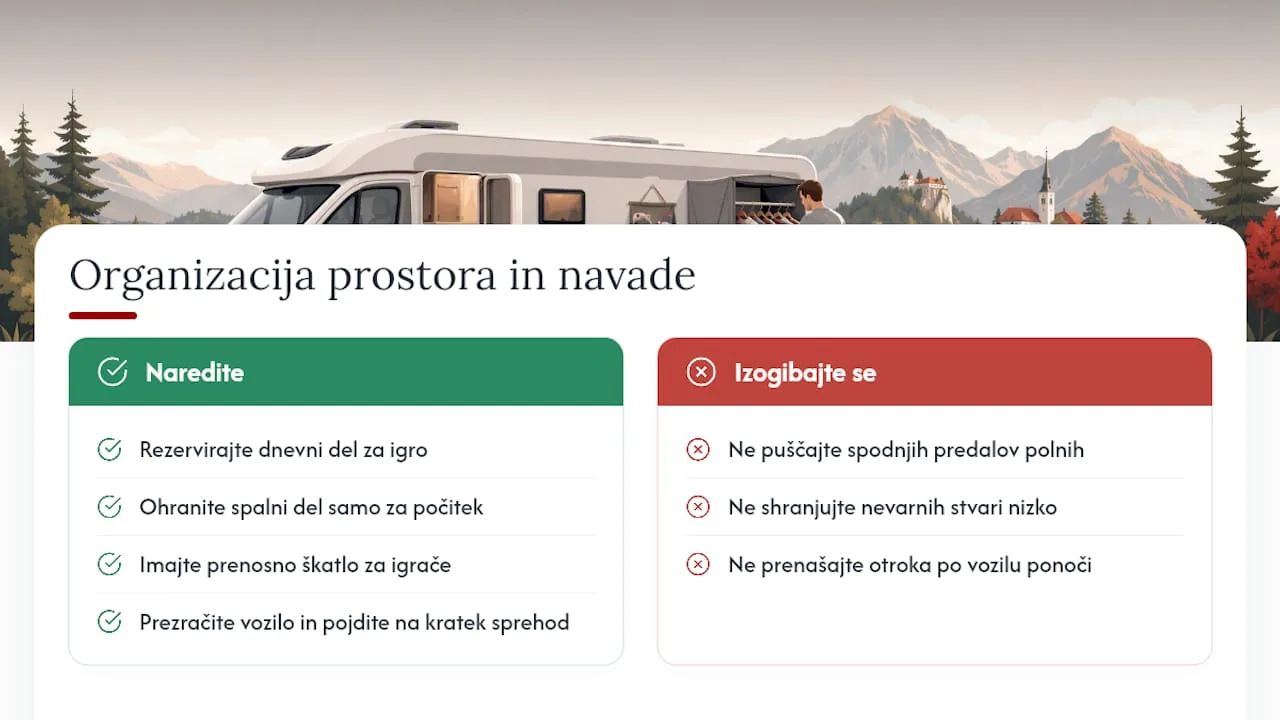
A campervan has limited space, so every area should have a clear purpose. Keep the living area available for floor play with a soft mat, while the sleeping area should primarily remain associated with rest. A table or bench near the baby’s sleeping area can make changing and night-time feeding easier because you do not have to carry the baby through the entire vehicle in the dark.
Keep lower drawers and storage compartments that your child may eventually reach either empty or filled only with safe items, because sooner or later your baby will start exploring independently. Dangerous items such as cleaning products, small parts or hot drinks should be stored high up or inside locked cupboards.
A child-friendly habit that pays off throughout the trip is creating a permanent “toy base”: one small box that travels with your child from the campervan to the campsite and everywhere in between. This reduces lost toys and makes tidying up before driving much easier. The same principle works for food: dedicate one area of the kitchen exclusively to your baby’s bottles and baby food so you do not have to search through your supplies at every stop.
In the evening, once the campervan is safely parked, opening the roof vent and doors can help improve natural ventilation. Fresh air can make the sleeping environment more comfortable, especially during warm weather. A short walk around the campsite before bedtime can also help settle your baby more effectively than a long attempt to get them to sleep in a confined space.
Tips for managing changes in schedule and time zones
If your journey takes you abroad, for example towards the southern Balkans or across several time zones, a baby’s body may take longer to adjust to the change than an adult’s. A small time difference of one or two hours is usually easier to manage if you maintain familiar bedtime rituals at approximately the same time according to the local schedule.
With larger time differences, it is better to adjust the schedule gradually, by around 15 to 30 minutes per day, rather than changing bedtime all at once. Natural daylight helps the body adjust, so expose your baby to natural light in the morning and make the sleeping area darker in the evening, regardless of where you park.
When driving through several countries, also remember that some European countries
have stricter rules for campervans and motorhomes, which may require additional stops or changes to your planned route. For a baby, an unexpected stop can actually be an advantage because it breaks up a long drive and provides an opportunity for feeding, changing and resting.
Treat crossing a border as an opportunity for a longer break rather than an inconvenience. Feeding, changing your baby and taking a short walk near the border work just as well as any other stop, while your baby will not notice the difference between countries.
Personal perspective: start with a weekend, not a two-week road trip
Your first trip with a baby should be short, perhaps just a weekend somewhere relatively close to Ljubljana. This gives you the opportunity to test how your baby sleeps in the nest, how they react to driving and which pieces of equipment you actually use, without risking an entire week of holiday while learning the basics.
The principle of driving fewer kilometres also applies to your first campervan trip: choose one campsite, perhaps two, and spend plenty of time at each location. Once you know that your baby is comfortable travelling in a campervan, you can expand the experience to a longer journey towards the coast or into the mountains.
A campervan is actually one of the few ways to travel where the whole family shares the same space throughout the journey, without separate hotel rooms or dining arrangements. For many families, that is precisely what makes them want to travel this way again.
— Rok
How Campervan.si helps: fast quotes and practical family packages
Campervan rental offers an alternative to searching for a vehicle through online classifieds, while also providing essential equipment and practical advice. For a family travelling with a baby, this means less time spent sourcing individual pieces of equipment, as the vehicles are already equipped with a kitchen, toilet and sufficient sleeping space.
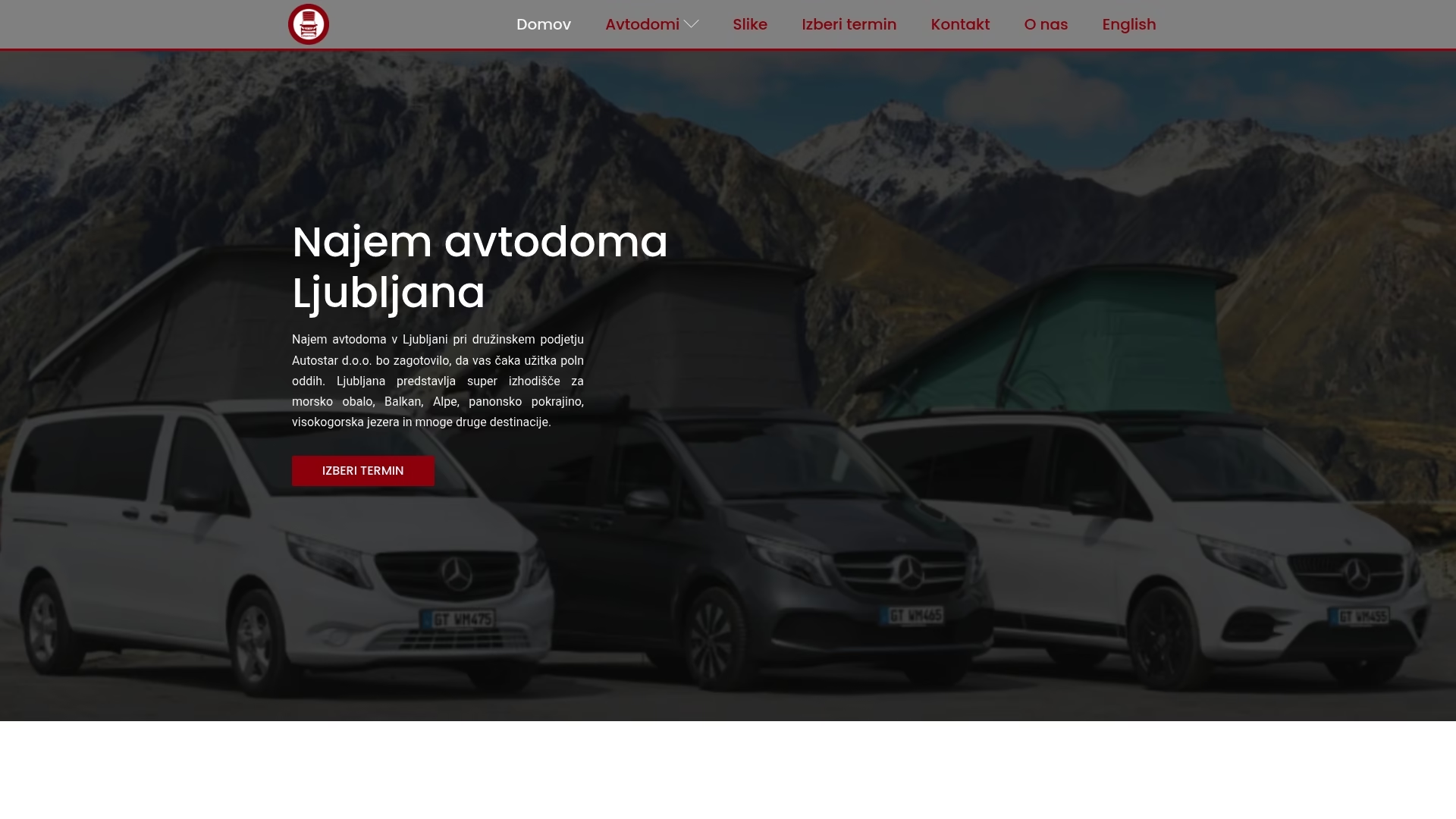
At pickup, our team can help you choose a model based on your child’s age and the length of your journey. For a specific quote and available dates, visit
Campervan.si and check the dates that work best for your family. You can also ask questions about the available campervan models and equipment before booking, so you know exactly what to expect when you collect the vehicle.
Sources
Recommended