Overnight stays in a campervan in Slovenia are permitted at designated campsites and campervan parking areas (PZA), while wild camping on public land, along the coast, at forest edges or in car parks without permission is considered an offence. The basic fine is €83.45,
and the fine can be higher if you put up a tent, table or awning. Slovenia has almost 100 campsites and an increasing number of designated campervan parking areas, so there is little reason to take the risk. Below you will find the key rules, a comparison of overnight options and five tried-and-tested routes around Slovenia.
In short:
- Wild camping without permission is an offence in Slovenia and can result in a fine of up to €83.45, while overnight parking without setting up camping equipment is generally not subject to the same penalties.
- Before staying overnight in a campervan, check local regulations, protected areas and the distance from residential areas to avoid conflicts and potential fines.
- Campervan parking areas (PZA) are designed for short stays and provide basic facilities, while campsites offer better infrastructure and greater security. Private pitches are an affordable alternative with additional privacy.
- It is advisable to book campsites and PZA spaces in advance, especially during the peak season from July to August, when popular destinations can become very busy.
- For longer stays, it is important to organise the campervan’s interior and outdoor living space and check the availability of electricity and water to avoid unnecessary problems.
Table of Contents
What Do Slovenian Law and Local Regulations Say About Camping
Slovenian legislation restricts camping outside designated areas not simply because of bureaucracy, but primarily to protect nature and maintain order in residential areas. The Police of the Republic of Slovenia clearly distinguishes between parking a vehicle and camping: setting up a tent, awning, table or chairs without the landowner’s permission can result in a fine of €83.45. If you simply park your campervan overnight without deploying outdoor camping equipment, the situation is generally less clear-cut and may also be subject to additional local regulations.
This is where most of the confusion arises. Individual municipalities can introduce their own rules, as documented by
Avtokampi. In Triglav National Park, camping outside designated areas is strictly prohibited. Coastal municipalities such as Piran and Koper closely regulate parking near the sea, while larger towns often allow overnight stays only in designated parking areas.
Before setting off, check:
- The local regulations of the municipality where you intend to stay overnight (available on the municipality’s website or from the local tourist information centre).
- Whether the location is within a protected natural area, such as a national park, landscape park or Natura 2000 site.
- Whether the location is close to residential properties, as many conflicts arise because of noise and light rather than the vehicle itself.
The distinction between “stopping” and “camping” is therefore crucial in practice. A campervan parked overnight in a designated parking space with the doors closed and no outdoor equipment deployed is unlikely to cause problems. A campervan with an awning, table and barbecue set up outside can be treated as camping by the police and inspection authorities, regardless of where the vehicle is parked.
Campsites, PZA or Private Pitch: Where to Stay Overnight
The best overnight option depends on how long you are staying and what facilities you need. Avtokampi.si states that Slovenia has almost 100 campsites, while the network of designated campervan parking areas continues to expand every year.
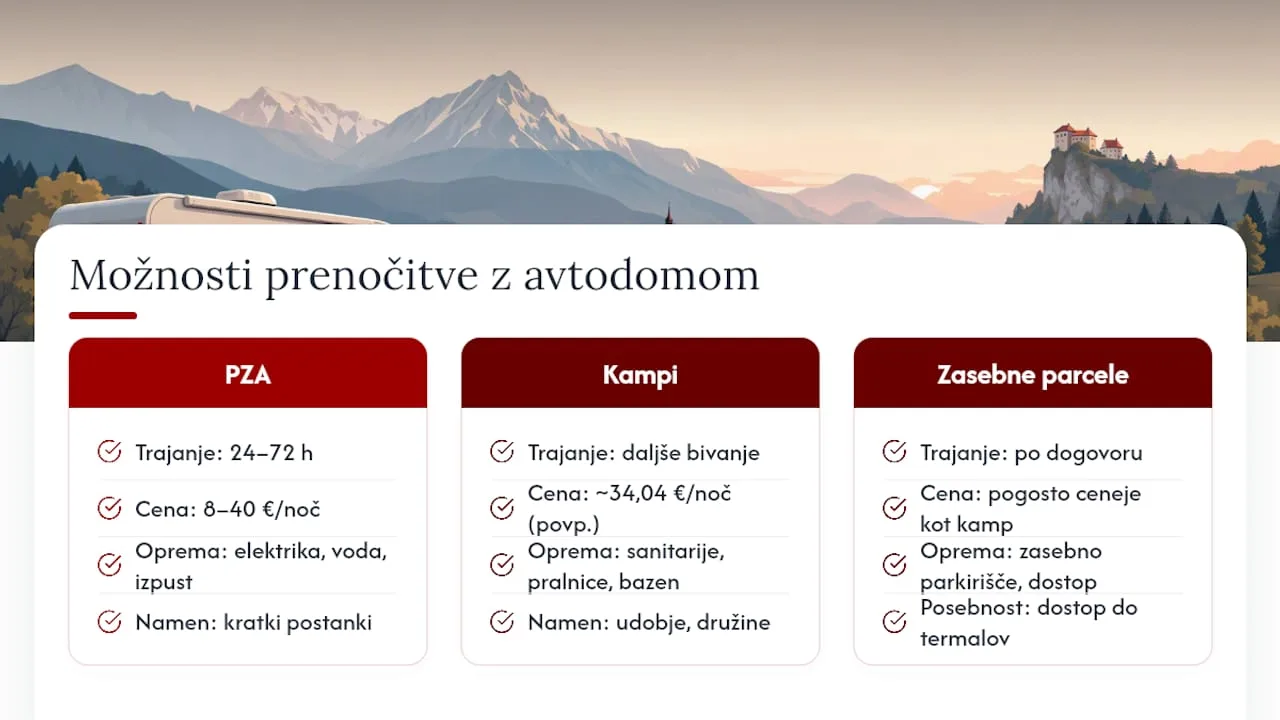
Campervan parking areas (PZA) are intended for short stays, typically between 24 and 72 hours. They usually provide basic facilities such as electricity, fresh water and wastewater disposal, while toilets or swimming pools are less common.
Svethribov reports prices ranging from approximately €8 to €40 per night, depending on the facilities available.
 Campsites
 offer considerably more: sanitary facilities, laundry facilities and sometimes swimming pools or children’s entertainment.
The average campsite price in Slovenia is approximately €34.04 per night, although summer stays on the coast or in popular Alpine valleys can quickly become more expensive.
Private pitches at farms, wineries or thermal resorts are a third option. Some thermal centres allow
campervan overnight stays in their parking areas in exchange for using their swimming pools, which can often be more affordable than a traditional campsite. When looking for specific service points, the
guide to campervan parking areas in Slovenia can help you check the location of fresh water, electricity and wastewater disposal before departure.
How to Plan Your Itinerary: Bookings, Vignettes and Driving Distances
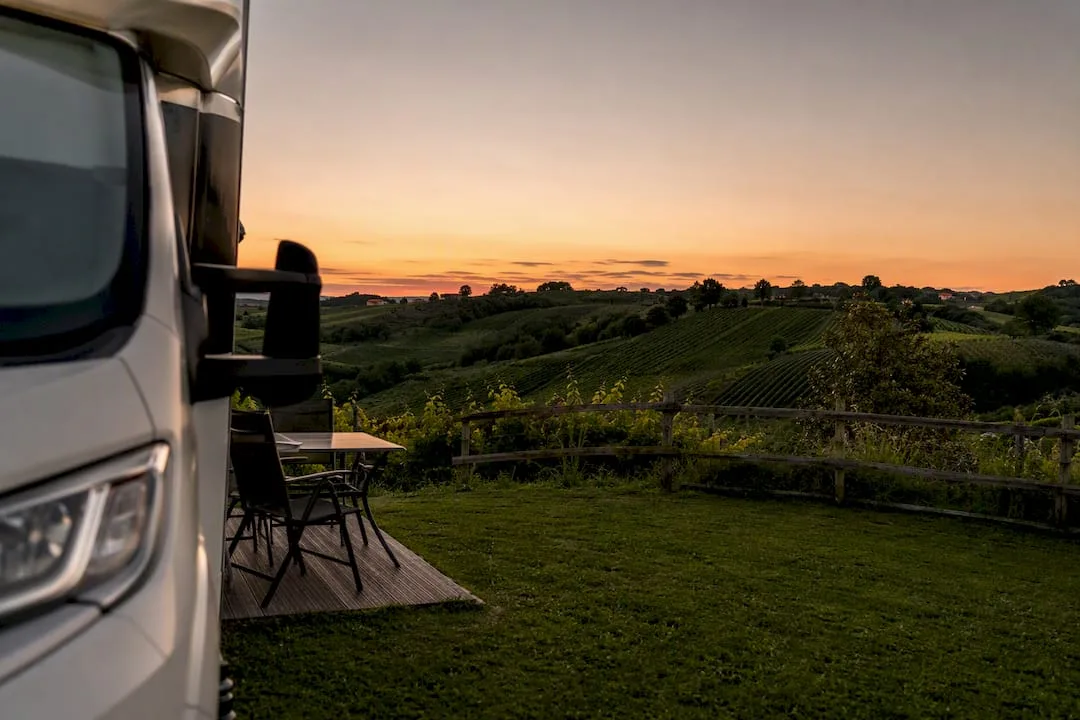
A good Slovenia campervan itinerary does not start with a map but with a calendar. The summer season, particularly July and August, quickly fills campsites along the coast and in the Julian Alps, so travelling without a plan can mean searching for an overnight stop after dark.
- Decide how long you are travelling and choose two or three regions. Slovenia is a small country, but mountain roads can be slow. A realistic daily driving distance is around 100 to 150 kilometres if you also want time for sightseeing and stops.
- Book campsites in advance during peak season. For popular coastal and Alpine destinations, local travel guides recommend booking at least 48 to 72 hours before arrival, and preferably earlier during the busiest periods.
- Get your vignette. Campervans up to 3.5 tonnes require an electronic vignette for Slovenian motorways, while heavier vehicles use the DarsGo system, which charges according to kilometres driven.
- Mark service points in advance. Check where you can empty wastewater and refill fresh water along your route so that you do not have to search for a service point on the last day before returning home.
Expert tip: Book your overnight stay in Bohinj, Bovec or Piran at least 48 to 72 hours in advance if you are travelling between July and August. During this period, campsites near popular attractions can often become full by midday.
Five Campervan Routes in Slovenia Suitable for Every Campervan
Slovenia is small enough to explore the mountains, coast and Karst region in a single week without spending every day driving hundreds of kilometres on the motorway.
- A weekend on the Slovenian coast. Two nights in Piran or nearby Lucija. In summer, booking a campervan parking space in advance is recommended, while autumn usually offers more availability. Spend the day exploring the old town and the evening enjoying the terrace views as the sun sets over the Adriatic Sea.
- A week in the Julian Alps. Bled, Bohinj and Kranjska Gora, with overnight stops at designated campervan parking areas outside the boundaries of Triglav National Park, where wild camping is strictly prohibited. Plan shorter daily driving distances because mountain roads are narrow and slow.
- The Karst and Postojna. Combine Postojna Cave, Škocjan Caves and wineries in the Vipava Valley, where regional tourism portals list designated campervan parking areas with electricity and water. The Karst region with campervan-friendly campsites is a practical base for exploring the area.
- The Soča Valley and rafting. Use Bovec as a base for rafting on the Soča River, canyoning and cycling. Local campervan parking areas and campsites are available close to the river, while summer here is generally more relaxed than on the coast.
- Thermal relaxation. Combine two or three thermal resorts in eastern Slovenia, where many thermal spas allow overnight campervan stays in their parking areas when guests use the swimming pools. This can be an affordable alternative to a traditional campsite.
Safety, Etiquette and Winter Campervan Camping
Slovenian campsites and campervan parking areas operate on a spirit of mutual respect that travellers have maintained over the years, and it is important to keep it that way. A few basic rules apply regardless of the season.
- Park in well-lit, visible locations and keep valuable belongings out of sight.
- Take your rubbish with you or dispose of it in designated bins. Never leave waste in nature.
- Only light fires in designated areas where this is explicitly permitted, as wildfires are a serious risk during dry summer periods.
- If a local resident or municipal officer asks you to move, remain calm and relocate the vehicle. Conflicts usually arise from a lack of knowledge about local rules rather than bad intentions.
In winter, provide additional window insulation, ventilate the vehicle regularly to reduce condensation and make sure the water-heating system is protected against freezing temperatures. The
detailed guide to winter campervan camping in Slovenia also covers which equipped parking areas remain open during colder months.
Expert tip: Before every longer overnight stay, check the weather forecast for the following day. In mountain valleys, overnight temperatures can quickly fall by 10 degrees compared with daytime temperatures.
Noise, Fire and Activities at Overnight Stops: What Is Allowed
Every campsite and campervan parking area in Slovenia has its own house rules, but some principles apply almost everywhere. Quiet hours at campsites generally begin at 10 or 11 p.m. and continue until 7 or 8 a.m. During this time, music, generators and outdoor conversations should be kept to a minimum. At PZA facilities, which are often located closer to roads or residential areas, expectations can be even stricter because these spaces are frequently shared with local residents.
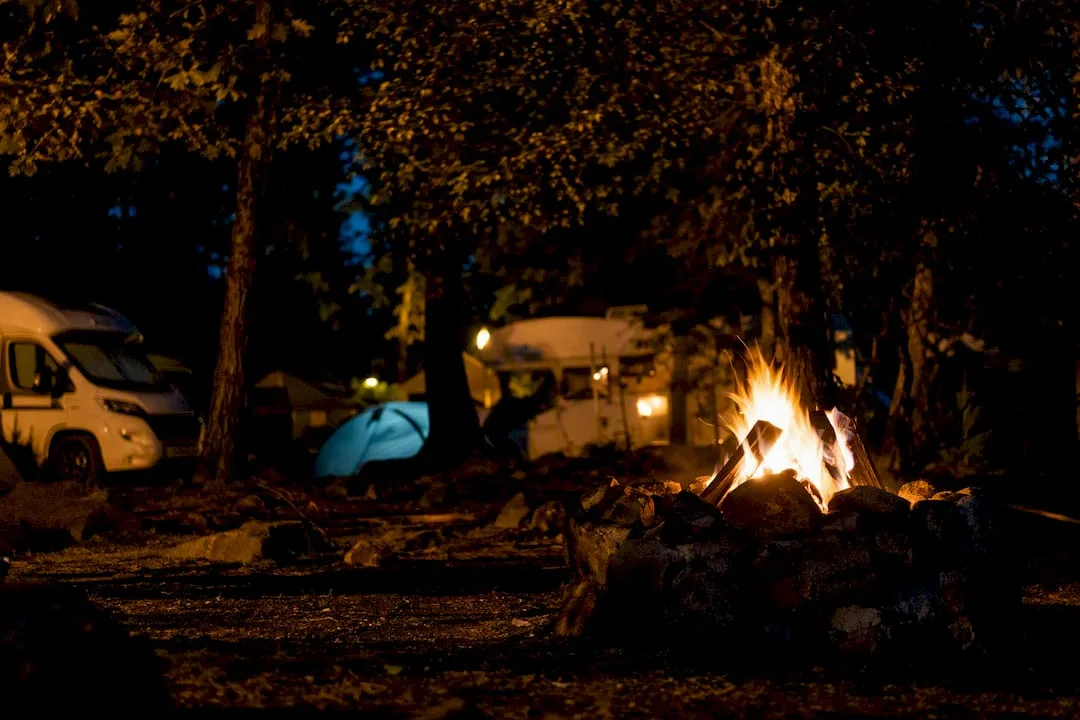
Open fires are permitted at most campsites only in designated fire areas and are almost never permitted at PZA facilities. Lighting an open fire on grass or at the edge of a forest is particularly risky during dry summer months and may be explicitly prohibited by local fire-safety regulations. Barbecues are often allowed, but should only be used on a stable concrete or metal surface, away from the vehicle and dry vegetation.
Activities such as ball games, cycling around the campsite or using drones are generally governed by common sense and the rules of the individual campsite or overnight facility. Drone use is additionally restricted in several locations, particularly near national parks and military areas, under national air-traffic regulations. Before setting up a tent or deploying an awning, check whether you are staying at a PZA, where such activity may be considered camping and therefore prohibited, or at a campsite where it is permitted.
How to Organise Space in a Campervan During a Longer Stay
During a stay lasting several days, it quickly becomes clear whether the interior of your campervan is well organised. The first rule is to separate “travel mode” from “living mode”. When you arrive at your overnight stop, set up the table, chairs and additional outdoor equipment outside the vehicle, freeing up the interior for sleeping and cooking, provided that such a setup is permitted at the location.
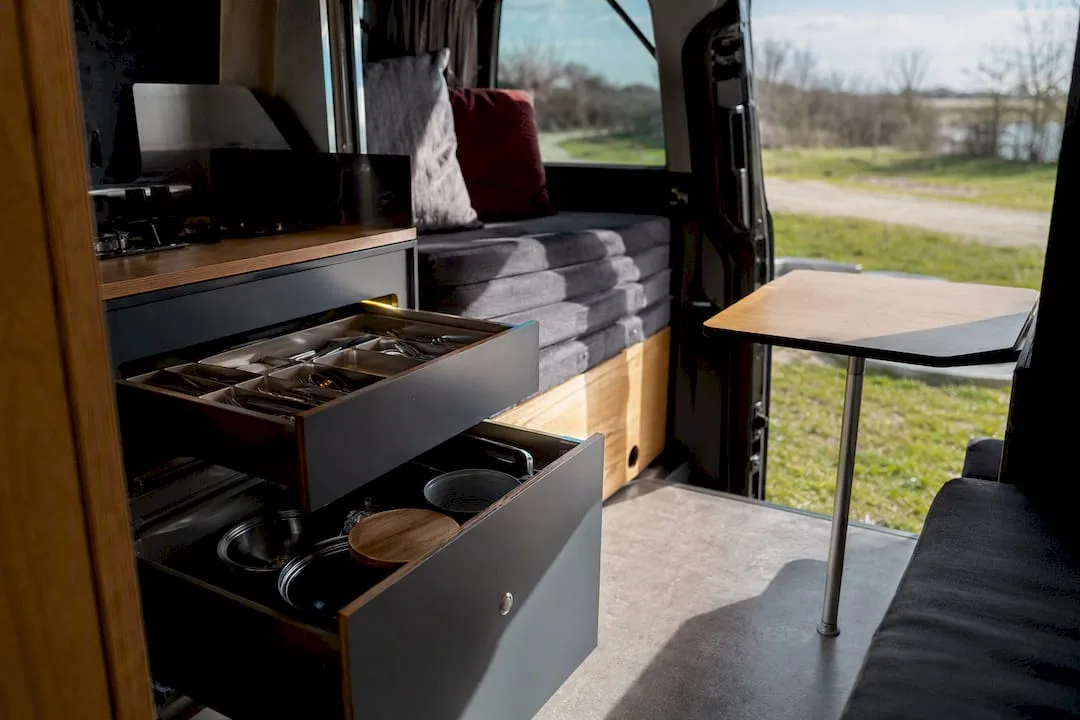
During the day, fold away the beds or convert them into a seating or working area. Making the same space serve multiple purposes significantly reduces the feeling of being cramped during longer stays. Organise kitchen equipment and food according to how frequently you use them rather than by category, keeping morning essentials such as coffee and cups within easy reach, while seasonal or rarely used equipment can be stored in lower drawers or the rear storage area.
Use insect screens and sun shades as soon as you arrive rather than waiting until evening. During longer stays, this helps prevent insects from entering and accumulating inside the vehicle throughout the day. When staying for several days, check whether the PZA or campsite provides a 230-volt electrical hookup. This can significantly extend the autonomy of your refrigerator and auxiliary batteries without having to run the engine.
What You Really Need to Know Before Setting Off
The biggest mistake when staying overnight in a campervan in Slovenia is not being unaware of the law, but assuming that local rules will not be enforced in smaller towns. Quite the opposite: smaller municipalities where campervans are less common can sometimes be stricter because unusual behaviour is noticed immediately.
Another underestimated factor is seasonal logistics. People tend to think mainly about where they want to go and rarely about when everyone else is planning to go there. The Julian Alps and coastal campsites are worth visiting outside the peak season, not only because of lower prices but also because of the overall experience. A full campsite in August means crowded sanitary facilities and a limited choice of pitches.
Finally, PZA facilities are not a “worse” alternative to campsites. They are a different tool for a different purpose. Travellers who understand this distinction when planning their itinerary can save both time and money while avoiding conflicts caused by turning a short overnight stop into a multi-day campsite in the wrong location.
— Rok
Campervan Rental in Ljubljana for Your Slovenia Road Trip
Campervan.si in Ljubljana allows you to pick up your campervan where most Slovenian road trips actually begin, without a long drive to a remote airport or vehicle depot.
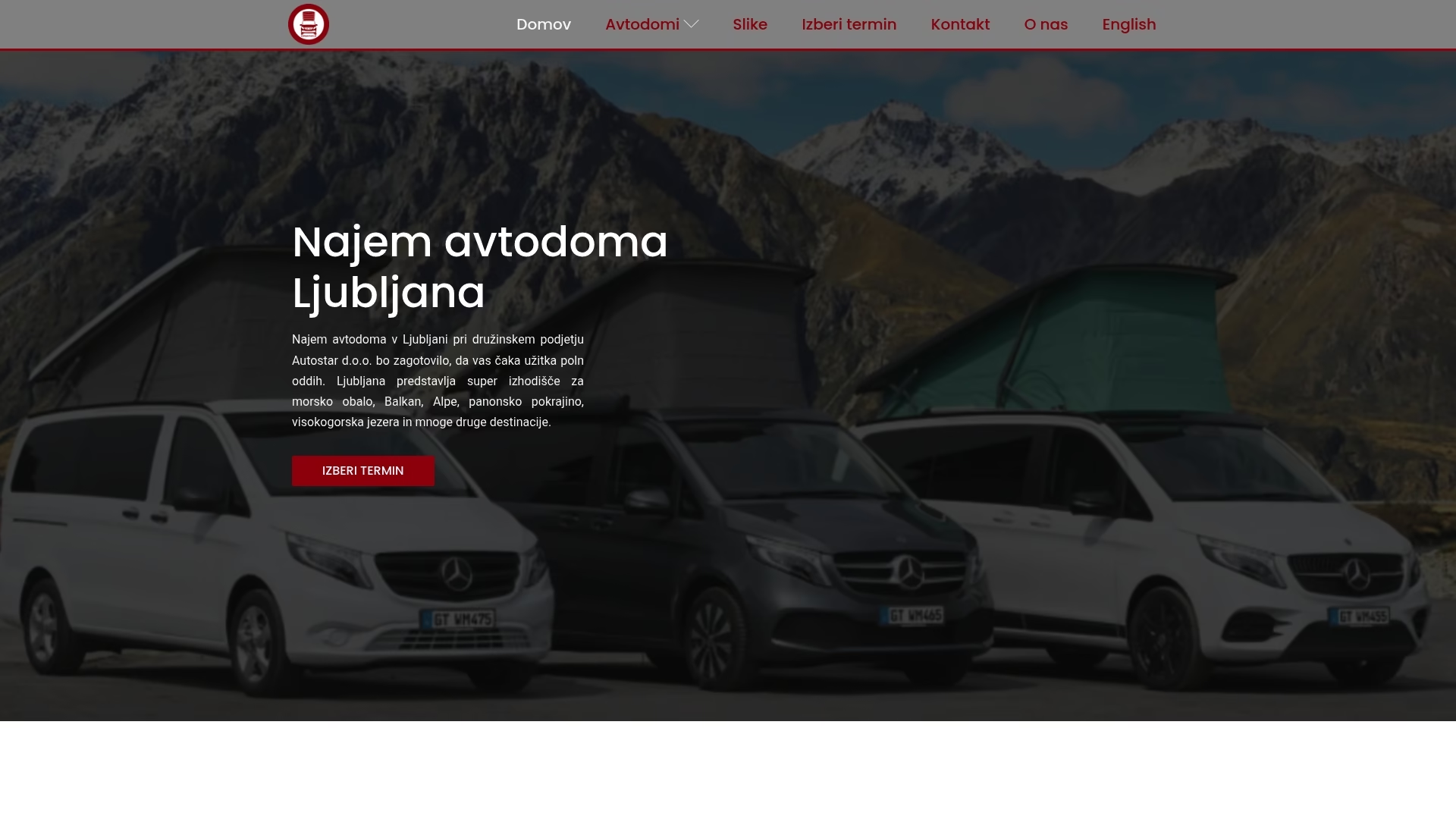
The Mercedes V Marco Polo is available for more compact road trips on narrow Alpine roads, while the Ford Transit Nugget Plus is ideal for families who need more space for sleeping and equipment. Both vehicles include a kitchen, fixed toilet and basic insurance, while 24/7 assistance means that a potential technical issue does not leave you stranded in the Soča Valley without support. The Campervan.si team also knows the local specifics, from which campervan parking areas operate during winter to where advance reservations are genuinely essential during peak season.
If you are planning a trip along the coast, into the mountains or through the Karst region, arrange your
campervan rental in Ljubljana at least a few weeks before the summer season, as popular dates and campervan models can book up quickly.
Sources
Practical planning requires more than simply knowing the law. You also need concrete locations and reliable local information. Campervan.si in Ljubljana has been preparing practical travel guides based on real campervan routes through Slovenia rather than generic travel advice.
Recommended